

In This Blog Post
Share This Article
- Last Updated: Aug 20, 2026
- 🔊 Listen
TL;DR
- Cash flow forecasting helps you identify potential cash shortages before they become emergencies.
- A 13-week rolling forecast provides practical short-term visibility for most small businesses.
- Forecasts should include realistic payment timings, not just expected income and expenses.
- Reviewing and updating your forecast regularly improves accuracy and decision-making.
- Combining technology with expert accounting support strengthens cash flow management and business resilience.
Revenue tells you how your business is performing. Cash flow tells you whether your business can keep running. For small business owners across the US, that distinction matters every single week, whether you are covering payroll, paying quarterly taxes, managing supplier terms, or planning your next hire. Cash flow forecasting is the practice of mapping your expected cash inflows and outflows over a future period, so you always know what your financial position will look like before you get there. Done consistently, it is one of the most effective tools for reducing financial stress, making smarter decisions, and building a business that can handle both slow months and periods of rapid growth. This guide covers the full picture, from what a forecast includes to how to build and maintain one that works.

Cash Flow Planning Made Simple
Avoid surprises, improve visibility, and make confident decisions.
What Is Cash Flow Forecasting?
Cash flow forecasting is the process of estimating the amount of money expected to flow into and out of your business over a defined period, typically weekly, monthly, or quarterly. It helps business owners project their future cash position by analyzing expected revenues, fixed and variable expenses, loan repayments, tax obligations, and other financial commitments, so they can plan ahead with confidence.
Why Is Cash Flow Forecasting Important for US Small Businesses?
For small businesses across the United States, cash flow challenges are not the exception; they are the norm. The JPMorgan Chase Institute found that the median US small business holds just 27 days of cash buffer, meaning a single delayed client payment can quickly create financial pressure. Alongside cash flow forecasting, monitoring key financial ratios such as the current ratio, quick ratio, and accounts receivable turnover can help business owners assess liquidity and identify potential cash flow risks before they become critical.
Here are why cash flow forecasting matters specifically for US small business owners:
- Avoid Cash Crunches Before They Hit: A forecast helps you see shortfalls 30, 60, or 90 days out, giving you time to act rather than scramble for emergency credit.
- Supports Loan and Credit Applications: US lenders, including the SBA and community banks, routinely ask for cash flow projections when evaluating business loan applications.
- Prepares You for Tax Season: Quarterly estimated tax payments are required for most US small business owners. A forecast makes sure you are setting aside enough to avoid IRS penalties.
- Strengthens Payroll Reliability: Missing payroll is a serious issue. With a forecast in place, you know weeks ahead whether your payroll obligations are covered.
- Guides Seasonal Planning: Many US businesses, especially retail, food service, and construction, deal with strong seasonal swings. Forecasting helps smooth out those highs and lows.
- Enables Smarter Growth Decisions: Whether you are thinking about hiring, expanding to a new location, or purchasing equipment, a forecast shows you whether the timing is right.
What Are the Key Components of a Cash Flow Forecast?
A cash flow forecast is only as useful as the data that goes into it. To build one that actually reflects your business, you need to understand each building block. Here are the core components to calculate cash flow:

Opening Cash Balance
This is the cash you have on hand at the start of the forecasting period. It is your starting point and should reflect your actual bank balance, not just what is showing in your accounting software.
Projected Cash Inflows
These include all expected incoming funds such as customer payments, recurring subscription revenue, expected loan disbursements, tax refunds, and proceeds from asset sales.
Projected Cash Outflows
This covers all money going out, including rent, payroll, insurance premiums, supplier payments, utilities, software subscriptions, and loan repayments.
Net Cash Flow
This is simply the difference between your inflows and outflows for each period. A positive number means more cash is coming in than going out. A negative number signals a potential problem.
Closing Cash Balance
This is your opening cash balance plus or minus the net cash flow for that period. It becomes the opening balance for the next period.
Timing Assumptions
Cash flow forecasting is not just about amounts; it is about when. You need to account for invoice payment terms, customer collection timelines, and the timing of bill due dates.
How Do You Create a Cash Flow Forecast Step by Step?
Building a cash flow forecast for your US small business does not require an accounting degree, but it does require discipline and the right inputs. Here is a clear, practical walkthrough:
Choose Your Forecasting Period
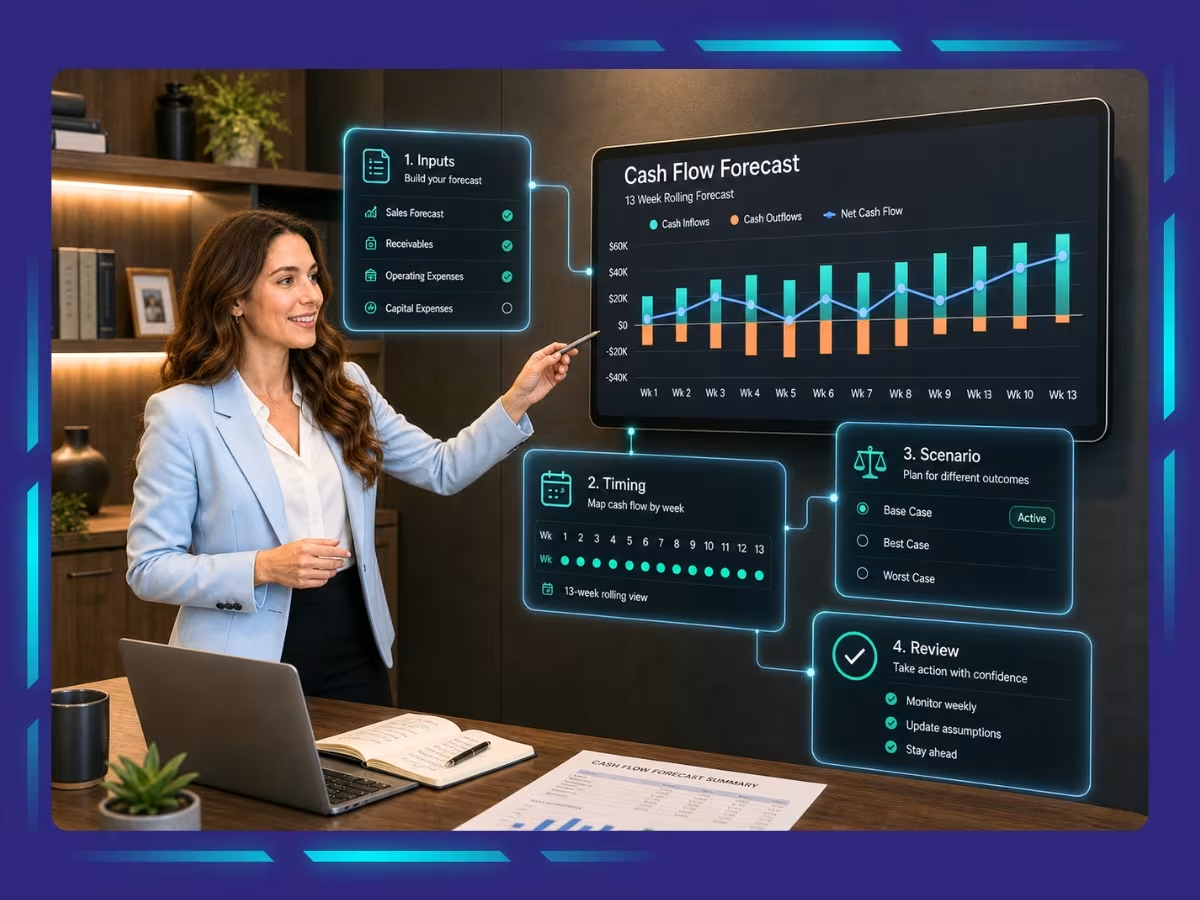
Most small businesses start with a 13-week (90-day) rolling forecast because it offers enough visibility without becoming unreliable. For annual planning, a 12-month outlook works well. Pick a period that matches your business cycle and your current level of uncertainty.
Gather Your Financial Data
Pull your bank statements, profit and loss reports, accounts receivable aging reports, and accounts payable schedules for at least the past 12 months. If you use accounting software like QuickBooks or Xero, this data is readily available. You want to identify patterns when customers pay and when your bills are typically due.
List All Cash Inflows
Document every source of expected cash coming in. This means customer invoices (and when you realistically expect them to be paid), any recurring payments, seasonal revenue spikes, grant disbursements if applicable, and any planned asset sales. Be conservative about timing. Late payments are a widespread reality for US small businesses, particularly in B2B transactions where net-30, net-45, or even net-60 terms are standard. Do not assume every invoice will come in on the due date; build realistic collection timelines based on your own historical data.
List All Cash Outflows
Break down every category of spending: fixed costs like rent, salaries, and insurance; variable costs like raw materials, contract labor, and shipping; and irregular costs like annual software renewals, equipment maintenance, and quarterly tax payments. Do not forget your estimated federal and state tax payments if you file quarterly with the IRS.
Build the Forecast Structure
Create a simple spreadsheet or use dedicated software. Set up columns for each week or month and rows for each inflow and outflow category. Calculate net cash flow for each period, then carry the closing balance forward as the opening balance for the next period. This rolling structure makes it easy to update regularly.
Run Scenario Analysis
Do not rely on just one version. Create a best case, base case, and worst-case forecast. What happens if your largest client pays 45 days late? What if a big order comes in early? Scenario planning is especially important for businesses affected by tariff changes, supply chain shifts, or seasonal demand variability.
Update It Regularly
A cash flow forecast is not a one-time document. Review it weekly or at least monthly. Compare actual results to your projections, identify variances, and adjust your assumptions going forward. The goal is to get more accurate over time.
Which Cash Flow Forecasting Method Should Your Business Use?
There are two main approaches to cash flow forecasting, and the right one depends on your business size, data availability, and what decisions you are trying to support.
Direct Method
The direct method tracks actual cash receipts and payments. You list every expected cash transaction, when it hits your bank account, and when payments go out. This is the most accurate method for short-term forecasting (up to 90 days) and is ideal for small businesses that want a clear, transaction-level view of their cash. It is the go-to for businesses monitoring payroll, managing vendor payments, or watching a tight cash position.
Indirect Method
The indirect method starts with your net income and adjusts for non-cash items like depreciation and changes in working capital. It is derived from your income statement and balance sheet rather than actual cash transactions. This method works well for longer-term forecasting (six months to a year or more) and is often used in financial reporting under US GAAP.
For most US small businesses, the direct method is the practical starting point. It does not require deep accounting knowledge, and it reflects real cash timing rather than accrual-based figures. Once your business grows and you have a finance team or an outsourced accounting partner, you can incorporate the indirect method for strategic planning alongside the direct approach.
What Common Cash Flow Forecasting Mistakes Should You Avoid?
Even business owners who make the effort to forecast their cash flow often fall into predictable traps. Here are the most common mistakes to watch for:

- Confusing Profit With Cash: A profitable business can still run out of cash. Revenue recognized on your income statement is not the same as cash in your bank account, especially on net-30 or net-60 payment terms.
- Being Overly Optimistic About Receivables: Many small business owners assume clients will pay on time. According to QuickBooks, 56% of US small businesses are owed money from unpaid invoices, averaging $17,500 per affected business. Always account for collection delays.
- Leaving Out Irregular Expenses: Annual insurance renewals, equipment repairs, software license fees, and one-time marketing costs are easy to overlook. They need to be included in your forecast.
- Skipping Tax Obligations: Federal estimated tax payments are due quarterly (April, June, September, January). Many state-level taxes add further obligations. Failing to forecast these can blindside your cash position.
- Not Updating the Forecast Regularly: A forecast built once and never revisited quickly becomes useless. Business conditions shift, and your model needs to reflect those changes.
- Using a Single Scenario: Building only a base case leaves you unprepared for downturns or surprises. Always run best case and worst case versions so you have contingency plans ready.
- Relying on Gut Feel Instead of Data: Cash flow forecasting works only when it is grounded in real numbers from your bank statements, invoices, and expense records, not rough estimates or wishful thinking.
How Can Accounting Software and Expert Support Improve Cash Flow Forecasting?
Manual spreadsheets can only take you so far. As your business grows, the right accounting software and professional support can dramatically improve the accuracy and usefulness of your cash flow forecasts.
Accounting Software Options for US Small Businesses
- QuickBooks: The most widely used accounting platform for US small businesses. It offers built-in cash flow projections, connects directly to your bank accounts, and integrates with most US payroll and tax tools.
- Xero: A cloud-based platform popular with businesses that need real-time cash flow visibility and strong bank reconciliation features. It integrates well with third-party forecasting tools like Float and Fathom.
- NetSuite: Best suited for growing businesses with more complex needs. NetSuite’s financial management suite offers sophisticated cash flow planning across multiple entities and currencies.
- Zoho Books: A cost-effective option that includes cash flow statements, automated payment reminders, and project billing, making it a solid choice for service-based businesses.
- Microsoft Dynamics 365: For mid-sized businesses that need ERP capabilities alongside financial planning, Dynamics 365 Finance offers robust cash flow forecasting with AI-driven predictions.
Beyond software, many US small businesses are turning to outsourced accounting firms to manage their cash flow forecasting and provide budgeting services more effectively. Outsourcing gives you access to experienced financial professionals without the overhead of a full-time hire. An outsourced accounting partner can set up your forecasting models, keep them updated, flag anomalies early, and provide strategic guidance, all while ensuring your books stay accurate and audit-ready.
Get Expert Cash Flow Guidance to Plan Your Business Better
Cash flow forecasting is one of the most powerful tools available to US small business owners, yet it remains widely underused. By understanding your cash position weeks and months ahead, you can avoid the financial surprises that derail so many businesses, make confident decisions about hiring and growth, and meet your tax and payroll obligations without stress. Whether you are just starting out or looking to sharpen your existing process, the steps and strategies covered in this guide give you a solid foundation to take control of your business finances.
At Whiz Consulting, we specialize in helping US small businesses build accurate, actionable cash flow forecasts that drive real decisions. Our team of experienced accounting professionals works as an extension of your business, setting up forecasting systems, managing your books, and providing the financial clarity you need to grow. Whether you need a one-time forecast model or ongoing monthly support, we are here to help. Reach out to Whiz Consulting today and take the guesswork out of managing your business cash flow.

Get customized plan that supports your growth

Have questions in mind? Find answers here...
For most US small businesses, updating your cash flow forecast weekly is ideal, especially if you operate on thin cash margins. At a minimum, update it monthly. Each update should compare your actual cash activity against your projections so you can identify variances, correct assumptions, and improve accuracy over time. Businesses in highly seasonal industries or those going through a period of rapid growth may benefit from daily or biweekly reviews.
A cash flow statement is a historical document that shows how cash actually moved through your business during a past period. It is a required financial report under U.S. GAAP. A cash flow forecast, on the other hand, is forward-looking. It projects how cash is expected to move in the future based on known commitments, expected revenues, and spending plans. Think of the statement as the report card and the forecast as the study plan.
Yes, absolutely. When you apply for an SBA loan or any small business loan in the US, lenders want to see evidence that your business can repay the debt. A well-prepared cash flow forecast demonstrates that you have analyzed your revenue and expenses, understand your repayment capacity, and are managing your business with financial discipline. Many SBA-approved lenders specifically ask for 12-month or 24-month cash flow projections as part of the application package.
Variances between your forecast and actual results are normal and expected. The key is to analyze why the gap occurred. Was revenue lower because of a delayed invoice? Did an unexpected expense come through? Were your assumptions too optimistic? Understanding these variances helps you build a more accurate forecast going forward. Consistent, significant variances in the same direction are a signal that your forecasting assumptions need a structural update.
Outsourcing cash flow forecasting is a smart move for many US small businesses, especially those without a dedicated finance team. An outsourced accounting partner brings expertise in financial modeling, knowledge of U.S. tax timelines and compliance requirements, and the bandwidth to keep your forecast current without pulling your attention away from running the business. Outsourcing is typically far more cost-effective than hiring a full-time controller or CFO and gives you access to professional-grade financial planning from day one.
Thousands of business owners trust Whiz to manage their account
Let us take care of your books and make this financial year a good one.