


In This Blog Post
Share This Article
- Last Updated: Sep 10, 2026
- 🔊 Listen
TL;DR
- Accounts payable best practices help US businesses reduce invoice errors, payment delays, fraud risks, and compliance issues.
- Centralized invoice intake, automated capture, and clear approval workflows create a stronger AP process.
- Clean vendor records support accurate payments, 1099 reporting, audit readiness, and fraud prevention.
- AP KPIs like invoice cycle time, cost per invoice, exception rate, and AP turnover ratio reveal process gaps.
- AP outsourcing can support growing businesses when internal teams struggle with volume, controls, and reporting.
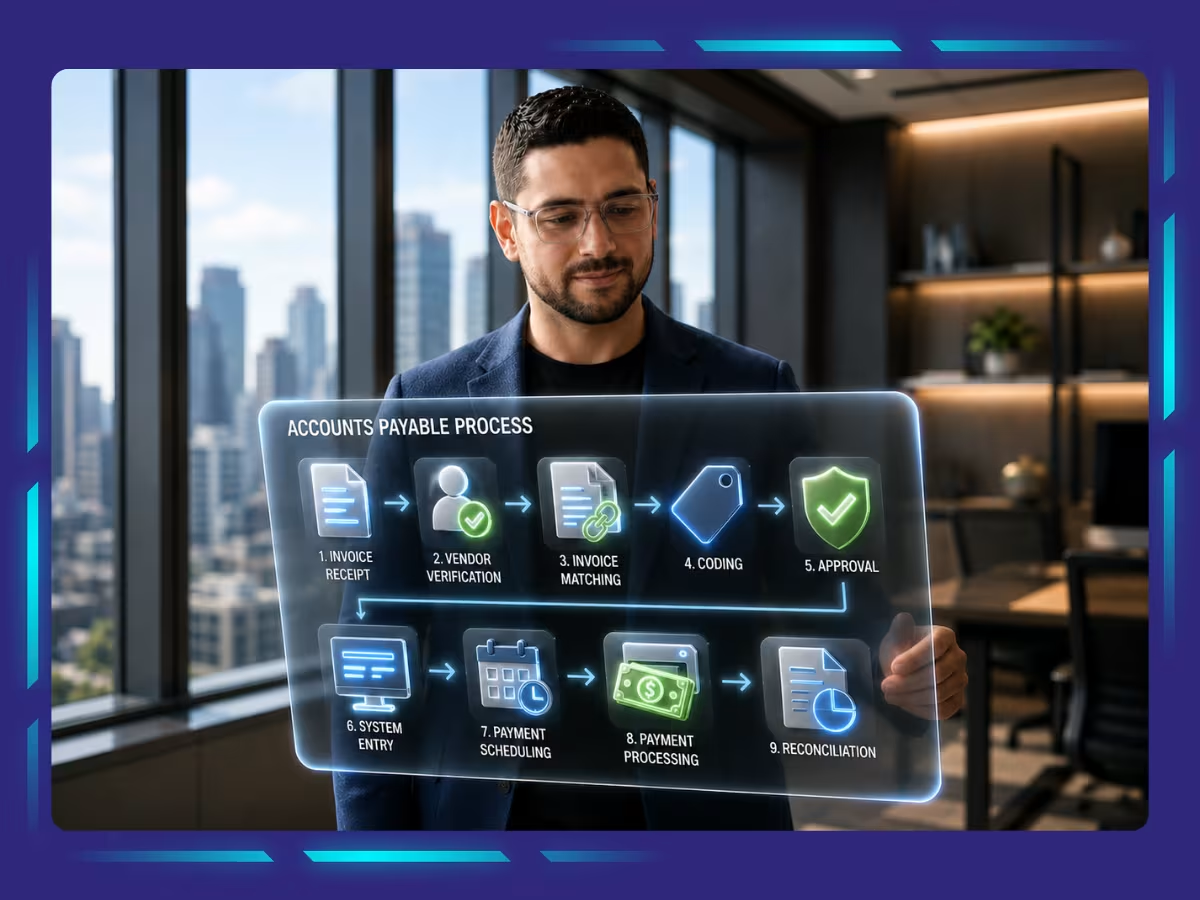
Accounts payable best practices are structured methods businesses use to process invoices, approve payments, prevent fraud, manage vendors, and maintain accurate financial records. They help US companies reduce manual errors, improve cash flow control, meet compliance requirements, and build stronger supplier relationships.
For US businesses, accounts payable is more than paying vendor bills. It affects working capital, tax reporting, internal controls, audit readiness, and vendor trust. A weak AP process can lead to late fees, duplicate payments, missed discounts, inaccurate accruals, and fraud exposure.
A strong AP process gives finance teams better visibility over what is owed, when payments are due, who approved each invoice, and whether vendor payments meet company policies. Read on this blog to discover how streamlining these accounts payable best practices can save your team hours of manual data entry and protect your bottom line from costly payment errors.

AP Support That Scales
Get the right accounts payable help as your invoice volume grows.
What Are the Challenges Faced in the Accounts Payable Process?
Accounts payable challenges usually include manual invoice entry, slow approvals, PO mismatches, duplicate payments, weak vendor records, poor cash flow visibility, and fraud risks. These problems can affect payment accuracy, vendor relationships, financial reporting, and internal controls.
This section should explain the problems first, so the best practices later feel more practical and solution led.
1. Manual Data Entry Errors
Manual entry remains one of the most common accounts payable challenges. When AP teams key in invoice numbers, vendor names, amounts, due dates, and GL codes by hand, small errors can create larger problems. A wrong vendor ID, duplicate invoice number, or incorrect USD amount can delay payment, distort reports, and create reconciliation issues.
This is why many AP best practices US companies follow now include OCR, AI invoice capture, and automated validation rules.
2. Slow Invoice Processing
Slow AP processing usually happens when invoices sit in email inboxes; approval chains are unclear, or managers approve invoices only after repeated follow-ups. Delays can lead to late fees, strained vendor relationships, and missed early payment discounts.
3. Invoice, PO, and Receiving Mismatches
Matching issues happen when invoices do not align with purchase orders, delivery receipts, or service confirmations. This may include price differences, missing PO numbers, partial deliveries, quantity disputes, or amended purchase orders that were not updated in the system.
Instead of listing matching errors and PO matching difficulty separately, treat them as one challenge. The real issue is poor document alignment across procurement, receiving, and accounts payable.
4. Poor Cash Flow Visibility
Paying vendors too early can reduce working capital. Paying too late can damage supplier trust, trigger late fees, and weaken negotiation power. Without real-time visibility into due dates, payment terms, cash position, and vendor priority, AP teams struggle to balance liquidity with timely payments.
Strong accounts payable management tips always include payment scheduling, cash flow forecasting, and vendor prioritization.
5. Duplicate Payments
Duplicate payments can happen when the same invoice is submitted twice, entered under different formats, or processed across multiple locations. For example, one vendor may send the same $8,500 invoice by email and through a supplier portal. If the AP system does not detect duplicates, the business may pay twice.
Duplicate payment checks should compare invoice number, vendor name, amount, date, bank account, and purchase order details.
6. Multi-Entity and Multi-Currency Invoice Management
Growing US businesses often manage invoices across multiple entities, locations, bank accounts, and currencies. A company may receive USD invoices from local suppliers, CAD invoices from Canadian vendors, and EUR invoices from software or logistics partners.
This creates challenges around exchange rates, intercompany approvals, entity-level coding, tax treatment, and consolidated reporting. Without clear controls, AP teams may post invoices to the wrong entity, pay from the wrong bank account, or misstate liabilities.
7. Weak Vendor Master Data
Vendor master data issues can create payment delays, compliance errors, and fraud exposure. Missing W-9 forms, outdated bank details, duplicate vendor profiles, incorrect payment terms, and incomplete tax classifications can all weaken the AP process.
This is especially important in the US because businesses may need to report payments using IRS Forms 1099-MISC or 1099-NEC. The IRS instructions state that Form 1099-NEC is generally used for nonemployee compensation of $600 or more, while Form 1099-MISC covers categories such as rent, prizes, awards, and certain other payments.
8. AP Fraud and Payment Security Risks
AP teams are frequent targets for vendor impersonation, invoice frauds, altered bank details, business email compromise, and urgent payment scams. IOFM has reported rising AP fraud concerns, especially as fraudsters use more sophisticated tactics.
Fraud risk increases when one person can create vendors, approve invoices, and release payments without review.
9. Difficulty Adopting AP Technology
AP automation can improve speed, accuracy, and control, but implementation is not always smooth. Businesses may face resistance from staff, poor ERP integration, unclear workflows, weak data migration, or lack of training.
The issue is not just buying software. The real challenge is redesigning the AP process before automating it.
What Are the Best Accounts Payable Best Practices?
The best accounts payable best practices for US businesses include centralized invoice intake, automated invoice capture, clear approval workflows, vendor master data reviews, 2-way and 3-way matching, payment scheduling, AP KPI tracking, and regular reconciliation.
These practices help finance teams reduce errors, prevent fraud, improve invoice processing, and build a more controlled AP process as vendor volume and approval complexity increase.

1. Centralize invoice intake to prevent lost invoices
Set up one controlled channel for invoices, such as a dedicated AP email inbox, vendor portal, or AP automation platform. Avoid accepting invoices across personal inboxes, chat messages, paper copies, and disconnected spreadsheets.
Centralized intake helps your team track every invoice from receipt to approval to payment. It also reduces duplicate submissions and gives finance leaders a clearer view of upcoming liabilities.
2. Standardize approval workflows to reduce delays
Every invoice should follow a defined approval path based on amount, department, vendor type, and purchase category. For example, invoices under $2,500 may need department approval, while invoices above $25,000 may need finance leadership review.
This keeps approval responsibilities clear. It also supports stronger internal controls and audit trails.
3. Automate invoice capture to reduce manual entry
Manual invoice entry slows AP teams and increases the chance of errors. Use AP automation tools to capture invoice data, extract key fields, validate vendor information, and route invoices for approval.
Common US AP software options include Tipalti, Bill.com, AvidXchange, Stampli, QuickBooks, NetSuite, and Sage Intacct. The right choice depends on invoice volume, ERP stack, approval complexity, entity structure, and payment requirements.
Ardent Partners’ 2025 report notes that best-in-class AP teams process invoices in 3.1 days compared with 17.4 days for others, showing how process maturity and automation can improve AP speed.
4. Use 2-way and 3-way matching to control payment accuracy
2-way matching compares the invoice against the purchase order. 3-way matching compares the invoice, purchase order, and receiving documents.
Use 2-way matching for service invoices or low-risk recurring purchases. Use 3-way matching for inventory, equipment, raw materials, and goods received. This helps confirm that the business only pays for what was ordered, received, and billed correctly.
5. Maintain clean vendor records to support compliance
Vendor records should include legal business name, W-9 details, tax classification, payment terms, contact information, approved bank details, and 1099 status. Review vendor records regularly to remove duplicates and inactive suppliers.
For US businesses, vendor data quality directly affects tax reporting. IRS guidance requires businesses to use the correct information return based on payment type, including Forms 1099-MISC and 1099-NEC.
6. Separate AP duties to reduce fraud risk
No single person should control the full AP cycle. Separate responsibilities for vendor setup, invoice approval, payment release, and bank reconciliation.
For example, the employee who creates a new vendor should not also approve that vendor’s first payment. This simple control reduces the risk of fake vendors, unauthorized payments, and internal fraud.
7. Set payment schedules to protect working capital
Paying every invoice as soon as it arrives can weaken cash flow. Delaying every payment can damage vendor trust. The better approach is to schedule payments based on due dates, vendor priority, early payment discounts, and cash availability.
For example, a US manufacturer may prioritize a key raw material supplier on Net 15 terms while scheduling a non-critical software vendor closer to Net 30.
8. Capture early payment discounts where they make sense
Early payment discounts can reduce costs, but only when cash flow allows it. A common example is 2/10 Net 30, where the buyer receives a 2% discount if payment is made within 10 days.
The AP team should flag these opportunities automatically and review whether the discount is worth the cash outflow. This turns AP from a back-office function into a working capital tool.
9. Track AP KPIs to identify process gaps
AP KPIs show whether your process is fast, accurate, controlled, and cost-effective. Track metrics such as:
| AP KPI | What It Measures |
|---|---|
| Cost per invoice | How much it costs to process one invoice |
| Invoice cycle time | Time from invoice receipt to approval or payment |
| Exception rate | Percentage of invoices requiring manual correction |
| Duplicate payment rate | Frequency of duplicate or incorrect payments |
| Days payable outstanding | How long the business takes to pay suppliers |
| AP turnover ratio | How often the business pays off supplier obligations |
APQC tracks the total cost to process accounts payable per invoice as a key finance benchmark, including personnel, systems, overhead, outsourced costs, and other related costs.
10. Monitor the AP turnover ratio correctly
The accounts payable turnover ratio shows how many times a business pays off its average accounts payable during a period.
Formula:
AP Turnover Ratio = Total Supplier Purchases / (Beginning AP + Ending AP) / 2)
A good AP turnover ratio depends on the industry, supplier terms, and cash flow strategy. As a general guide, many businesses consider a ratio between 6 and 10 healthy, but it should be compared against industry norms and payment terms.
A very high ratio may mean the business pays suppliers quickly, which can support vendor trust but reduce working capital. A very low ratio may suggest delayed payments, cash flow pressure, or strained supplier relationships.
11. Prepare for year-end AP close before Q4 ends
US businesses should not wait until year-end to clean up AP. Q4 often brings vendor payment acceleration, tax planning, accrual reviews, budget use-it-or-lose-it spending, and heavier finance workloads.
Before year-end close, review unpaid invoices, open purchase orders, goods received but not invoiced, vendor statements, accrued expenses, and 1099 vendor data. This supports cleaner reporting and smoother audit preparation.
12. Strengthen AP controls for SOX and audit readiness
AP controls should show who approved an invoice, why it was approved, when it was paid, and whether supporting documents were reviewed.
For public companies, SOX Section 404 requires management to assess internal control over financial reporting, making AP controls important for financial statement reliability.
Even for private companies, strong controls reduce audit issues and improve lenders, investors, and board confidence.
13. Reconcile vendor statements regularly
Vendor statement reconciliation helps identify missing invoices, unapplied credits, duplicate payments, and disputed balances. This is especially useful for high-volume vendors, recurring suppliers, and critical operating partners.
Monthly reconciliation also helps AP teams spot issues before they become payment delays or month-end reporting problems.
14. Use AP automation tools that fit your business size
Do not choose software only because it is popular. Match the tool to your AP volume, accounting system, approval structure, vendor base, and payment methods.
US SMEs may consider tools such as Bill.com, Stampli, AvidXchange, Tipalti, QuickBooks Bill Pay, or NetSuite AP automation. Larger businesses may need deeper ERP integration, multi-entity workflows, global payment controls, and stronger audit reporting.
15. Consider AP outsourcing when internal capacity becomes stretched
AP outsourcing becomes a best practice when invoice volume, approval complexity, compliance needs, or staffing gaps start affecting accuracy and payment timeliness.
Instead of treating outsourcing as a separate topic, frame it as a process improvement option. A business may consider accounts payable outsourcing when it needs faster invoice processing, stronger controls, better reporting, vendor statement reconciliation, 1099 support, or scalable AP coverage without expanding the internal team.
Accounts payable outsourcing does not replace good controls. It works best when paired with clear approval rules, documented workflows, defined KPIs, and secure system access.
Read More: Complete Guide to Invoice Processing
Implement Best Practices in Accounts Payable using the Right Expertise
Accounts payable best practices work best when businesses have the right systems, controls, and financial expertise behind them. Professional accounts payable services can help US businesses manage invoice approvals, vendor records, payment scheduling, reconciliations, and reporting with greater accuracy and consistency.
For over a decade, Whiz Consulting has delivered premier accounts payable expertise to US businesses. By blending advanced AI and automation into your AP workflow, we ensure faster invoicing, seamless reconciliation, and stronger vendor relationships. Contact us today to transform your AP process and get ahead of the curve.

Get customized plan that supports your growth

Have questions in mind? Find answers here...
Improve your AP process by centralizing invoice intake, automating invoice capture, setting clear approval workflows, maintaining clean vendor records, and tracking AP KPIs. These accounts payable best practices help reduce errors, speed up payments, prevent fraud, and improve cash flow visibility.
AP teams should track cost per invoice, invoice cycle time, exception rate, duplicate payment rate, days payable outstanding, early payment discount capture, and AP turnover ratio. These KPIs show whether your AP process is efficient, accurate, and financially controlled.
Prevent AP fraud by separating duties, verifying vendor bank changes, using approval thresholds, matching invoices with purchase orders, restricting vendor master access, and reviewing payment reports regularly. AP automation can also flag duplicate invoices and unusual payment patterns.
A good AP turnover ratio depends on your industry, supplier terms, and cash flow strategy. Many businesses view 6 to 10 as a healthy range, but the ratio should be compared with vendor payment terms and industry benchmarks.
The most important AP best practices US companies should follow include automated invoice processing, clean vendor records, 2-way or 3-way matching, strong approval controls, 1099-ready vendor data, AP KPI tracking, and year-end accrual reviews.
Vendor master data affects payment accuracy, tax reporting, fraud prevention, and reconciliation. Incorrect vendor records can lead to duplicate payments, failed payments, IRS reporting issues, and unauthorized changes to supplier bank details.
A business should consider AP outsourcing when invoice volume increases, approvals slow down, errors become frequent, vendor queries rise, or internal staff lack time to manage controls and reporting properly. Outsourcing can support speed, accuracy, scalability, and stronger AP discipline.
Thousands of business owners trust Whiz to manage their account
Let us take care of your books and make this financial year a good one.