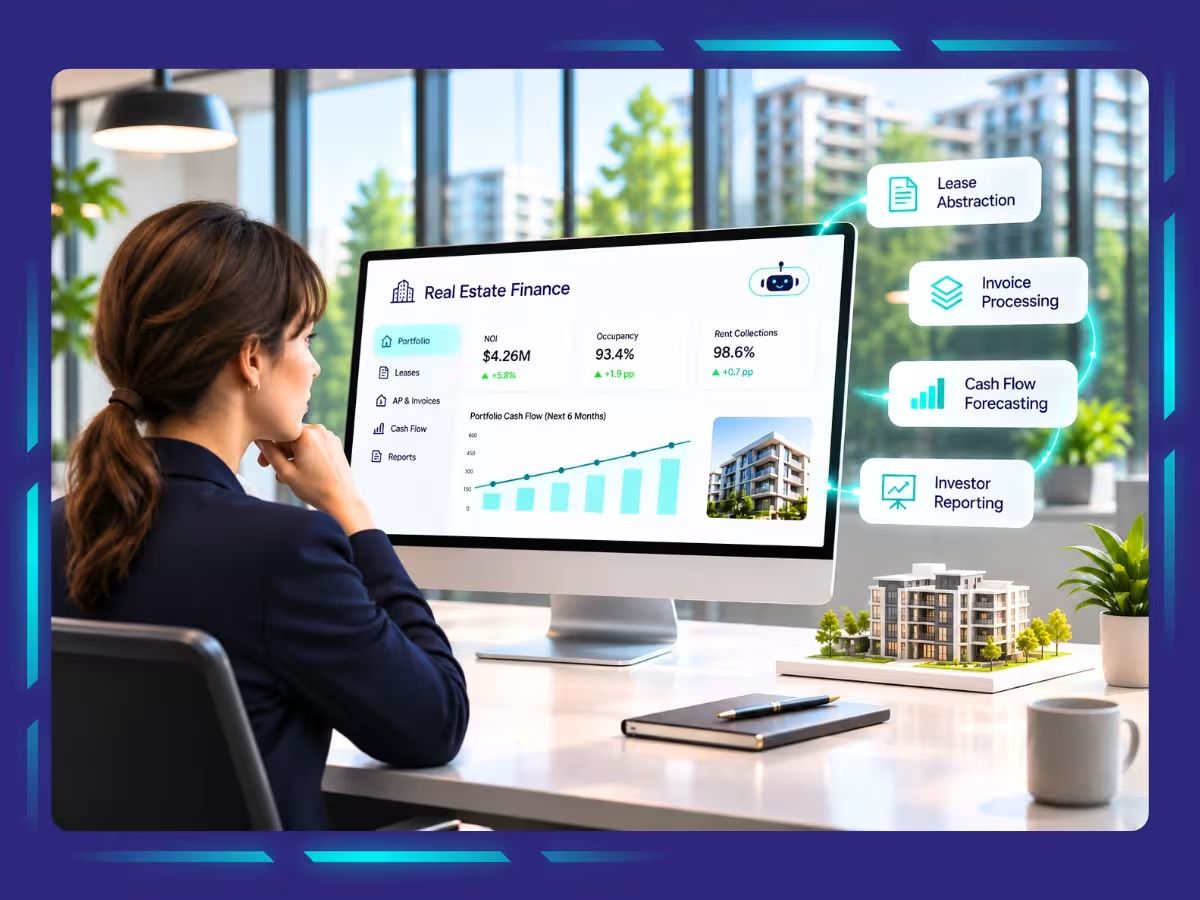
AI is changing how real estate property management and investment firms handle financial operations. From lease administration to investor reporting, AI-powered tools can reduce manual work, identify discrepancies, and improve financial visibility across property portfolios.
This blog examines six practical applications of AI in real estate finance in 2026. These include extracting lease data, automating invoice coding and accounts payable, forecasting portfolio cash flows, reconciling transactions, detecting unusual vendor payments, and preparing investor reports.
Each application addresses a specific accounting challenge, such as missed rental updates, incorrect expense allocations, delayed collections, duplicate invoices, or reporting variances. However, AI does not eliminate the need for accounting oversight. Your finance team must verify extracted information, review suggested transaction matches, investigate flagged payments, and validate financial reports. Combining AI capabilities with accounting expertise and appropriate financial controls can help property management and investment firms improve processing efficiency, maintain reliable records, and make better-informed portfolio decisions.
AI is steadily gaining ground across real estate operations, with more firms incorporating it into their day-to-day workflows.According to the 2026 IREM–AppFolio AI Insights Report, 58% of real estate professionals now use AI at work and the number continues to grow.
But how can you apply it to your finance operations?
Your accounting software records rental income, but it cannot account for a rent increase your team never entered. Similarly, an invoice coded to the wrong property can distort its operating expenses without triggering an error.
With the right tools, you can compare lease agreements against billing records and check vendor invoices for unusual coding patterns. This helps you identify discrepancies earlier, before they affect your property-level financial reports.Here are top use cases of AI in real estate and how they help finance and accounting team in improving their existing workflow.
How Is AI Improving Real Estate Finance in 2026?
AI is helping property management and investment firms improve financial operations through five practical applications: lease abstraction, automated invoice processing, cash flow forecasting, vendor payment anomaly detection and investor reporting.
By identifying discrepancies earlier and reducing manual processing, these applications can help you maintain more accurate financial records, shorten reporting cycles and make better-informed decisions across your property portfolio.
Use Case 1: AI-Powered Lease Abstraction and Data Extraction
Think about how often rental agreements change across your portfolio. A new tenancy needs to be entered into your property management system, while a renewal may introduce a revised rent or a different payment schedule. If these changes aren’t captured correctly, your billing records can quickly fall out of sync with the actual lease agreements.
AI can help by extracting rent amounts and effective dates directly from lease documents, including changes made through renewals or amendments. Once extracted, these details can be checked against your existing property records to identify missed updates or inconsistencies.
The technology is already finding its way into property management software. In 2026, Yardi introduced Smart Lease, which allows users to extract lease details from commercial agreements and update records in Voyager after review.
Use Case 2: Automated Invoice Coding and AP Processing Across Properties
When invoices need to be allocated across multiple properties, it adds another layer of complexity to accounts payable. A maintenance contractor may work at several locations, while certain costs need to be distributed between properties according to established allocation rules.
Your AP team must identify the appropriate property and general ledger account before each invoice is posted. As invoice volumes increase, this can take considerable time, if done manually.
AI can assist by extracting invoice information and recommending accounting classifications based on previous transactions and established coding patterns.
This is particularly useful when an invoice requires a distinction between routine repairs and capital expenditure. An incorrect classification can affect your property’s operating expenses and reported profitability.
If your team regularly discovers incorrectly coded expenses while closing the books, earlier invoice classification can reduce the rework. You can measure the improvement by tracking how many invoices remain unprocessed at month-end and how many entries require reclassification before you finalise your property reports.
Use Case 3: AI-Driven Cash Flow Forecasting for Portfolios
The rent your properties generate on paper isn’t always the amount that reaches your bank account on time. Tenants may delay payments, vacancies may take longer to fill, and unexpected repairs can eat into your available funds. But your loan repayments and other financial obligations still need to be met.
This makes forecasting tricky, especially when you’re managing several properties. AI can help your finance team analyse past rental collections, occupancy trends, and operating expenses to estimate when money is likely to come in and what expenses lie ahead.
For example, Yardi Forecast IQ uses property-level data from Yardi Voyager to prepare revenue and expense forecasts. It works with existing rent rolls and budgeting assumptions to project monthly revenue, helping your team assess how changes in occupancy, rental income, or property expenses could affect future budgets. You can then compare expected cash inflows against upcoming loan repayments and planned capital expenditure.
Use Case 4: AI-Assisted Transaction Reconciliation Across Properties
Reconciling transactions across multiple properties can become complicated, particularly when rental collections, vendor payments, and bank deposits are recorded in different systems. Your accounting team needs to match these transactions against bank statements and investigate any discrepancies before closing the books.
AI can help by comparing transaction details across connected financial records and identifying potential matches, even when payment references or descriptions differ.
For example, a tenant’s payment may appear in your bank statement without a clear property or unit reference. AI-assisted reconciliation tools can suggest a match using the payment amount, transaction date, and historical collection patterns, allowing your accounting team to verify it.
This reduces the time spent on manual matching and helps your team focus on unresolved transactions. You can measure the improvement by tracking outstanding reconciliation items, transaction matching rates, and the time required to complete month-end reconciliations.
Use Case 5: Anomaly Detection for Vendor Payments and Fraud Risk
When you’re paying contractors and service providers across multiple properties, unusual transactions can be easy to miss. A contractor might submit the same invoice twice, charge an unexpected amount for recurring maintenance, or request payment to a different bank account.
AI can help your AP team spot some of these issues by checking invoices and payment records for duplicates, unusual charges, and inconsistencies that need further investigation.
For example, Topkey, an AI-powered accounting platform for property managers, uses AI agents to check for duplicate bills, mismatched payments, missing receipts, and expenses that fall outside established policies. These exceptions are flagged for review, helping your team identify potential errors before they affect your financial records.
Not every unusual transaction indicates fraud. A contractor’s higher invoice may reflect additional work, while a change in banking details may be legitimate. Your accounting team still needs to investigate flagged transactions and independently verify any changes to vendor payment information before releasing funds.
Use Case 6: Investor and Portfolio Reporting Automation
You need to communicate your portfolio’s financial performance to investors and lenders regularly. You may already have the required financial information available, but consolidating it into a useful report still involves considerable work. AI can assist by gathering data from connected financial systems and preparing an initial analysis of property and portfolio performance.
For example, you could use a reporting tool to compare actual net operating income (NOI) against the approved budget and identify properties with significant variances.
Based on the underlying accounting records, the system could also generate a draft explanation of the factors contributing to those variances. That gives you a starting point for investigating changes in operating performance without having to work through every property’s figures manually.
Make AI Work for Your Portfolio with the Right Accounting Support
Implementing AI in real estate finance goes beyond choosing the right tools. You also need an accounting team that understands your property-level financial operations and knows where AI can make a meaningful difference to your real estate accounting process. From identifying discrepancies in lease records to improving cash flow forecasts, the value comes from applying these technologies to the right processes.
Having an AI-skilled accounting team can help you identify opportunities forx automation, interpret AI-generated insights, and maintain the financial controls needed for reliable reporting. With the right combination of accounting expertise and AI capabilities, you can make your finance operations more efficient while maintaining the accuracy and oversight your portfolio requires.