


In This Blog Post
Share This Article
- Last Updated: Sep 25, 2026
- 🔊 Listen
TL;DR
- Accounting for real estate investment helps investors assess property profitability, cash flow, and overall portfolio performance.
- Tracking rental income, operating expenses, debt, and capital expenditures improves property-level financial visibility.
- Regular financial reports help investors identify revenue shortfalls, rising expenses, and potential financial risks.
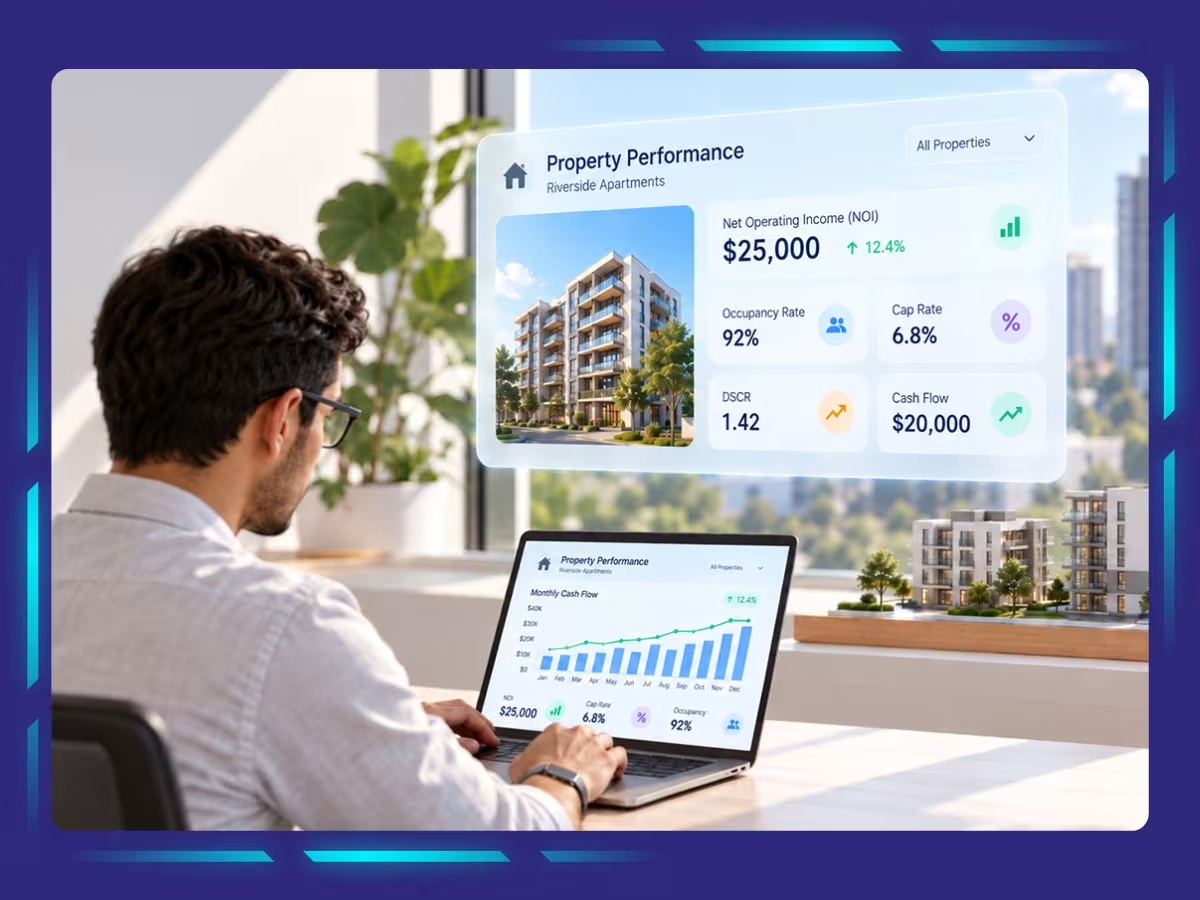
- Key metrics like NOI, cap rate, DSCR, and occupancy rates reveal property performance.
- Accurate property-level data supports informed decisions about capital improvements, refinancing, and future investment opportunities.
- QuickBooks, Buildium, AppFolio, Yardi, and REI Hub support accounting for real estate investments and financial reporting.
Accounting for real estate investment turns property-level financial data into insights investors can use to evaluate performance, manage cash flow, and make better portfolio decisions. By tracking rental income, operating expenses, debt, capital spending, occupancy, and profitability for each property, investors can see which assets are performing well and where issues may be emerging.
Accurate property-level accounting also supports stronger budgeting, forecasting, and investment analysis across multiple properties. This blog explains the key reports, metrics, and practices behind accounting for real estate investment that investors should use to move beyond basic bookkeeping and make more informed investment decisions.

Keep Your Property Finances on Track
Stay on top of rental income, expenses, and portfolio performance.
What Financial Information Should Be Tracked at the Property Level?
Property-level financial tracking should cover income, operating expenses, maintenance, management fees, capital expenditures, debt, and liabilities. Accurate property management accounting helps investors assess each property’s profitability, cash flow, and future capital needs. Let’s look at what to track under each category.
- Rental and Other Property Income: Track base rent, parking fees, service charges, storage income, late fees, and other property revenue separately to understand where income is coming from and how it is changing.
- Operating Expenses: Record recurring costs such as utilities, insurance, property taxes, cleaning, landscaping, security, and administration to monitor cost trends and operating efficiency.
- Repairs and Maintenance: Track routine repair and maintenance costs separately to identify recurring issues, ageing assets, and expenses that may affect future cash flow.
- Property Management Costs: Monitor management fees, leasing commissions, and administrative charges to assess whether these costs remain proportionate to the income generated by the property.
- Capital Expenditures: Record major renovations, replacements, and improvements separately from routine repairs to support capital planning and evaluate long-term property performance.
- Debt and Interest Costs: Track mortgage payments, loan balances, interest expenses, financing fees, and related costs to understand debt obligations and property cash flow after financing.
- Security Deposits and Other Liabilities: Record security deposits, prepaid rent, accrued expenses, unpaid vendor balances, and other obligations accurately to avoid overstating available cash or profitability.
Which Property-Level Reports Matter Most Investment Decisions?
The key property-level reports are the P&L, balance sheet, cash flow statement, rent roll, AR and AP reports, and budget-versus-actual report. Each plays an important role in accounting for real estate investment, helping investors assess profitability, cash flow, and financial performance. Let’s look at what each report reveals.
Profit and Loss Statement
A property-level P&L shows rental income, other revenue, operating expenses, and net operating performance for a specific asset. It helps investors see whether the property is generating healthy margins and where costs may be rising faster than income.
Balance Sheet
The balance sheet provides a snapshot of the property’s assets, liabilities, and equity. It can include cash balances, receivables, security deposits, loan balances, accrued expenses, and other obligations, giving investors a clearer view of the asset’s financial position.
Cash Flow Statement
A cash flow statement shows how cash moves through operating, investing, and financing activities. For real estate investors, it helps distinguish accounting profit from actual cash generated and highlights the impact of debt payments, capital expenditures, and other major cash movements.
Rent Roll
The rent roll provides property-level detail on tenants, lease terms, rental rates, occupancy, renewals, and outstanding balances. It is particularly useful for evaluating income stability, lease concentration, vacancy exposure, and future changes in rental revenue.
Accounts Receivable and Payable
AR and AP reports show outstanding tenant balances and upcoming vendor obligations. Reviewing them helps investors monitor collections, identify overdue rent, manage supplier payments, and understand short-term cash requirements at the property level.
Budget vs. Actual Report
A budget-versus-actual report compares expected property performance with actual results. It helps investors identify revenue shortfalls, cost overruns, unexpected maintenance expenses, or other variances that may require operational or financial action.
What Real Estate Investment KPIs Should Investors Track?
The key real estate investment KPIs include NOI, cap rate, cash-on-cash return, DSCR, occupancy, operating expense ratio, and property-level cash flow. Tracking these metrics in accounting for real estate investment helps investors evaluate profitability, returns, financial risk, and operating performance. Reviewing these metrics consistently makes it easier to compare assets, identify performance issues, and make more informed investment decisions.
Net Operating Income (NOI)
Net Operating Income measures the income a property generates after deducting its operating expenses, but before debt service, income taxes, depreciation, and capital expenditures.
NOI is one of the most closely watched figures in accounting for real estate investment because it isolates operating performance from financing decisions.
NOI = Property Revenue − Operating Expenses
Tracking NOI helps investors understand the underlying operating performance of a property and identify whether income growth is keeping pace with expenses.
Capitalization Rate
The capitalization rate, or cap rate, compares a property’s NOI with its value and is commonly used to evaluate income-producing real estate.
Cap Rate = NOI ÷ Property Value × 100
Investors can use cap rates to compare properties and assess the income return generated relative to an asset’s value, although cap rate alone does not account for financing structure.
Cash-on-Cash Return
Cash-on-cash return measures the annual cash generated by an investment relative to the amount of cash the investor has actually invested.
Cash-on-Cash Return = Annual Pre-Tax Cash Flow ÷ Total Cash Invested × 100
This metric is particularly useful for leveraged properties because it considers the investor’s actual equity contribution rather than the property’s total value.
Debt Service Coverage Ratio
Debt Service Coverage Ratio (DSCR) measures whether property income is sufficient to cover scheduled debt payments.
DSCR = NOI ÷ Annual Debt Service
A ratio above 1.0 indicates that NOI exceeds debt service, while a ratio below 1.0 indicates that property operations are not generating enough income to cover scheduled debt payments.
Occupancy and Vacancy Rates
Occupancy rate shows the proportion of available space or units currently occupied, while vacancy rate represents the unused portion. Tracking both helps investors evaluate rental demand, revenue stability, and potential income loss from vacant units.
Operating Expense Ratio
The operating expense ratio shows how much of a property’s income is being consumed by operating costs.
Operating Expense Ratio = Operating Expenses ÷ Effective Gross Income × 100
Rising ratios may indicate increasing costs, weaker income performance, or areas where property operations require closer review.
Property-Level Cash Flow
Property-level cash flow shows how much cash an asset generates after considering operating activities and relevant cash obligations such as debt service and capital spending. Tracking it alongside NOI helps investors distinguish operating profitability from the cash actually available from the investment.
Which Accounting Software Is Best for Real Estate Investors?
Popular accounting software for real estate investors includes QuickBooks Online, Buildium, AppFolio, Yardi, and REI Hub. Each supports accounting for real estate investment, offering features ranging from property-level bookkeeping to portfolio reporting and management. Here are their key features.
QuickBooks Online
QuickBooks Online is a widely used accounting platform that can support real estate investors with straightforward bookkeeping, reporting, and property-level tracking, making it a common starting point for accounting for real estate investment. Its functionality includes:
- Income and expense tracking by property using classes or locations
- Bank feeds and transaction categorization
- Profit and loss, balance sheet, and cash flow reporting
- Budgeting and financial reporting
- Accounts payable and receivable tracking
- Integration with third-party property management tools
- Collaboration with bookkeepers, accountants, and CPAs
Buildium
Buildium combines accounting with property management, making it useful for growing residential portfolios. Its platform brings financial reporting and day-to-day property operations together through features such as:
- Property-level accounting and general ledger
- Rent collection and tenant payment tracking
- Accounts payable and vendor management
- Bank reconciliation
- Owner statements and financial reporting
- Leasing and tenant management
- Maintenance request tracking
- Budgeting and property performance reporting
AppFolio
AppFolio is a broader property management platform with strong accounting and automation capabilities. It supports investors and property managers with tools including:
- Property and portfolio-level accounting
- Automated bank feeds and reconciliation
- Accounts payable and bill approval workflows
- Rent collection and payment processing
- Budget-versus-actual reporting
- Income statements, balance sheets, and cash flow reports
- Leasing and maintenance management
- Workflow automation and operational reporting
Yardi
Yardi offers a range of real estate accounting and property management solutions, including Yardi Breeze and more advanced platforms such as Yardi Voyager. Depending on the solution used, investors can access:
- General ledger, AP, and AR
- Bank reconciliation
- Budgeting and forecasting
- Property and portfolio-level reporting
- Rent and receivables tracking
- Owner and investor reporting
- Support for multiple property types
- Advanced consolidation and operational capabilities
REI Hub
REI Hub is designed specifically for rental property investors and focuses more on real estate bookkeeping than full property management. It provides tools such as:
- Income and expense tracking by property and unit
- Automated bank and loan account connections
- Rental property transaction categorization
- Property-level profit and loss reporting
- Cash flow and balance sheet reporting
- Portfolio-level financial views
- Schedule E-oriented reporting for US rental investors
- Expense and loan tracking
Best Practices for Reliable Real Estate Investment Accounting
Reliable real estate investment accounting requires separate property records, regular reconciliations, consistent account coding, and timely reporting. Following these best practices for accounting for real estate investment helps investors maintain accurate books, monitor performance, and manage their portfolios effectively. Here are the key practices to follow.
Maintain Separate Records for Each Property or Entity
Keep financial records separate for each property, legal entity, or investment vehicle. This is one of the simplest ways to strengthen accounting for real estate investment, since it makes it easier to track income, expenses, debt, liabilities, and cash flow accurately without mixing activity across the portfolio.
Reconcile Accounts Regularly
Bank accounts, credit cards, loan balances, security deposits, and other key accounts should be reconciled on a regular schedule. Frequent reconciliations help identify missing entries, duplicate transactions, and posting errors before they affect reporting.
Use a Consistent Chart of Accounts
A standard chart of accounts allows investors to compare properties using the same revenue and expense categories. Consistent coding also makes portfolio consolidation easier and reduces confusion when reviewing performance across multiple assets.
Close the Books Monthly
A structured monthly close helps ensure transactions are recorded, reconciliations are complete, accruals are posted, and reports are ready on time. Timely closes give investors more current information for cash flow, budgeting, and performance decisions.
Track Budget vs. Actual Performance
Compare actual income and expenses with the property budget each month. Significant variances should be investigated to understand whether they come from occupancy changes, unexpected repairs, rising operating costs, timing differences, or other factors.
Review Property-Level KPIs
Track relevant metrics such as NOI, occupancy, cash flow, DSCR, operating expense ratio, and rent collection performance. Reviewing KPIs consistently helps investors spot trends and identify which properties require closer attention.
Consolidate Portfolio Reporting
Property-level reports should roll into a consolidated portfolio view. This allows investors to compare asset performance, understand total cash flow and debt exposure, and see how individual properties contribute to overall portfolio results.
Strengthen Your Investment Decisions with Expert Real Estate Accounting Services
Reliable accounting for real estate investment gives investors a clearer view of income, expenses, cash flow, debt, occupancy, and overall asset performance. When these numbers are tracked consistently and consolidated across the portfolio, investors can compare properties more effectively, identify risks earlier, and make better-informed decisions about capital, financing, and growth. Getting accounting for real estate investment right from the start also makes it easier to scale a portfolio without losing visibility into individual asset performance.
Whiz Consulting provides real estate accounting services to help investors and property businesses maintain accurate books and improve financial visibility. Our team supports property-level bookkeeping, reconciliations, AP/AR, month-end close, management reporting, budgeting, and portfolio-level analysis, helping businesses turn financial data into clearer insights and stronger investment decisions.

Get customized plan that supports your growth

Have questions in mind? Find answers here...
To calculate an investment property’s profitability, subtract operating expenses from property income to determine net operating income (NOI). Investors should also evaluate cash-on-cash return, cash flow after debt payments, and capital expenditures to understand actual returns and compare investment opportunities.
NOI measures property income after operating expenses but before debt service, income taxes, depreciation, and capital expenditures. Property cash flow measures the actual cash generated after relevant cash expenses, including debt payments and capital spending. NOI indicates operating performance, while cash flow shows the money available to investors.
Investors should maintain separate financial records for each property while using a consistent chart of accounts across their portfolio. Property-level tracking, regular reconciliations, monthly financial reporting, and consolidated portfolio statements help investors compare performance, monitor expenses, and manage cash flow.
Not every investor is legally required to maintain a separate bank account for each property. However, separate accounts for different legal entities are generally advisable to avoid mixing funds. Investors should also maintain property-specific accounting records to track income, expenses, and cash flow accurately, even when multiple properties share an account.
Routine repairs and maintenance are generally recorded as operating expenses when they do not require capitalization. Major improvements that better, restore, or adapt a property are generally capitalized and depreciated over the applicable recovery period. Investors should maintain separate records for both categories, subject to applicable IRS rules and safe-harbor exceptions.
Thousands of business owners trust Whiz to manage their account
Let us take care of your books and make this financial year a good one.