

In This Blog Post
Share This Article
- Last Updated: May 29, 2026
- 🔊 Listen
TL;DR
- AI and automation are streamlining accounting processes, enabling professionals to focus on strategy and decision-making over routine tasks.
- Real-time financial reporting and predictive forecasting are becoming vital for agile decision-making and proactive financial management.
- Accounting outsourcing service providers are prioritizing cybersecurity, adhering to global regulations like GDPR and CCPA to ensure robust data protection.
- Sector-focused accounting delivers customized financial strategies, addressing distinct industry hurdles and regulatory demands.
- Strategic partnerships and skilled talent acquisition are transforming outsourcing firms into value-driven, future-ready financial allies.
The outsourcing market has evolved beyond cost savings into a strategic advantage for US businesses navigating automation, complex compliance, and ongoing talent shortages. What was once a support function is now a critical driver of efficiency, accuracy, and scalability across major business hubs.
Businesses investing in outsourced accounting are gaining an edge through faster processes, better financial visibility, and stronger regulatory readiness. In this blog, we explore key accounting outsourcing trends, offering valuable insights to help you stay ahead of the curve.

Outsourcing Done Right!
Get Streamlined Processes, Expert Support, and Financial Clarity.
Why Is Accounting Outsourcing Gaining Momentum?
Outsourcing accounting functions is gaining momentum as businesses look for more efficient ways to manage finances without increasing overhead. It helps reduce costs while providing access to real-time financial insights, accurate reporting, and reliable compliance support. This allows companies to stay in control of their finances without the need for a full in-house team.
With the rise of cloud-based tools, automation, and global expertise, accounting services has evolved into a strategic advantage. Businesses can improve accuracy, reduce errors, and scale operations with ease while staying agile in a competitive environment, making outsourced accounting an essential part of modern financial management.
10 Accounting Outsourcing Trends Redefining 2026
The evolving business landscape, driven by technology, compliance demands, and the need for smarter financial management, is reshaping how companies operate, making accounting outsourcing trends increasingly focused on AI-driven automation, real-time insights, stronger data security, specialized solutions, and scalable global support that enhances efficiency, reduces costs, and enables better decision-making.

1. Integration of AI and Automation in Accounting
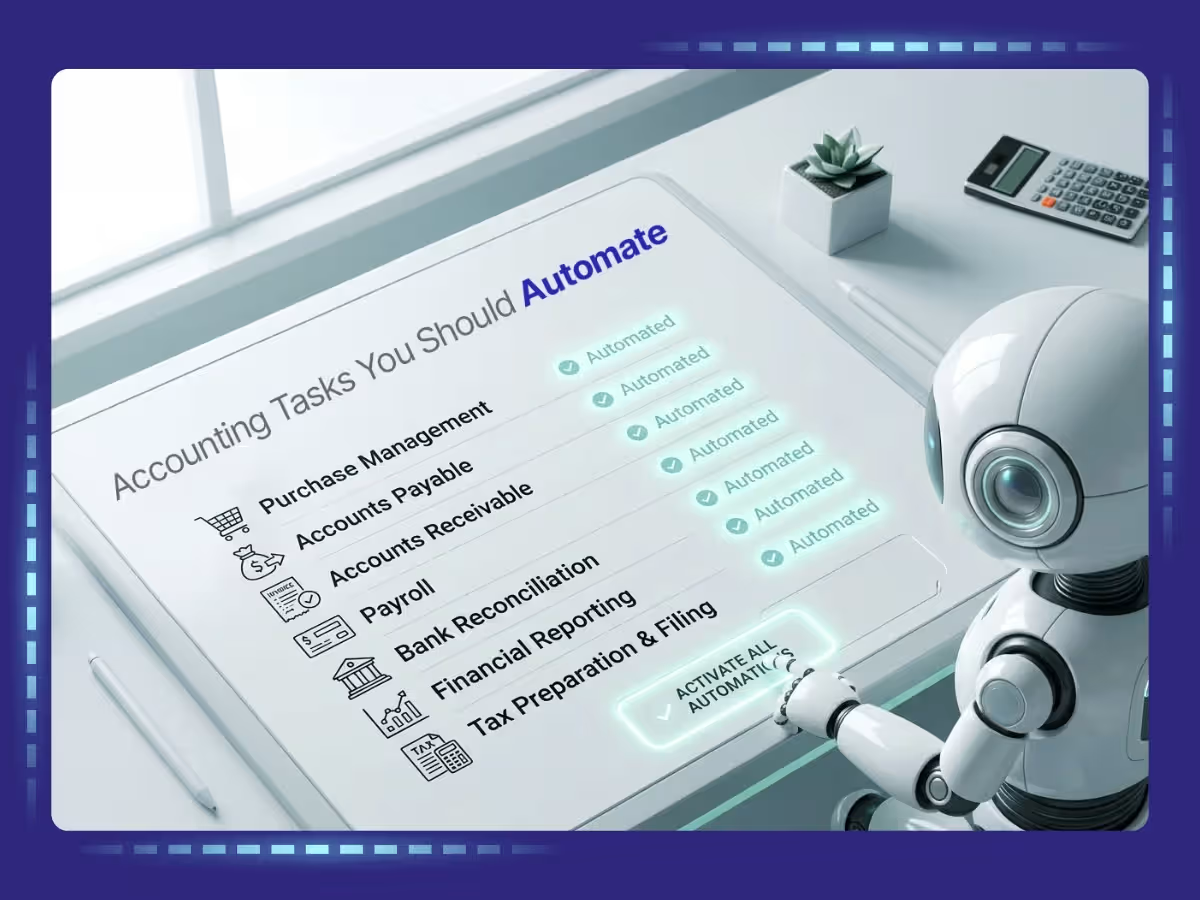
AI and automation are making outsourced accounting faster, cheaper, and more accurate than in-house alternatives, with McKinsey estimating that 60-70% of routine accounting tasks are technically automatable today. Outsourcing firms that have deployed AI are passing this efficiency directly to clients through lower costs and faster turnaround.
Use Cases of AI in Accounting:
- Forecasting: Unlike older methods, AI can analyze past data to depict financial forecasting regarding cash flow, revenue, or any financial figures with far greater accuracy.
- Workflow Automation: Expense report management, account reconciliation, and invoice processing are examples of AI endeavors that improve productivity.
- Data Analysis: AI has the capability to conduct financial analysis and reporting with a wide variety of datasets by identifying trends, anomalies, and insights that would otherwise be missed.
- Fraud Detection: AI can strengthen internal controls by identifying patterns and anomalies that indicate fraud.
- Risk Assessment: Various data sources can be analyzed, and potential problems can be detected so that AI can accurately assess financial risk.
2. Enhanced Data Analytics and Predictive Forecasting
As AI and automation continue to reshape the accounting landscape, outsourcing firms are tapping into data analytics and predictive forecasting capabilities. They are leveraging smart tools like NetSuite, QuickBooks, and Xero to provide businesses with clearer financial visibility and more accurate forward-looking insights.
Gone are the days when businesses needed to build large in-house teams for in-depth financial analysis. Today, outsourced accounting firms can rapidly process vast amounts of data, identify trends, and deliver actionable forecasts, all with precision and speed.
3. Increased Focus on Cybersecurity and Data Privacy
The need for robust data security has never been more critical. Businesses prioritize data security when partnering with an outsourced accounting firm considering the increasing data threats worldwide.
They are looking for firms with stringent data security protocols adhering to global data protection regulations such as GDPR and CCPA. Consequentially, accounting outsourcing firms are stepping up their game by showcasing a commitment to cybersecurity. They build secure infrastructure, acquire relevant security certifications, and implement transparent data management practices.
4. Specialized Industry Outsourcing
Depending on the industry, accounting needs vary drastically; this has resulted in the emerging trend of specialized industry outsourcing. For instance, if you run an online store, your e-commerce accounting needs will revolve around meticulous inventory tracking, sales tax management across multiple jurisdictions, and reconciling payments from various platforms.
This specialization allows them to offer tailored solutions that address each sector’s unique challenges and regulatory requirements, providing clients with more efficient and effective accounting services.
5. Emphasis on ESG Reporting
Environmental, Social, and Governance (ESG) reporting has become a necessity for businesses across the globe. Companies are under growing pressure to show measurable progress in sustainability, social impact, and ethical governance. In response, outsourced accounting firms are expanding their role, moving beyond traditional bookkeeping to become strategic ESG partners.
These firms provide reliable, auditable ESG data to help clients navigate complex reporting standards. These centered solutions help US businesses adhere to compliance goals, attract responsible investors, and strengthen their reputation as socially responsible organizations.
6. Real-Time Financial Reporting and Analysis
The need for real-time insights is rapidly shadowing the demand for historical financial data. To sustain this volatile market, businesses need up-to-the-minute financial reporting and analysis to make agile decisions.
This shift allows for proactive financial management, enabling businesses to identify trends, mitigate risks, and capitalize on opportunities. Outsourcing accounting firms must align their services to meet the ever-evolving needs of the US businesses and improve their decision-making abilities.
7. Dominance of Cloud-based Accounting Solutions
Cloud-based accounting solutions offer a smarter and more effective way of financial management, making it more accessible, scalable, and secure. Outsourcing firms are embracing these platforms to streamline workflows and foster real-time collaboration.
Features like automated bank reconciliation, real-time reporting, and integrated payroll platforms enable efficient, remote operations. Additionally, seamless integration with AI and automation tools unlocks deeper insights and process optimization.
8. Strategic Partnerships and Value-Added Services
Another key accounting outsourcing trend is the move away from simple task delegation toward efficient partnerships. This means offering value-added services like financial planning, risk assessment, and industry-specific insights.
Outsourcing firms are building teams with advanced financial expertise, capable of aligning their support with a client’s broader business goals. Consequentially, a great shift from basic service delivery to proactive, personalized guidance exists. That’s why accounting outsourcing is becoming a smart investment that helps companies stay competitive, make informed decisions, and scale effectively.
9. Talent Acquisition and Skill Development in Outsourcing
Firms prioritize talent acquisition and upskilling as accounting outsourcing expands into areas like AI analytics and ESG reporting. There’s a growing need for professionals with expertise beyond traditional accounting.
Providers are investing in aggressive recruitment and continuous training to bridge this gap. This ensures teams stay current with emerging technologies and industry shifts while preparing for future demands. Outsourced accounting firms are building resilient, future-ready teams equipped to deliver high-value, specialized services by focusing on talent development.
10. Offshoring for Cost Saving
US businesses can save 50–60% on by leveraging offshore accounting by moving accounting tasks to regions with lower labor expenses. This strategy enhances operational efficiency, focusing on reduced overhead costs while maintaining high service quality.
Service providers focus on streamlined processes and scalable models to maximize this advantage. They standardize workflows and utilize technology to maintain output while cutting costs. Offshoring accounting services create lean, cost-effective structures, enabling them to offer competitive rates and deliver essential services.
Choose Reliable Accounting Outsourcing Service Provider & Grow with Confidence
On the whole, integrating AI and automation is about bringing efficiency and reshaping the accounting outsourcing landscape for the better. Trends like AI adoption, specialized services, ESG reporting, and real-time analytics position accounting firms as reliable partners.
Outsourced accounting firms must invest strategically in talent and technology to meet rising demands for financial intelligence and data security. At Whiz Consulting, we provide holistic accounting services aligning with versatile business goals.

Get customized plan that supports your growth

Have questions in mind? Find answers here...
Building ESG data infrastructure typically takes 6–12 months. Outsourcing firms with established ESG practice areas compress this significantly. Waiting until the deadline creates serious compliance risk under SEC reporting requirements.
Yes, when the provider holds SOC 2 Type II and ISO 27001 certifications. These firms operate structured GAAP-compliant review workflows and multi-tier oversight that often exceed what a lean in-house team delivers.
Choosing on price alone without verifying security certifications, industry specialization, or technology stack. A provider without SOC 2 compliance or live AI workflows may cost less upfront but creates IRS exposure and process bottlenecks that cost far more to fix than they save.
Thousands of business owners trust Whiz to manage their account
Let us take care of your books and make this financial year a good one.