


In This Blog Post
Share This Article
- Last Updated: Sep 30, 2026
- 🔊 Listen
TL;DR
- AI reduces repetitive accounting work while allowing accountants to focus on review, analysis, and financial decisions.
- Offshore accountants can use AI to process transactions faster without giving up important human oversight.
- AI bookkeeping works best when professionals review exceptions, classifications, supporting documents, and unusual activity.
- Combining AI and offshore teams can improve month-end close, AP, AR, reporting, and accounting capacity.
- Small businesses can gain greater scalability by using automation for processing and accountants for judgment and financial insight.
AI is changing accounting by automating routine work such as data entry, invoice processing, reconciliations, and transaction reviews. For US small business owners, this raises an important question: will ai replace accountant roles, or will it make skilled accounting professionals more valuable? The answer is becoming clearer as businesses combine automation with human judgment, financial oversight, and offshore accounting support.
AI can process information quickly, but accountants still play a critical role in reviewing exceptions, interpreting results, managing risks, and supporting better decisions. The real shift is in how accounting work gets done. In this blog we will explain this.

Advanced Accounting Starts Here!
Combine AI Efficiency, Offshore Expertise, and Clearer Financial Control.
How AI Is Changing Accounting Roles for US Small Businesses
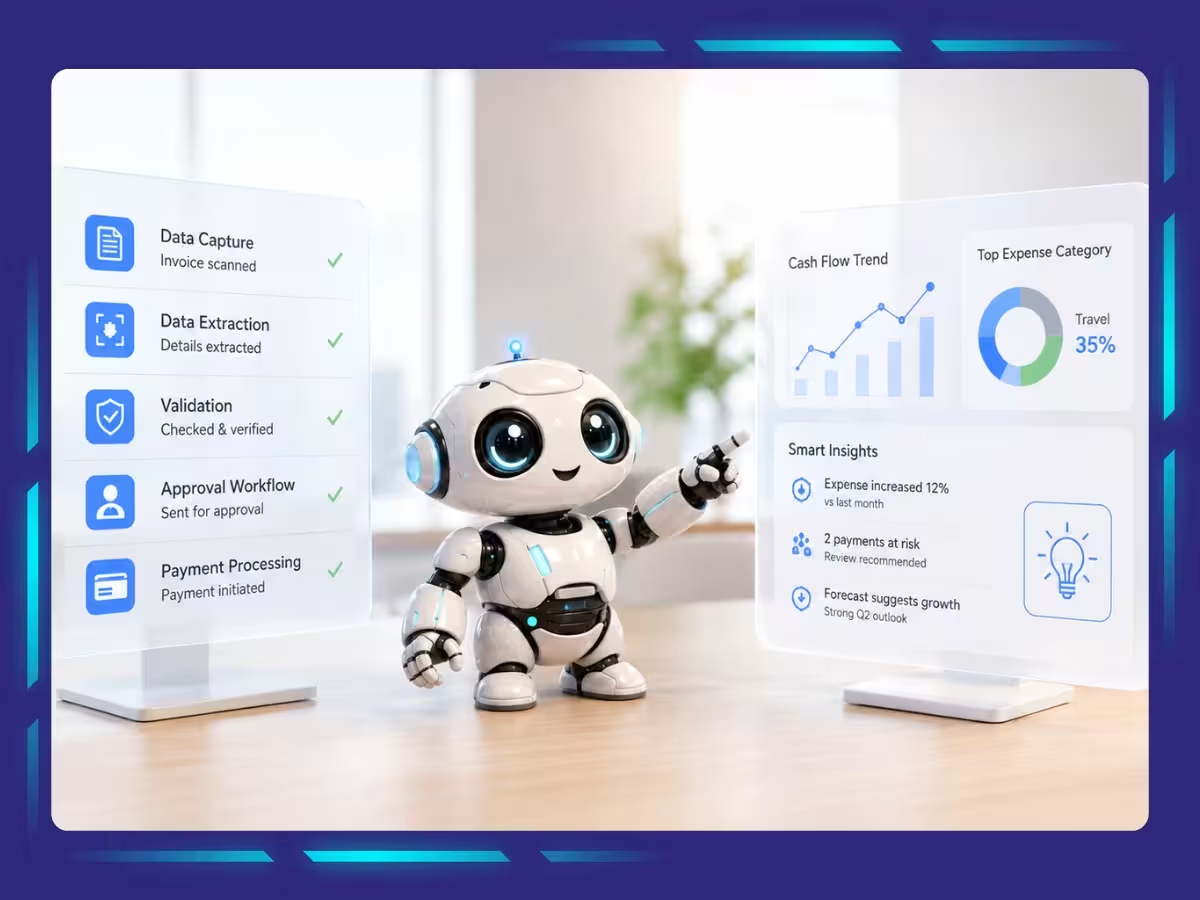
For small businesses, AI in accounting is guiding business owners where to spend their time. Tasks that once depended heavily on manual processing can now be completed or supported by automated systems. As a result, bookkeepers, accountants, and CPAs are increasingly moving toward exception review, financial analysis, controls, cash flow management, and business advisory rather than simply recording transactions.
Bookkeeping and Data Entry
Much of the repetitive work behind bookkeeping can now happen automatically. AI tools can capture information from receipts and invoices, suggest transaction categories, and connect bank activity with accounting records. The bookkeeper’s role then becomes more focused on checking accuracy, resolving exceptions, correcting classifications, and making sure the books reflect what actually happened in the business.
Invoicing and Collections
Accounts receivable teams no longer need to treat every outstanding invoice the same way. AI can monitor due dates, automate reminders, and highlight accounts showing signs of delayed payment. That allows teams to prioritize the invoices that need human follow-up while spending less time manually reviewing aging reports and routine collection activity.
Tax and Compliance
The biggest value of AI in tax work is often preparation rather than final judgment. It can collect documents, extract financial information, organize transactions, and surface items that may need closer attention. Accountants and CPAs can then concentrate on areas where professional review matters most, including tax treatment, deductions, documentation, and potential compliance risks.
Anomaly Detection
Instead of searching transaction by transaction for something that looks wrong, accounting teams can use AI to narrow the field. Unusual payment amounts, duplicate transactions, unexpected vendor activity, or entries outside normal patterns can be flagged automatically. Human review can then be directed toward the transactions most likely to contain an error, control weakness, or potential invoice fraud issue.
Cash Flow Forecasting
Cash flow planning becomes more forward-looking when AI can continuously assess historical transactions, collection behavior, recurring costs, and payment timing. These patterns can help create short-term projections that accountants can translate into practical decisions, such as whether the business has enough liquidity for payroll, supplier commitments, taxes, or an upcoming period of slower collections.
Month-End Close
A faster close often comes from identifying problems earlier. AI can support reconciliations, surface unmatched transactions, gather supporting records, and point accountants toward balances that appear inconsistent. Instead of spending most of the close assembling information, the accounting team can devote more attention to resolving discrepancies, validating accounts, and getting dependable reports to management sooner.
Financial Advisory
The role of the accountant becomes more valuable when less time is consumed by routine processing. With cleaner and more readily available financial information, accountants can help owners interpret margins, compare actual performance with budgets, evaluate spending decisions, and understand what is driving changes in profitability and cash flow. AI supports the analysis, while the accountant provides the context and judgment needed to turn that information into decisions.
How AI Could Make Offshore Accounting Teams More Valuable
AI can make offshore accounting services more potent by removing repetitive processing from their workload. For small business owners asking will ai replace accountants, the bigger change is that offshore professionals can spend more time reviewing exceptions, improving controls, closing books faster, and supporting financial analysis.
More Time for Exception Review
AI can process routine invoices and bank transactions, while offshore accountants handle unclear coding, missing documents, duplicate entries, and reconciliation differences that still require accounting knowledge and judgment.
Faster Month-End Close
AI can flag unreconciled accounts and missing transactions before month-end. Offshore teams can investigate those items throughout the month, reducing last-minute corrections and helping financial statements get completed sooner.
Better Control Over Automated Bookkeeping
AI bookkeeping can speed up transaction processing, but automated entries still need review. Offshore accountants can support accounting automation by validating classifications, checking supporting documents, and correcting errors before they flow into financial reports.
Stronger Accounts Payable and Receivable Management
AI can identify overdue invoices, duplicate bills, and unusual payment activity. Offshore teams can follow up on exceptions, resolve vendor issues, and keep receivables and payables records properly updated.
More Capacity Without Matching Staff Growth
Automation allows offshore teams to process a larger transaction volume without adding people at the same rate. This gives growing businesses accounting capacity without building a much larger internal finance department.
More Useful Management Reporting
With less time spent entering transactions, offshore accountants can review cash flow, margins, expenses, and budget variances. Owners receive more useful explanations of what changed and where action may be needed.
Human Review Becomes More Important
The question will ai replace accountants overlooks the need to validate automated output. As businesses adopt more AI bookkeeping, skilled offshore accountants become important for reviewing accuracy, exceptions, and financial context.
AI Vs. Offshore Accountants: Which Model Delivers Better Results?
AI and offshore accountants solve different parts of the accounting workload. AI is strongest at speed, pattern recognition, and repetitive processing, while offshore professionals add judgment, review, communication, and business context. For most small businesses, the strongest results come from combining both.
| Area | AI Alone | Offshore Accountants | AI + Offshore Team |
|---|---|---|---|
| Transaction Processing | Processes large volumes quickly | Reviews and records transactions manually | AI handles routine entries while accountants review exceptions |
| Accuracy Review | Flags unusual patterns based on available data | Checks records using accounting knowledge | AI identifies risks and accountants investigate the cause |
| Month-End Close | Automates matching and reconciliation support | Resolves differences and prepares closing schedules | Routine checks happen faster while accountants focus on unresolved items |
| AP and AR | Tracks invoices, reminders, and payment patterns | Handles vendor issues and collection follow-ups | Automation identifies priorities while accountants manage exceptions |
| Compliance | Organizes records and flags possible issues | Applies accounting rules and professional judgment | AI supports preparation while accountants review treatment and documentation |
| Financial Reporting | Produces reports and basic data analysis | Reviews results and explains financial changes | AI prepares data faster while accountants add context and interpretation |
| Business Advice | Provides data-based suggestions | Connects financial results with business decisions | Accountants use AI-supported insights to give owners more practical guidance |
| Scalability | Handles more data with limited added cost | Adds capacity through skilled offshore staff | Businesses gain both processing scale and human financial support |
For US small businesses, the choice does not need to be AI or offshore accounting. AI can reduce repetitive work, while offshore accountants handle the areas where judgment, review, and follow-up still matter. Together, they can create a faster and more useful accounting function without removing human oversight.
Combine AI With Offshore Expertise for a Successful Future
AI is changing accounting roles, but it is not removing the need for skilled professionals. The stronger approach combines automation with human review, financial judgment, and practical business support. Offshore accounting teams can use AI to process routine work faster while spending more time on exceptions, reporting, controls, and analysis that help small business owners make better decisions.
At Whiz Consulting, we combine experienced offshore accounting professionals with technology-driven processes to support bookkeeping, reconciliations, reporting, AP, AR, and month-end close. Our teams help US small businesses reduce manual workload, improve financial visibility, and build an accounting function that can scale with growth. Talk to our experts to strengthen your accounting operations.

Get customized plan that supports your growth

Have questions in mind? Find answers here...
AI is more likely to change accounting roles than remove them completely. It can automate data entry, transaction matching, invoice processing, and routine reconciliations, while accountants remain responsible for reviewing exceptions, applying judgment, interpreting reports, and supporting financial decisions.
AI can support transaction categorization, invoice data extraction, bank reconciliation, payment matching, document processing, anomaly detection, collections reminders, and financial forecasting. Human review remains important when transactions are unusual or accounting treatment requires professional judgment.
AI reduces the time offshore accountants spend on repetitive processing. This gives them more capacity to review exceptions, resolve reconciliation issues, manage AP and AR, prepare management reports, strengthen controls, and support month-end closing.
AI bookkeeping can automate many routine tasks, but it cannot reliably handle every accounting situation without review. Offshore bookkeepers can validate classifications, investigate unusual transactions, check supporting documents, and correct errors before they affect financial statements.
For many growing businesses, combining both can provide greater value than relying on either model alone. AI handles repetitive processing quickly, while offshore accountants provide review, financial context, follow-up, and accounting knowledge that automated systems cannot fully replicate.
Thousands of business owners trust Whiz to manage their account
Let us take care of your books and make this financial year a good one.