


In This Blog Post
Share This Article
- Last Updated: May 18, 2026
- 🔊 Listen
TL;DR
- Choosing the right outsourced bookkeeping service provider requires evaluating financial reporting quality, communication processes, security controls, and scalability, not just pricing.
- A reliable provider should support structured month-end close processes, bank reconciliation services, accrual basis bookkeeping, and real-time financial reporting.
- Businesses should ask detailed questions about accounting software expertise, onboarding workflows, reporting timelines, accounts payable and receivable management, and quality control systems before signing a contract.
- Trustworthy outsourced bookkeeping support providers scale with business growth by offering advanced reporting, controller oversight, QuickBooks Online or Xero expertise, and proactive financial support.
Knowing how to choose outsourced bookkeeping service provider involves evaluating industry expertise, reporting processes, security controls, communication standards, and accounting software capabilities.
The right provider should function as an extension of your finance team, helping you maintain clean books, improve the month-end close process, and make better financial decisions as your US business grows. The questions below will help you evaluate providers more effectively, compare service quality beyond cost, and avoid outsourcing mistakes.

Streamline Your Bookkeeping
Get Tailored Outsourced Bookkeeping Services for Your US Firm
What Should a Reliable Outsourced Bookkeeping Provider Actually Deliver?
A reliable online bookkeeping service provider should improve visibility, maintain accurate financial records, and provide consistent financial operations support.
Here is what US businesses should expect from a professional bookkeeping partner:
| Expectation | What it means in practice |
|---|---|
| Accuracy | Clean books with reconciled accounts every period |
| Visibility | Real-time access to your financial data through cloud-based systems |
| Consistency | Predictable close timelines, reporting schedules, and communication cadences, month after month |
| Accountability | A named contact who owns your account and can answer for errors without deflecting to process |
| Proactive Communication | Flagging irregularities and upcoming deadlines before you have to ask |
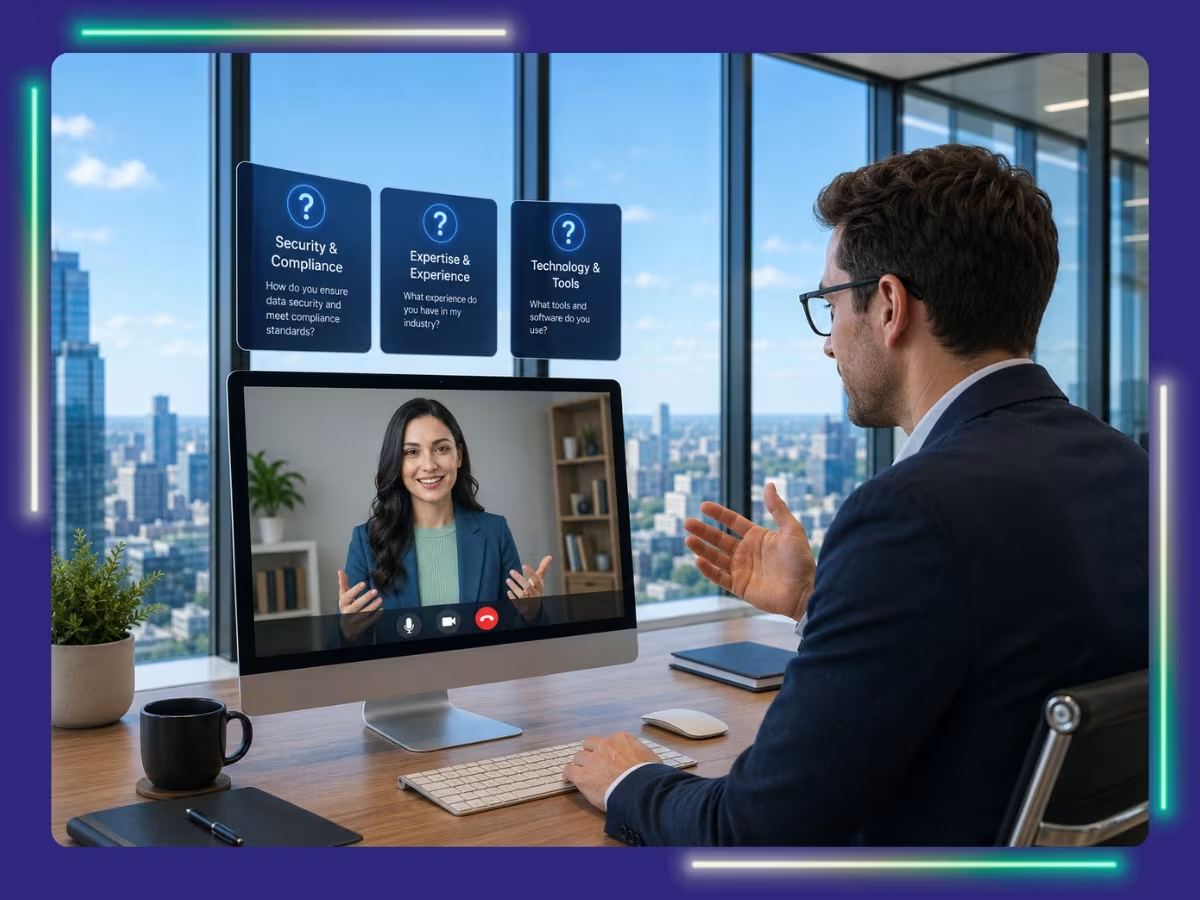
10 Questions to Ask Before Hiring an Outsourced Bookkeeping Provider
Before choosing a remote bookkeeping service provider, businesses should evaluate industry expertise, accounting software proficiency, data security standards, and reporting processes. It is also important to clarify service scope, communication expectations, pricing structure, and timelines for monthly financial reporting before signing a contract.
1. What is your experience in my specific industry?
A qualified outsourced bookkeeping service provider should understand the financial workflows, reporting requirements, and operational nuances specific to your industry. E-commerce businesses require inventory and multi-channel reconciliation, while healthcare companies manage insurance reimbursements and compliance-sensitive transactions.
Ask whether the provider currently works with businesses like yours and request sample reports, workflows, or dashboards relevant to your industry. Industry-specific experience reduces reporting errors and improves financial visibility.
2. What accounting software and automation tools are you proficient in?
Your bookkeeping provider should have expertise in the accounting software your business already uses, be it QuickBooks, Zoho Books, MS Dynamics, Xero or NetSuite. Beyond accounting platforms, providers should support integrations with payroll systems (Gusto, ADP), payment processors (Stripe, Square), e-commerce platforms (Shopify, Amazon), and expense management tools (Expensify, Ramp).
It is also worth asking how the provider uses AI and automation within their workflow. The rise of AI in accounting has changed what modern bookkeeping looks like many modern bookkeeping firms now use AI-powered tools to handle transaction categorization, bank feed reconciliation, invoice matching, and anomaly detection. Ask specifically:
- Which tasks are handled by AI versus a trained bookkeeper
- How AI-generated entries are reviewed and verified before financials are finalized
- What their data privacy policy is when client financials pass through automated or third-party AI systems
3. What does your month-end close process include?
The month-end close process determines how accurate and reliable your financial reporting will be. A structured close process should include bank reconciliation services, journal entry reviews, accrual adjustments, prepaid expense tracking, and balance sheet reconciliations.
Ask how long the month-end close process takes, how delayed transactions are handled, and who reviews the financial statements before delivery. Providers without a documented close process often struggle with consistency and reporting accuracy.
4. Who will manage my account day-to-day?
Businesses should understand exactly who handles their bookkeeping work after onboarding. Some firms assign senior advisors during sales conversations and transition accounts to junior staff afterwards.
A reliable outsourced bookkeeping provider should offer:
- A dedicated point of contact
- A senior reviewer or accounting manager
- Backup support procedures
- Defined escalation paths
Clear account ownership improves communication consistency and reduces operational risk if team members change.
5. What is your accuracy and quality control process?
Reliable bookkeeping providers for US businesses rely on documented review systems rather than manual oversight alone. Quality control processes should include transaction reviews, approval workflows, reconciliation checklists, and audit trails.
Ask whether:
- Multiple people review financial data
- Corrections are tracked systematically
- Reconciliations are reviewed monthly
- Approval processes are documented
Businesses outsourcing bookkeeping services should prioritize providers with structured financial controls and review procedures.
6. What security protocols do you have for data protection?
Financial data security is essential when outsourcing bookkeeping. Providers should use encrypted systems, multi-factor authentication, role-based access controls, and secure document-sharing tools.
SOC 2 compliance is a strong indicator that the provider follows independently audited security standards. Businesses should also ask how employee access is managed and how sensitive financial records are stored and protected.
7. What reports will we receive and how frequently?
A professional bookkeeping provider for US businesses should deliver consistent and actionable financial reporting. Standard reports typically include Profit and loss statements, balance sheets, and cash flow statements.
More advanced providers may also offer:
- Budget vs actual reporting
- KPI dashboards
- Accounts payable and receivable management reports
Ask whether reports are automated, customizable, and accessible directly through your accounting software.
8. How will we communicate and at what frequency?
Communication problems are one of the most common reasons businesses replace bookkeeping providers. Before signing, clarify response times, communication channels, meeting schedules, and escalation procedures, so you and your outsourced partner are on the same page.
Businesses should ask:
- How quickly urgent issues are handled
- Whether communication happens through email, Slack, Google Meet, or Teams
- How often financial review meetings occur
- Who handles unresolved issues
Clear communication standards improve accountability and reduce delays during critical reporting periods.
9. How do you handle onboarding?
Onboarding directly affects how quickly your outsourced bookkeeping becomes reliable. If historical records contain errors, uncategorized transactions, or incomplete reconciliations, those issues should be corrected before ongoing bookkeeping begins.
Ask providers:
- How onboarding timelines are structured
- Whether cleanup work is included
- How chart of accounts reviews are handled
- What migration process is used for software transitions
10. Can your team scale as our business grows?
Your bookkeeping needs will become more complex as revenue, transaction volume, and operational requirements increase. A scalable outsourced bookkeeping service provider should support advanced reporting, controller oversight, and multi-entity financial management as your business grows.
Ask whether the provider can support:
- Multi-entity consolidations
- Advanced financial reporting
- Payroll coordination
- Board-ready reporting packages
- Fractional CFO or controller services
The best providers offer long-term financial operations support instead of forcing businesses to switch vendors during growth stages.
Choose an Outsourced Bookkeeping Service Provider That Supports Long-Term Financial Growth
Choosing the right outsourced bookkeeping service provider requires more than comparing monthly pricing. Businesses need a bookkeeping partner that can maintain reporting accuracy, improve financial visibility, support compliance requirements, and scale alongside operational growth. Without structured processes and reliable reporting, bookkeeping gaps can quickly turn into cash flow issues, reconciliation delays, and poor financial decision-making.
At Whiz Consulting, we help US businesses build stronger financial operations through accurate bookkeeping, structured month-end close processes, and scalable reporting support. From bank reconciliation services to accounts payable and receivable management, we support firms with reliable financial workflows tailored to their operational needs.

Get customized plan that supports your growth

Have questions in mind? Find answers here...
Outsourced bookkeeping services cost in the USA typically depend on transaction volume, reporting complexity, and the service scope of businesses. Companies requiring payroll support, or controller-level reporting generally pay higher monthly fees.
Compare providers across five dimensions: industry expertise, software capabilities, communication standards, and security controls. Price is rarely the most important variable, a cheaper provider with weak quality controls will cost more in CPA cleanup fees and decision-making errors than a premium provider with structured processes.
To tell if a bookkeeping provider is reliable, ask for client references in your industry, request a sample month-end reporting package, and look for documented close timelines, named account ownership, and a clearly described review and approval process.
Outsourced bookkeeping service providers should, at minimum, have SOC 2 certification, multi-factor authentication, end-to-end encrypted data storage and transmission, role-based access controls, and secure document sharing protocols. Avoid providers who share sensitive files via unencrypted email or cannot produce documentation of their security controls.
Yes, your bookkeeping service provider should work within the platform you already use (whether it is QuickBooks, Xero, or MS Dynamics). Beyond the core accounting platform, integration with your payroll, payment processing, expense management, and e-commerce systems is essential to reducing manual entry risk.
A thorough onboarding should include a chart of accounts review and restructuring, historical transaction cleanup and reconciliation, software access setup and integration testing, a defined reporting template review, and a kickoff meeting to align on communication preferences and close timelines.
For a business with clean, current books, it should take two to four weeks to set up outsourced bookkeeping. For businesses requiring historical cleanup, platform migration, or a chart of accounts restructuring: four to eight weeks would be more realistic.
The best outsourced bookkeeping service providers can scale with your US business. Look for providers that offer a progression from bookkeeping to controller oversight to fractional CFO services. Multi-entity consolidation, lender reporting, board package preparation, and payroll coordination are capabilities growing businesses will eventually need.
Thousands of business owners trust Whiz to manage their account
Let us take care of your books and make this financial year a good one.