


In This Blog Post
Share This Article
- Last Updated: Aug 6, 2026
- 🔊 Listen
TL;DR
- Full charge bookkeeping covers the entire accounting cycle, not just transaction recording.
- A full charge bookkeeper can manage payroll, reconciliations, financial reports, and IRS filing support.
- Businesses struggling with bookkeeping workload often benefit from upgrading beyond basic bookkeeping.
- Choosing the right provider means evaluating compliance knowledge, software expertise, and reporting capabilities.
- Outsourced full charge bookkeeping services can provide enterprise-level financial support without the cost of a full-time hire.
A lot of business owners reach a point where they realize bookkeeping is no longer just about recording transactions. Payroll needs to go out on time, bank accounts need to reconcile, vendors need to be paid, and financial reports need to be accurate enough to support real business decisions. The books become too important to treat as an afterthought, but hiring a full-time accountant or controller may still be out of reach.
That is where full charge bookkeeping fills the gap. A full charge bookkeeper manages the day-to-day financial operations of your business, keeping your records organized, your reporting up to date, and your finances running smoothly behind the scenes.
In this guide, we’ll break down what full charge bookkeeping really means, how it differs from a regular bookkeeper or accountant, what responsibilities the role typically covers, and how to know if your business is ready for one.

Complete Financial Control
Get Tailored Full Charge Bookkeeping Services for Your US Business
What is Full Charge Bookkeeping?
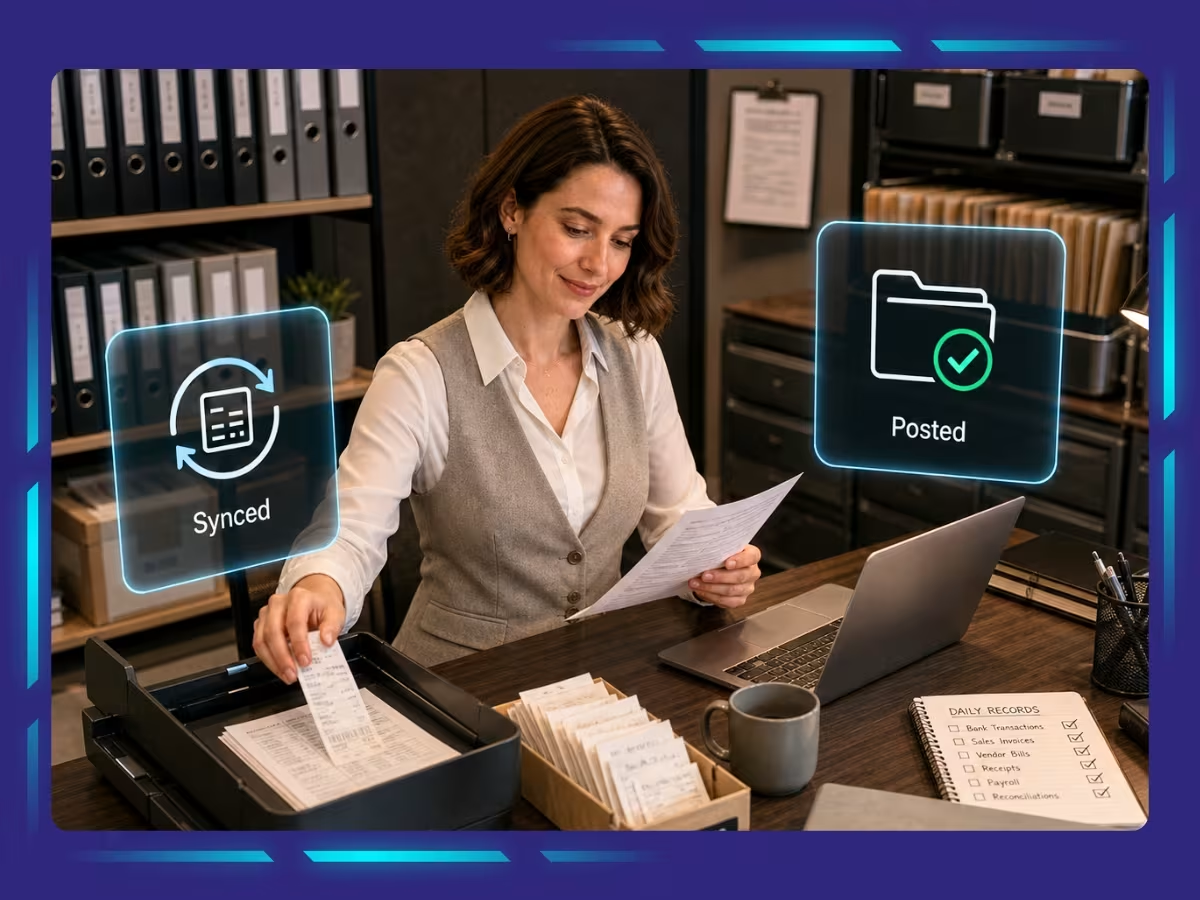
Full charge bookkeeping is a comprehensive financial management service where one professional handles your company’s entire accounting cycle, from daily transaction recording and payroll processing to financial statement preparation and IRS compliance, giving small and mid-sized businesses complete, end-to-end financial oversight without a full accounting department.
What Does a Full Charge Bookkeeper Do?
Full charge bookkeeping services take change of your business’s bookkeeping process from top to bottom. Here is what that looks like in practice:
- Manages the full accounting cycle from recording journal entries to closing the books each month
- Handles accounts payable and receivable, making sure vendor bills are paid on time and customer invoices are tracked and collected
- Runs payroll including calculating employee wages, processing direct deposits, and staying current with FICA, FUTA, and state-specific payroll tax rules
- Files IRS Form 941 quarterly to report federal income tax, Social Security, and Medicare withholdings
- Prepares and files W-2 and W-3 forms annually for all employees, meeting IRS deadlines
- Manages state payroll tax filings since some US states like California, New York, and Pennsylvania have additional employer-side requirements your bookkeeper tracks and handles
- Performs bank and credit card reconciliations monthly to catch errors and prevent fraud
- Prepares financial statements including profit and loss reports, balance sheets, and cash flow statements for your CPA or internal review
- Tracks fixed assets and depreciation schedules relevant for tax planning
- Supports audit readiness by maintaining organized, compliant records throughout the year
- Coordinates with your CPA at tax time so filings are accurate and deadlines are met
Checklist for Hiring Full Charge Bookkeeping Services
Hiring a full charge bookkeeping services often provides everything from daily bookkeeping and payroll support to financial reporting and tax-ready records. Before making a decision, use this checklist to evaluate whether a candidate or service provider has the right skills and experience for your business.

- Verify their credentials and practical experience
Professional certifications from organizations such as the American Institute of Professional Bookkeepers (AIPB) or the National Association of Certified Public Bookkeepers (NACPB) demonstrate a commitment to industry standards. However, qualifications alone are not enough. Ask whether they have worked with businesses similar to yours in terms of industry, size, and legal structure, as bookkeeping requirements can vary significantly.
- Confirm their understanding of IRS and payroll compliance
A full charge bookkeeper should be familiar with the day-to-day compliance responsibilities that keep your business running smoothly. They should understand payroll reporting, employment tax obligations, and the preparation of forms such as Form 941 and W-2/W-3, while also being aware of any state-specific filing requirements that apply to your business.
- Evaluate their accounting software expertise
Your bookkeeper should be comfortable working within the systems you already use, whether that is QuickBooks Online, Xero, NetSuite, or another accounting platform. It is also worth asking about their experience with integrated tools for payroll, inventory, payment processing, or customer relationship management, as these connections help reduce manual work and improve accuracy.
- Ask about financial statement preparation and reporting
One of the biggest advantages of hiring a full charge bookkeeper is gaining access to timely and accurate financial information. They should be able to prepare monthly profit and loss statements, balance sheets, and cash flow reports while keeping your records organized and ready for your CPA or tax professional when needed.
- Understand their communication style and reporting process
Strong bookkeeping is about more than numbers. You need someone who provides regular updates, explains financial information in a way that makes sense, and is available when important questions arise. Establishing expectations around reporting frequency and communication early on can help avoid misunderstandings later.
- Compare the cost of hiring in-house versus outsourcing
The average annual salary for a full-time bookkeeper in the United States is approximately $50,573. Once you factor in employee benefits, payroll taxes, training, software subscriptions, and office overhead, the total cost can be considerably higher. Outsourced full charge bookkeeping services often give businesses access to a broader range of expertise and scalable support without the long-term commitment of a full-time hire.
- Request references from businesses like yours
A strong track record is one of the best indicators of future performance. Ask for references from clients in your industry or businesses with a similar revenue range and operational complexity. A bookkeeper who understands the financial challenges specific to your sector will usually require less onboarding and can add value much more quickly.
Take the Stress Out of Your Books with a Full-Charge Bookkeeper
Running a business in the US means dealing with real financial complexity: quarterly IRS filings, state payroll tax variations, employee W-2s, and financial statements that actually tell you where your business stands. Full charge bookkeeping ties all of that together under one capable set of hands. Instead of patching together a basic bookkeeper, a payroll service, and a scramble every quarter, you get one organized, compliant, and complete financial operation.
At Whiz Consulting, our full charge bookkeeping services are built specifically for US small and mid-sized businesses. Whether you are an LLC, S-Corp, or C-Corp, our experienced team handles everything from daily transaction recording and IRS payroll tax compliance to monthly financial reporting and year-end prep. We do the books right so you can focus on building the business. Reach out to Whiz Consulting today and let us take the financial load off your plate.

Get customized plan that supports your growth

Have questions in mind? Find answers here...
A regular bookkeeper handles limited tasks like data entry, basic transaction recording, and accounts payable. A full charge bookkeeper manages the entire accounting cycle, including payroll, IRS compliance, financial statement preparation, and month-end close, making them a much more comprehensive financial resource for a growing business.
Hiring an in-house full charge bookkeeper typically costs between $45,000 and $65,000 per year in base salary, plus benefits and overhead. Outsourcing full charge bookkeeping services generally runs lower comparatively depending on your business size, type, scale, and services you take, offering more flexibility and often broader expertise at a comparable or lower total cost.
A full charge bookkeeper routinely manages IRS Form 941 (quarterly federal payroll tax report), W-2 and W-3 annual filings, FUTA and FICA calculations, and state payroll tax filings. They also keep payroll records organized so your CPA has clean data for your annual tax return.
Not entirely. A full charge bookkeeper can prepare financial statements and handle day-to-day compliance, but they are not a substitute for a licensed CPA when it comes to signing tax returns, conducting audits, or providing formal financial advisory services. The two roles work best together, with the bookkeeper doing the ongoing work and the CPA handling higher-level tax strategy.
The right time is typically when your business has employees on payroll, operates under a formal entity structure like an LLC or S-Corp, generates consistent revenue, or when you are spending too much of your own time managing financial records. If your CPA is regularly cleaning up your books before filing, that is also a strong signal that you need full charge bookkeeping support.
Thousands of business owners trust Whiz to manage their account
Let us take care of your books and make this financial year a good one.