


In This Blog Post
Share This Article
- Last Updated: Feb 4, 2026
- 🔊 Listen
TL;DR
- Tax rates stayed at 10%–37%, but higher income thresholds mean many taxpayers avoid bracket creep and may see a lower effective rate without real income growth.
- New deductions for tips, overtime, and car loan interest offer relief, yet income-based phase-outs mean high earners often receive partial benefits or none at all.
- The expanded SALT cap provides real savings for high-tax states through 2029, but income limits and a hard reversion to $10,000 demand timing and projection strategies.
- The higher Child Tax Credit and senior deduction improve certainty, but unchanged phase-out thresholds restrict value for upper-income households.
- Personal and commercial clean vehicle credits and SAF incentives largely disappear after September 30, 2025, making acquisition timing critical for eligibility.
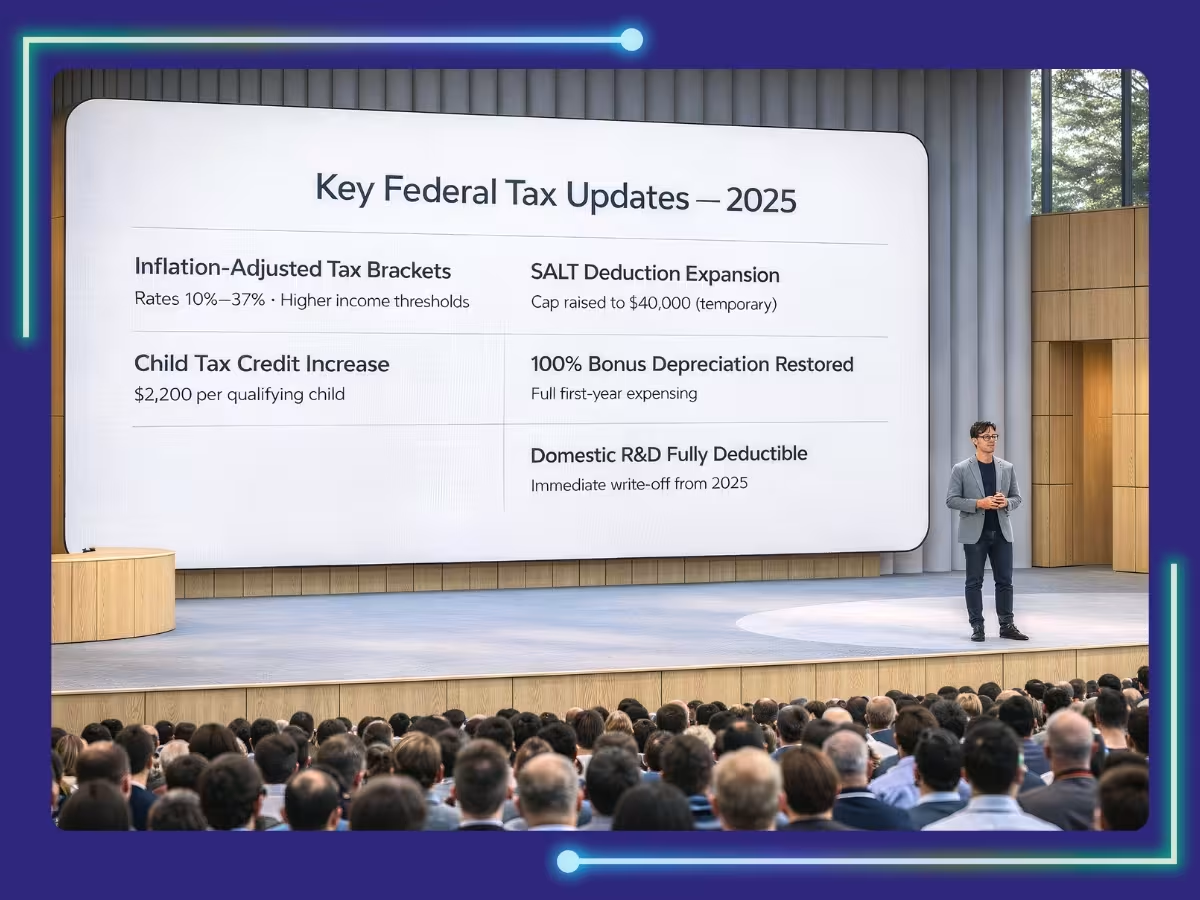
- 100% bonus depreciation and immediate domestic R&D expensing shift tax strategy toward faster write-offs, while foreign R&D remains penalised.
Stepping into the 2026 filing season requires a sharp look back at the federal tax shifts that defined 2025. From inflation-adjusted income brackets to evolving credits and deduction limits, last year’s updates have a direct impact on your current bottom line. For business owners and individuals alike, missing these technical nuances means risking overpayment or IRS scrutiny. Staying ahead of these changes is about more than just compliance; it’s about strategic financial control. In this blog, we will look at core updates and financial strategies.

Simplified Tax Compliance!
Accurate Filings, On-Time Submissions & Full Compliance
Individual Tax Rates
Individual income tax rates for 2025 remain structurally the same, but the IRS has adjusted income thresholds to account for inflation. These changes are designed to prevent taxpayers from being pushed into higher tax brackets solely due to cost-of-living increases.
- Federal income tax rates continue to range from 10% to 37%
- Inflation adjustments increase the income thresholds for each bracket
The applicable tax brackets depend on filing status:
- Married Filing Jointly
- Head of Household
- Single
- Married Filing Separately
Taxpayers whose wages increased only due to inflation may:
- Remain in the same tax bracket
- Experience a lower effective tax rate
These adjustments do not change marginal rates, only the income levels at which they apply
Standard Deduction Made Permanent
The standard mileage method provides a simplified way for taxpayers to deduct vehicle expenses without maintaining detailed records of actual costs. It is commonly used by self-employed individuals, employees with unreimbursed expenses, and charitable volunteers.
Mileage deductions are calculated based on miles driven for qualified purposes
Applicable 2025 rates:
- Business use: 70 cents per mile, Reflects increased fuel, maintenance, and ownership costs
- Medical or moving purposes: 21 cents per mile
- Applies only to qualifying medical travel or eligible moving expenses
- Charitable purposes: 14 cents per mile
- Set by statute and not indexed for inflation
When electing the standard mileage method:
- Gas, oil, insurance, repairs, depreciation, and maintenance are included in the rate
- These costs cannot be deducted separately
- Parking fees and tolls related to qualified travel remain deductible in addition to mileage
Once the standard mileage method is chosen for a vehicle:
- Switching to actual expenses later may be limited
Case Study – Charitable Mileage Deduction
David uses his personal vehicle for charitable purposes and drove 1,400 miles. He spent $50 on gas and oil, $40 on parking fees, and $60 on tolls. By choosing the standard mileage method, his deductible amount is calculated as follows:
1,400 miles × $0.14 = $196, plus $40 in parking and $60 in tolls, for a total deduction of $296. Gas and oil are not deductible under the standard mileage method.
Deduction for State and Local Taxes (SALT Deduction)
The SALT deduction cap is temporarily expanded, offering meaningful relief to taxpayers in high-tax states while retaining income-based limitations.
SALT deduction applies to:
- State and local income taxes
- Sales taxes (if elected)
- Property taxes
Temporary cap increases:
- $40,000 for tax year 2025
- $40,400 for tax year 2026
- Annual 1% increases through 2029
- After 2029, the SALT cap reverts to $10,000
High-income limitation:
- Applies when MAGI exceed: $500,000 (single or joint filers) $250,000 (married filing separately)
- Deduction reduced by 30% of excess MAGI
- Minimum allowable deduction is $10,000
Planning considerations:
- Timing of property tax payments may impact deductibility
- High-income taxpayers may receive partial rather than full benefit
Senior Exemption Authorized
A temporary deduction provides targeted relief to older taxpayers during the 2025-2028 tax years.
- Available to individuals aged 65 or older
- Applies for tax years 2025 through 2028
Deduction amount:
- $6,000 per qualifying individual
Income-based phase-out:
- Deduction reduced by 6% of MAGI exceeding: $75,000 for single filers, $150,000 for joint filers
This deduction is separate from:
- The standard deduction
- Additional age-based standard deduction
Intended to offset rising healthcare and living costs for seniors
Child Tax Credit
The child tax credit is expanded and stabilized, offering long-term predictability for families.
- Nonrefundable child tax credit increased to $2,200 per qualifying child
Credit amount is:
- Indexed for inflation
- Rounded down to the nearest $100
Permanently retained credits include:
- Additional Child Tax Credit (ACTC)
- 500 Other Dependent Credit (ODC)
Income phaseout thresholds remain unchanged:
- $200,000 for single filers
- $400,000 for married filing jointly
Families above the phaseout thresholds may see reduced or eliminated benefits
Tax on Tips
A deduction allows eligible workers to exclude a portion of tip income from taxable income, subject to strict limitations.
- Applies to tips earned in occupations that customarily received tips before December 31, 2024
- Qualified tips must be properly reported and documented
- Maximum annual deduction of $2500
Income-based reduction:
- Deduction reduction by $100 for every $1,000 MAGI exceeds: $1,50,000 for single filers, $300,000 for joint filers
This deduction does not:
- Exclude tips from payroll reporting
- Eliminate self-employment tax where applicable
Case Study – Tip Income Deduction
Olivia, a single taxpayer, has MAGI of $170,000 and earned $150,000 in qualified tips. Her maximum deduction of $25,000 is reduced by $2,000 due to excess MAGI, resulting in an allowable deduction of $23,000.
Tax on Overtime
Temporary relief is provided to workers earning significant overtime income during peak labour periods.
- Available for tax years 2025 through 2028
- Applies only to overtime paid at:
- 1.5× the regular hourly rate
- Hours worked beyond 40 per week
Deduction limits:
- $12,500 for single filers
- $25,000 for married filing jointly
Income-based reduction:
- Reduced by $100 for each $1,000 MAGI exceeds: $150,000 (single), $300,000 (joint)
Employers must properly classify overtime for eligibility
Case Study – Overtime Deduction
Harry, married filing jointly, has MAGI of $350,000 and $50,000 in qualified overtime pay. His maximum deduction of $25,000 is reduced by $5,000 due to excess MAGI, resulting in an allowable deduction of $20,000.

Car Loan Interest Deduction
A temporary deduction offsets interest costs for qualifying passenger vehicle loans.
- Available for tax years 2025 through 2028
Maximum deduction:
- $10,000 per year
Vehicle eligibility criteria:
- Final assembly in the United States
- Originally used by the taxpayer
- Gross vehicle weight under 14,000 pounds
Income-based reduction:
- Reduced by $200 for each $1,000 MAGI exceeds: $100,000 (single), $200,000 (joint)
Clean Energy Incentives – Non-Commercial
Tax incentive for personal clean vehicle purchases are phased out to reduce federal subsidy exposure.
- Eliminates tax credits for:
- New clean vehicles
- Previously owned clean vehicles
Applies to purchases made after September 30, 2025
Purchases acquired on or before September 30, 2025, may still qualify under prior rules, even if the vehicle is delivered or placed in service later, subject to IRS requirements.
Clean Vehicle Incentive – Commercial
Commercial clean vehicle incentives are also discontinued
- Eliminates tax credits for qualified commercial clean vehicles
Purchases acquired on or before September 30, 2025, may still qualify under prior rules.
Affects fleet operators and logistics businesses
Bonus Depreciation
Full expensing is restored to promote capital investment and equipment upgrades
- Bonus depreciation under Section 168 is permanently extended
- Increased to 100% first-year deduction
Applies to qualified property:
- Acquired and placed in service on or after January 19, 2025
Enables immediate write-off rather than multi-year depreciation
Domestic Research and Development Expense
The tax treatment of R&D costs is revised to favour domestic innovation.
Domestic R&D expenditures:
- Immediately deductible beginning in 2025
Foreign R&D expenditures:
- Must continue to be capitalized and amortized over 15 years
For expenditures incurred between 2022–2024:
- Taxpayers may deduct remaining unamortized amounts in 2025, or
- Spread deductions over two years starting in 2025
Small businesses with average gross receipts ≤ $31 million:
- May retroactively expense domestic R&D back to 2022
Election deadline: July 4, 2026
Sustainable Aviation Fuel Credit
Tax incentive for sustainable aviation fuel credit
- Eliminates the SAF tax credit after September 30, 2025
- SAF is produced from non-petroleum feedstocks
- Can reduce aviation emissions by up to 94%
- Removal may impact airlines and fuel producers relying on credits
Stay Compliant and Grow Stronger with Trusted Tax Expertise
Staying compliant isn’t just about meeting deadlines. It’s about protecting your business, making confident decisions, and building a foundation for sustainable growth. When tax compliance is handled with clarity and foresight, risks reduce, planning improves, and your business stays ready for what’s next.
At Whiz Consulting, our experts tax service providers keep you ahead of regulatory updates, legislative changes, and evolving tax requirements. We track what changes, explain what it means for your business, and handle the details end to end so nothing slips through the cracks. That way, you stay compliant, informed, and focused on growing stronger year after year.

Get customized plan that supports your growth

Have questions in mind? Find answers here...
In 2025, several federal tax laws changed under the “One Big Beautiful Bill” (OBBB) and other IRS adjustments. Key updates include increased standard deductions, enhanced tax credits, new deductions for tipped and overtime income, senior deductions, and adjustments to filing requirements and credits.
The federal income tax brackets remain the familiar seven rates (10%, 12%, 22%, 32%, 35%, 37%) with thresholds adjusted for inflation. The top 37% rate applies to higher income levels as adjusted for 2025.
Yes. The Child Tax Credit was increased to $2,200 per child 2025, though eligibility rules (like valid Social Security numbers for both parents and children) are now stricter.
Taxpayers aged 65 or older may claim an additional $6,000 deduction on top of the standard deduction. This benefit phases out at higher income levels based on modified adjusted gross income.
Under the new law, qualified tipped workers can exclude up to $25,000 of cash tips from taxable income and deduct up to $12, 500 of overtime pay. Eligibility generally phases out at higher income level.
Yes. The state and local tax (SALT) deduction cap has been temporarily raised to $40,000, benefiting taxpayers in high-tax states who itemize deductions.
One notable change is the IRS phasing out paper refund checks starting late 2025, meaning most refunds and benefit payments will be delivered electronically.
Yes. The IRS is updating forms and systems to reflect these law changes, and the filing season may open later than usual to accommodate adjustments. It’s wise to start preparing early and confirm which deductions and credits you qualify for.
Thousands of business owners trust Whiz to manage their account
Let us take care of your books and make this financial year a good one.