

In This Blog Post
Share This Article
- Last Updated: Aug 3, 2026
- 🔊 Listen
TL;DR
- The best hospitality accounting software helps businesses automate bookkeeping, payroll, inventory tracking, financial reporting, and revenue management.
- Hotels and hospitality businesses need software that integrates with property management systems (PMS), point-of-sale (POS) systems, and reservation platforms.
- Xero, FreshBooks, QuickBooks, M3, Sage Intacct, Cloudbeds, ZarMoney, and Zoho Books are among the strongest solutions available today.
- The right platform depends on business size, operational complexity, reporting requirements, and growth plans.
- Hospitality businesses should evaluate integrations, automation capabilities, reporting features, scalability, and industry-specific functionality before choosing software.
Hospitality businesses operate differently from most industries. Their financial performance depends on occupancy levels, room rates, labor costs, food margins, inventory management, and guest demand.
Traditional accounting software may handle basic bookkeeping, but it often lacks the operational visibility required by hospitality businesses. Modern hospitality accounting software helps businesses:
- Track revenue in real time
- Manage payroll efficiently
- Monitor inventory levels
- Improve cash flow visibility
- Automate financial reporting
- Integrate operational and financial data
- Reduce manual accounting tasks
- Improve decision-making
The right platform transforms accounting from a back-office function into a strategic management tool.

Upgrade Hospitality Finance
Choose technology that supports profitability, growth, and control
What Features Should Hospitality Accounting Software Include?
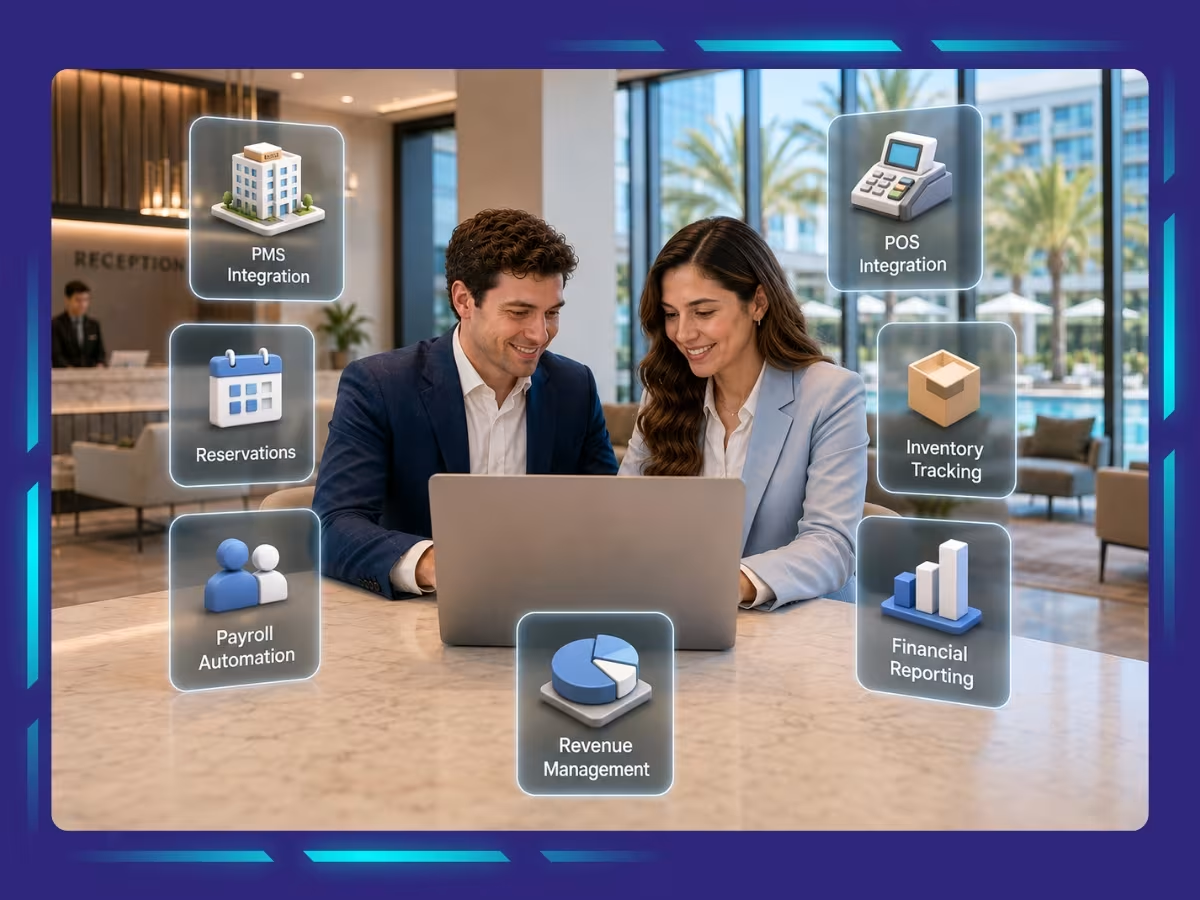
Hospitality accounting software should include PMS and POS integrations, payroll, inventory tracking, automated reconciliations, revenue reporting, and real-time dashboards to support accurate financial management.
Revenue Management Integration
Hospitality businesses generate revenue through multiple channels.
The software should support:
- Room revenue tracking
- Food and beverage sales
- Event revenue
- Reservation systems
- Online booking channels
Property Management System (PMS) Integration
Hotels and resorts benefit significantly from software that integrates directly with their PMS platform.
This allows:
- Automatic posting of room revenue
- Guest billing synchronization
- Occupancy reporting
- Reduced manual entries
Point of Sale (POS) Integration
Restaurants, bars, and hospitality venues rely heavily on POS systems.
POS integration supports:
- Automated sales imports
- Inventory updates
- Daily revenue reconciliation
- Labor reporting
Payroll Management
Labor costs often represent one of the largest hospitality expenses.
Strong payroll functionality should support:
- Employee scheduling
- Overtime calculations
- Payroll processing
- Labor cost reporting
Inventory Management
Food, beverage, and hospitality businesses need visibility into inventory movement.
Inventory capabilities should include:
- Real-time stock tracking
- Purchase order management
- Waste monitoring
- Inventory valuation
Financial Reporting
Hospitality leaders need detailed reporting to monitor performance.
Essential reports include:
- Profit and Loss Statements
- Departmental reporting
- Cash Flow Statements
- Budget comparisons
- Occupancy metrics
The 8 Best Hospitality Accounting Software Solutions
The best hospitality accounting software solutions help hotels, restaurants, and hospitality groups automate reporting, manage costs, improve integrations, and gain clearer financial visibility.

Xero
Xero remains one of the most popular cloud accounting platforms among smaller hospitality operators.
Its simplicity, affordability, and extensive integration ecosystem make it attractive for hospitality businesses seeking straightforward financial management.
Key strengths include:
- Automated bank reconciliation
- Expense tracking
- Mobile access
- Real-time reporting
- Extensive POS integrations
- Cloud-based accessibility
Many restaurants and boutique hotels use Xero because it combines ease of use with strong operational flexibility.
Pros
- User-friendly interface
- Strong third-party integration marketplace
- Excellent mobile functionality
- Affordable pricing
FreshBooks
FreshBooks focuses on simplicity and efficient client billing.
Hospitality businesses providing services such as catering, event management, or corporate hospitality often benefit from its invoicing capabilities.
Notable features include:
- Automated invoicing
- Payment reminders
- Expense management
- Time tracking
- Client portals
Its ease of implementation makes it attractive for smaller operations.
Pros
- Fast implementation
- Strong invoicing functionality
- Simple interface
QuickBooks Online
QuickBooks Online helps hospitality businesses in the USA manage transactions, vendor bills, payroll, expenses, and financial reporting from one central platform. With professional QuickBooks accounting services, hotels and restaurants can improve bookkeeping accuracy, streamline reconciliations, and gain better visibility into cash flow and operating costs.
QuickBooks Online supports:
- Invoice and bill management
- Bank and credit card reconciliation
- Expense categorization
- Payroll integration
- Financial reporting
- Multi-location tracking
These features help reduce manual work and make it easier to monitor performance across departments or locations.
Pros
- Easy-to-use cloud platform
- Strong reporting capabilities
- Integrates with hospitality tools
- Supports growing businesses
- Real-time financial visibility
M3
M3 is purpose-built for hotel accounting. Unlike general accounting software, M3 was specifically designed for hospitality organizations and follows the Uniform System of Accounts for the Lodging Industry (USALI).
Key capabilities include:
- Hotel financial reporting
- Labor cost management
- Occupancy analytics
- Multi-property consolidation
- Budgeting and forecasting
Hotel operators frequently choose M3 because of its deep hospitality specialization.
Pros
- USALI-compliant reporting
- Built specifically for hotels
- Excellent multi-property visibility
Sage Intacct
Sage Intacct offers sophisticated financial management capabilities for hospitality businesses operating at scale. Its strengths include:
- Multi-entity management
- Advanced reporting
- Budgeting
- Forecasting
- Multi-currency support
- Automation capabilities
Hospitality groups operating across multiple locations often benefit from Sage Intacct’s reporting depth.
Pros
- Highly scalable
- Advanced reporting
- Strong automation capabilities
Cloudbeds
Cloudbeds combines property management and accounting functionality within a single platform. This integration allows hospitality businesses to manage:
- Reservations
- Guest billing
- Room inventory
- Channel management
- Financial reporting
Because operational and financial information remain connected, businesses gain improved visibility into performance.
Pros
- Integrated PMS functionality
- Reservation management
- Revenue visibility
ZarMoney
ZarMoney bridges the gap between basic accounting software and enterprise systems. Hospitality businesses with significant inventory requirements often benefit from its capabilities.
Key features include:
- Inventory tracking
- Multi-location support
- Workflow approvals
- Financial reporting
- Purchase management
It is particularly useful for motel operators and hospitality businesses with extensive inventory requirements.
Pros
- Strong inventory management
- Workflow controls
- Multi-location capabilities
Considerations
- Less specialized for hotel operations than M3
Zoho Books
Zoho Books offers a broad feature set at a competitive price point. Hospitality businesses benefit from:
- Automated workflows
- Expense tracking
- Vendor portals
- Recurring billing
- Financial reporting
Its integration with the wider Zoho ecosystem provides additional operational flexibility.
Pros
- Affordable pricing
- Strong automation features
- Integrated business ecosystem
Hospitality Accounting Software Comparison
Selecting the right platform depends heavily on business size, operational complexity, and reporting requirements.
| Software | Best For | Key Hospitality Feature |
|---|---|---|
| Xero | Cafés & Small Restaurants | Extensive POS integrations |
| FreshBooks | Caterers & Event Planners | Simplified invoicing |
| QuickBooks | Growing Hospitality Groups | AI-driven transaction matching |
| M3 | Hotel Management Companies | USALI-compliant reporting |
| Sage Intacct | Large Hospitality Groups | Multi-entity consolidations |
| Cloudbeds | Hotels & B&Bs | Integrated PMS and reservations |
| ZarMoney | Inventory-Heavy Operations | Multi-location inventory tracking |
| Zoho Books | Budget-Conscious Businesses | Integrated business ecosystem |
How to Choose the Best Hospitality Accounting Software
Every hospitality business has different requirements. The best hospitality accounting software should align with both current needs and future growth plans.
Evaluate Business Size
Smaller hospitality businesses often prioritize:
- Simplicity
- Ease of use
- Cost efficiency
Larger organizations may require:
- Multi-property reporting
- Consolidation capabilities
- Advanced analytics
Consider Operational Complexity
Hotels, restaurants, resorts, and hospitality groups all have unique operational requirements. The software should support those specific workflows.
Review Integration Capabilities
Integration remains one of the most important selection criteria. Evaluate compatibility with:
- PMS systems
- POS systems
- Payroll platforms
- Reservation systems
- Revenue management software
Assess Reporting Requirements
Management reporting needs vary significantly across hospitality businesses. Ensure the platform supports:
- Financial reporting
- Department reporting
- Occupancy metrics
- Labor analytics
- Cash flow visibility
Evaluate Scalability
Software should support future expansion.
Consider:
- Additional locations
- Increased transaction volumes
- New revenue streams
- Operational complexity
Common Mistakes When Choosing Hospitality Accounting Software
Common mistakes in choosing hospitality accounting software include overlooking integrations, ignoring hospitality-specific features, underestimating scalability, neglecting user adoption, and failing to evaluate implementation support.
Overlooking Integration Capabilities
Hospitality businesses depend on booking systems, POS platforms, payroll tools, inventory software, and payment gateways. Selecting software that does not connect with these systems can create duplicate entries, reconciliation issues, and reporting delays.
Ignoring Hospitality-Specific Features
A reliable hospitality accounting guide should help businesses identify software that supports occupancy data, room revenue, food costs, departmental reporting, and multi-location operations. Generic platforms may lack these capabilities, forcing teams to rely on spreadsheets and manual workarounds.
Underestimating Scalability
Software that works for one location may become restrictive as the business adds properties, outlets, employees, or revenue streams.
Neglecting User Adoption
Complicated software can reduce productivity when employees receive limited training or struggle to use it effectively.
Failing to Assess Implementation Support
Poor onboarding, data migration, and technical support can result in errors, delays, and operational disruption.
Expand Your Vision with the Tools You Need and the Expertise You Deserve
Hospitality businesses operate in an agile environment where daily transactions, seasonal demand shifts, and tight margins leave little room for financial blind spots. The right accounting software brings structure to this complexity by organizing revenue, expenses, payroll, and vendor payments into one reliable system.
Whiz Consulting helps hospitality businesses across the USA implement, manage, and optimize accounting systems that truly support growth. Our professional hospitality accounting services provide industry-specific reporting standards, cost controls, and automation workflows. Whether you operate a boutique hotel or a multi-property chain, we align your software with disciplined financial processes. Connect with us and build a finance function that is efficient, compliant, and ready to scale.

Get customized plan that supports your growth

Have questions in mind? Find answers here...
M3 is one of the best options for hotels, while Cloudbeds is ideal for independent properties and Sage Intacct suits larger hotel groups.
Xero and Zoho Books are popular choices for small hotels, cafés, restaurants, and hospitality startups due to their affordability and ease of use.
Yes. Many hospitality accounting platforms integrate with property management systems (PMS), POS systems, booking engines, and payroll software.
Key features include financial reporting, payroll management, inventory tracking, revenue management, bank reconciliation, and hospitality-specific integrations.
Yes. It provides real-time financial insights, controls costs, automates processes, and helps managers make informed decisions that improve profitability.
Thousands of business owners trust Whiz to manage their account
Let us take care of your books and make this financial year a good one.