


An E-commerce Company Managing Weekly Cash Flow Across Multiple Vendors
The client had a weekly cash flow forecast that depended on manual data assembly. The process required information to be pulled from seven source files across five separate Excel sheets, and building it required combining bank activity, vendor payables, and the previous week's forecast across several files. Moreover, the workflow was not documented in SOPs and depended heavily on one person on the team.
A Manual, Repetitive Process Locked in One Person's Institutional Knowledge
Every week, updating the cash flow forecast meant manually opening seven source files and coordinating five separate Excel sheets by hand. The process took about two hours every week because each step was performed manually. Nothing was documented, so the entire process rested on one team member's knowledge.
Manual File Handling Across Seven Sources
The team pulled information from seven source files and worked across five separate Excel sheets. This created a recurring data-assembly workload that limited the team's time for reviewing the forecast.
30–50 Transactions Categorised Manually
Approximately 30 to 50 transactions were individually typed and categorised every week. Each manual entry added another opportunity for an incorrect category, formula issue, or other processing mistake.
Single-Person Dependency
Because the process lived in one person's head rather than in a documented workflow, it created an institutional knowledge trap: no SOPs existed, and no one else could reliably step in to complete the update.
Significant Recurring Time Cost
Around two hours each week went into assembling the data required for the forecast. That time could instead have been used to review the numbers and focus on the information the forecast was intended to provide.
Replaced a Six-Step Manual Workflow with a Single-Click Automation
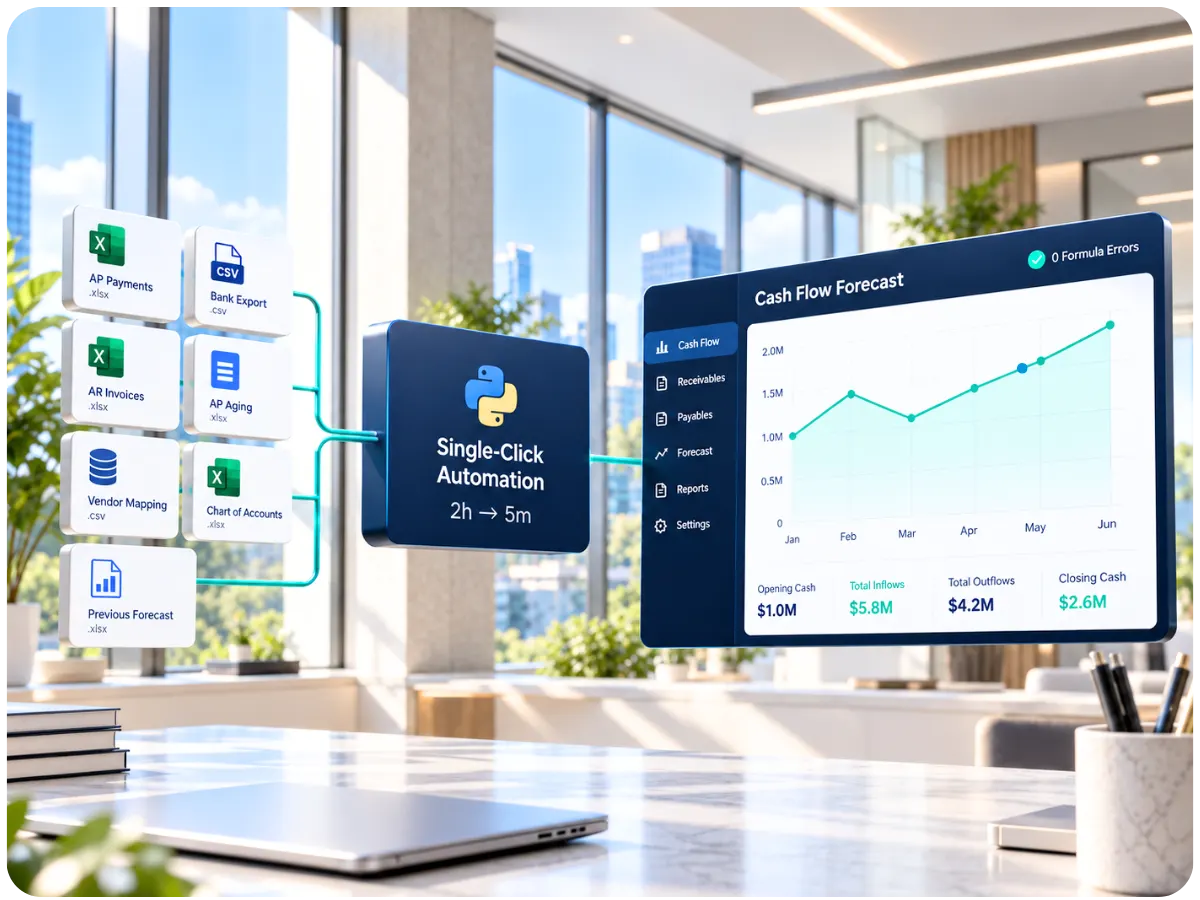
A Python-based automation engine was built to take over the full weekly cycle: pulling in the prior week's forecast workbook, the latest bank export, the NetSuite AP Aging Summary, and vendor mapping files, then producing a publication-ready forecast in five minutes rather than hours.
- Seven source files opened and coordinated by hand every week
- 30–50 bank transactions typed and categorised individually
- AP aging summary rebuilt manually, prone to errors
- Forecast rows pointing to wrong vendor rows
- Five Excel sheets updated one at a time
- About 2 hours of weekly effort
- Process known to one person, with no SOPs or backup
- All seven source files processed together in a single run
- Transactions categorised automatically, with unmapped items flagged
- Vendors rebuilt automatically
- Forecast rows dynamically linked to their corresponding vendors
- All five sheets updated simultaneously
- About 5 minutes from start to finish
- Documented, repeatable single-click run available to the whole team
Make Your Weekly Reporting Faster and Less Dependent on One Person
Automate weekly cash flow forecasting with a single-click reporting engine
A Structured Python Workflow for Single-Click Cash Flow Forecasting
The solution is a single-click Python utility that replaces five hand-built steps with one connected run, without removing the team's control over the output. Its AI-assisted logic reads all seven source files, updates the five Excel sheets at the same time, and keeps every forecast row linked to its supporting vendor and payables data. Each stage removes a specific weakness in the old routine, and together they form one repeatable weekly workflow that now finishes in under five minutes.
Structured Input Intake
- Accepted the prior week's cash flow forecast workbook as the base file for the update
- Pulled in the latest bank export, covering new transactions and account mapping
- Brought in the NetSuite AP aging summary, including manual payment mapping
- Incorporated vendor alias and expense-nature mapping files to keep vendor naming consistent across sources
Automated Transaction Processing
- Processed all seven source files instantly instead of requiring manual file-by-file review
- Categorised bank transactions automatically, replacing the manual typing and tagging step
- Flagged unmapped transactions automatically rather than letting them pass through unnoticed
Vendor and Payables Reconciliation
- Rebuilt vendor records within the AP aging summary automatically, removing manual copy-pasting between sheets
- Routed autopay pickups automatically into the Needs-to-Pay queue
- Dynamically linked forecast rows to their corresponding vendors
Forecast Assembly and Delivery
- Updated all five linked Excel sheets simultaneously in a single run
- Completed the entire six-step pipeline in under five minutes
- Delivered a publication-ready cash flow forecast with no manual formula rebuilding required
A Faster, More Reliable Weekly Forecast Anyone on the Team Can Run
Since being deployed for weekly production use, the automation has consistently replaced a two-hour manual routine with a five-minute automated run, while removing the errors and single-person dependency that came with the old process.
Three Principles Behind Reliable Cash Flow Forecast Automation
This engagement shows three practical principles: connect the whole process instead of speeding up a single step, flag exceptions for review instead of guessing, and move critical knowledge out of one person's head and into a repeatable system. Together, they help reduce manual errors, strengthen internal controls, and produce forecasts the team can rely on.
Automate the Whole Pipeline, Not Just One Step
Real time savings came from automating the entire chain of file intake, categorisation, vendor reconciliation, and forecast assembly together, rather than automating a single task in isolation.
Remove Single-Person Process Dependency
A process with no SOPs and no backup is a business risk. Encoding it into a repeatable tool protects the deliverable from absences, keeps the output consistent, and lets the approach be reused for other clients.
Free Your Team's Time for Judgement, Not Data Entry
Once data assembly is automated, the finance team's time shifts naturally toward reviewing outputs and making decisions, rather than performing the same manual steps week after week.