


In This Blog Post
Share This Article
- Last Updated: Sep 23, 2026
- 🔊 Listen
TL;DR
- Automation follows rules; AI learns from data and identifies patterns.
- Automation is ideal for repetitive accounting tasks like invoicing and reconciliations.
- AI adds value through forecasting, fraud detection, and financial insights.
- Most businesses benefit from implementing automation before adopting AI.
- Combining AI and automation creates a faster, smarter, and more scalable accounting function.
The future of accounting is being shaped by AI and automation, but they are not the same. Automation handles repetitive, rules-based tasks like data entry, invoice processing, and scheduled reporting, while AI analyzes data, detects patterns, predicts outcomes, and supports better decisions.
Understanding the difference helps finance teams choose the right tools, reduce manual work, improve accuracy, and gain stronger financial visibility. This guide covers the discussion about AI vs automation in accounting, when each should be used, and why many businesses now combine both to create faster, smarter, and more scalable finance functions.

From Manual Work to Smart Finance
Automate routine accounting tasks and unlock AI-powered insights
Is AI the same as automation in accounting?
No, AI and automation are not the same in accounting, though they often complement each other. Automation follows predefined rules to perform repetitive tasks such as invoice generation, journal entries, payment reminders, and transaction matching.
AI goes a step further by analyzing financial data, identifying patterns, detecting anomalies, and generating forecasts. While automation focuses on executing processes efficiently and consistently, AI provides insights that support better decision-making.
For example, an automated accounts payable system can route invoices for approval, while AI can detect duplicate invoices, flag suspicious vendor activity, and predict cash flow impacts. Together, they improve efficiency, accuracy, and financial visibility.
What is the Difference Between AI and Automation in Accounting?
The easiest way to understand the difference is this: automation follows instructions, while AI learns from data.
Traditional accounting automation is designed to execute repetitive tasks the same way every time. If a process follows a clear set of rules, automation can handle it efficiently. For example, automatically posting recurring journal entries, matching invoices to purchase orders, generating month-end reports, or scheduling payment runs.
AI takes things a step further. Instead of simply following rules, it analyzes information, identifies patterns, makes predictions, and helps accountants make better decisions. AI can recognize unusual transactions, forecast cash flow, categorize expenses, and extract information from invoices and receipts with minimal human input.
For many U.S. businesses, the most effective approach is not choosing one over the other. Automation reduces manual work, while AI helps uncover insights hidden within financial data. Together, they create a smarter and more efficient accounting function.
AI vs Automation in Accounting: Key Differences
| Dimension | General Automation (RPA / Rule-Based Systems) | AI-Specific (Machine Learning, NLP, Generative AI) |
|---|---|---|
| What It Does | Repeats fixed, rules-based steps exactly as programmed | Learns patterns, predicts outcomes, interprets information, and handles ambiguity |
| Best At | High-volume, predictable tasks such as data entry, invoice matching, and scheduled reporting | Judgment-adjacent tasks such as forecasting, anomaly detection, fraud monitoring, and document analysis |
| Handles Exceptions? | Poorly. Processes often fail when inputs vary from predefined rules | Yes. Can adapt to changing, incomplete, or unstructured inputs |
| Improves Over Time? | No. Requires manual updates and reprogramming | Yes. Models improve as they process more data and feedback |
| Accounting Examples | Auto-posting invoices, recurring journal entries, payment processing, bank reconciliation workflows | Cash flow forecasting, fraud detection, expense categorization, OCR-powered invoice reading, predictive analytics |
| Limitation | Requires clean and consistent data; struggles with exceptions | Requires quality data, human oversight, and professional review of outputs |
A Real-World Example
Consider a U.S. manufacturing company processing hundreds of supplier invoices every month.
Automation can capture invoices, route them for approval, match them against purchase orders, and schedule payments. The process becomes faster, more consistent, and less dependent on manual effort.
AI can then analyze those same invoices to identify unusual spending patterns, predict future cash requirements, flag possible duplicate payments, and highlight vendors whose costs are rising faster than expected.
In short, automation helps accounting teams work faster, while AI helps them work smarter.
Where Automation Adds the Most Value in Accounting
Many accounting teams still spend hours every week on repetitive administrative work. These tasks are necessary, but they rarely contribute to strategic decision-making. This is where automation delivers the greatest value.
Accounts Payable Processing
Automation can capture invoice data, route approvals, match purchase orders, and schedule vendor payments automatically. This reduces processing time, improves consistency, and minimizes manual errors.
For U.S. businesses managing hundreds or thousands of invoices every month, automation can significantly reduce accounts payable processing costs while strengthening internal controls.
Bank Reconciliation
Instead of manually matching hundreds or thousands of transactions, automated systems can compare bank records against accounting data and identify matches within seconds.
This helps accounting teams close books faster and maintain more accurate financial records.
Payroll Processing
Payroll automation helps businesses calculate wages, process payments, manage deductions, and maintain compliance with federal, state, and local payroll requirements.
This is particularly valuable for businesses operating across multiple states where payroll regulations and tax requirements can vary.
Accounts Receivable Management
Automated invoicing and payment reminders help businesses improve collection rates while reducing the time spent following up on overdue invoices.
Improved collections often translate directly into stronger cash flow and reduced Days Sales Outstanding (DSO).
Financial Reporting
Businesses can automatically generate recurring financial reports, dashboards, and management summaries without manually compiling data each reporting period.
This allows finance teams to spend less time creating reports and more time analyzing results.
Where AI Adds the Most Value in Accounting?
While automation focuses on efficiency, AI focuses on insight.
AI in accounting helps teams move beyond recording transactions and toward understanding what financial data reveals about the business.
Cash Flow Forecasting
AI can analyze historical payment trends, customer behavior, seasonal fluctuations, and spending patterns to produce more accurate cash flow forecasts.
For businesses operating in uncertain economic conditions, this visibility can significantly improve planning and decision-making.
Fraud Detection
Traditional systems typically rely on predefined rules to identify suspicious activity. AI can detect unusual patterns that may indicate duplicate payments, unauthorized transactions, vendor fraud, or internal control weaknesses.
This makes AI a valuable tool for strengthening risk management and financial oversight.
Expense Analysis
AI can review large volumes of expense data and identify spending trends, cost-saving opportunities, and unusual expenditures that might otherwise go unnoticed.
Business owners gain a clearer understanding of where money is being spent and where efficiencies can be created.
Revenue Forecasting
Businesses can use AI to predict future revenue based on historical performance, customer purchasing patterns, market conditions, and seasonal demand.
This helps leadership teams make more informed budgeting, hiring, and investment decisions.
Tax Planning Support
AI-powered tools can quickly analyze financial information and identify potential deductions, credits, and planning opportunities. While professional review remains essential, AI can significantly improve the efficiency of tax analysis.
For U.S. businesses to maintain federal and state tax requirements, this additional insight can be extremely valuable.
When Should Businesses Use Automation?
Automation is often the best starting point for businesses looking to modernize their accounting operations.
Consider automation if your business:
- Processes a high volume of transactions every month
- Relies heavily on manual data entry
- Experiences delays in reconciliations or reporting
- Has repetitive invoicing and payment workflows
- Wants to reduce administrative workload
- Needs more standardized accounting processes
Automation delivers immediate benefits because it improves efficiency without fundamentally changing how decisions are made.
Many small and mid-sized U.S. businesses see measurable productivity improvements shortly after implementing accounting automation solutions.
When Should Businesses Use AI?
AI becomes increasingly valuable as business complexity grows.
Consider AI if your business:
- Needs better cash flow forecasting
- Requires stronger fraud detection capabilities
- Manages large volumes of financial data
- Wants real-time financial insights
- Operates across multiple locations or states
- Needs predictive reporting and scenario planning
AI helps businesses become more proactive. Rather than simply reporting what happened last month, it helps explain why it happened and what may happen next.
This enables leaders to make decisions with greater confidence and accuracy.
Why the Future of Accounting Requires Both AI and Automation
One of the biggest misconceptions surrounding AI vs automation in accounting is that businesses must choose one technology over the other.
In reality, the strongest accounting functions use both.
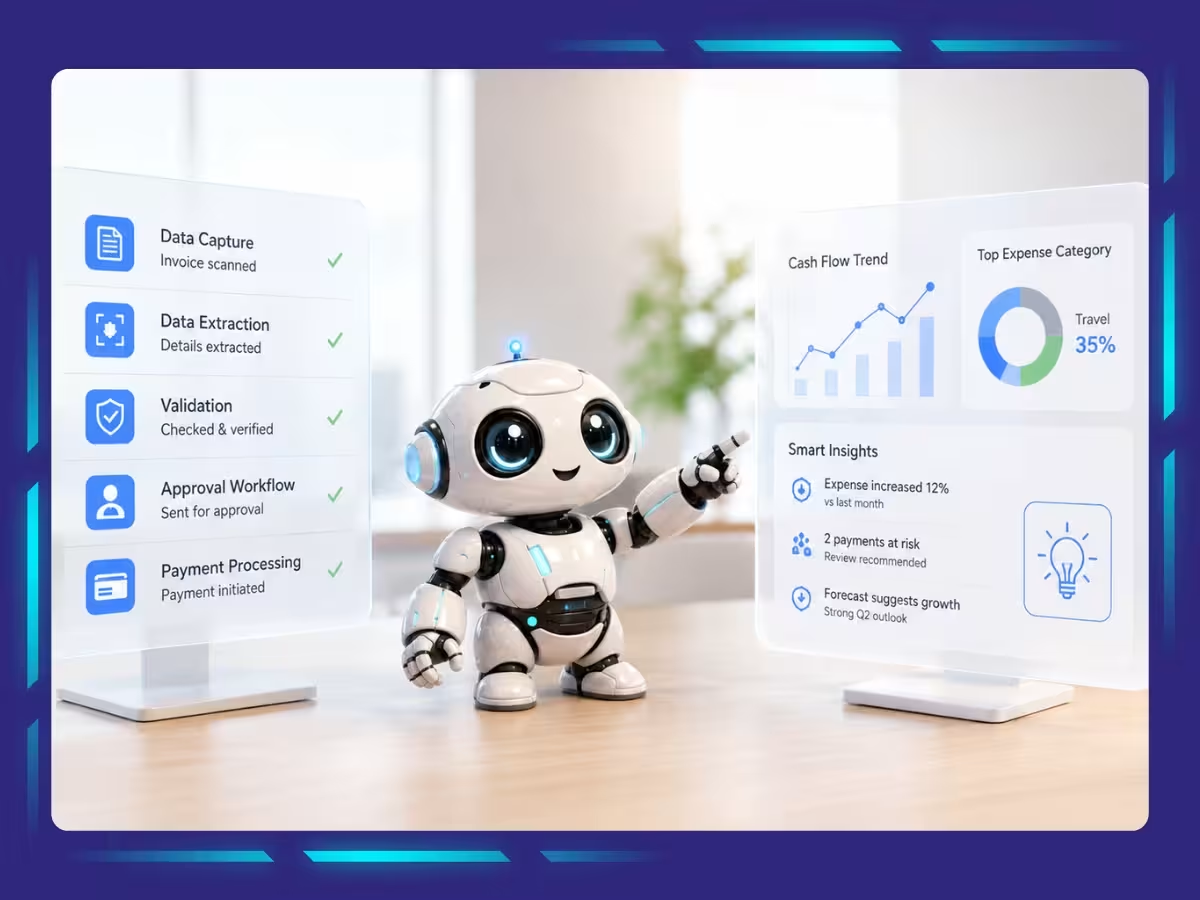
- Automation handles routine execution. It captures data, processes transactions, manages workflows, and reduces manual effort.
- AI adds intelligence to those processes. It analyzes information, identifies risks, uncovers opportunities, and provides predictive insights.
For example, automation may collect invoice and payment data throughout the month. AI can then analyze that information to forecast cash flow, identify spending anomalies, and recommend actions that improve financial performance.
As accounting continues evolving, businesses that combine AI and automation will be better positioned to improve efficiency, strengthen controls, and gain a competitive advantage.
Integrate AI and Automation into Your Accounting System with the Help of Our Experts
The discussion around AI vs automation in accounting is not about choosing one technology over the other. Automation excels at handling repetitive, rules-based processes, while AI helps businesses interpret data, identify trends, and make better decisions. Together, they create a more efficient, accurate, and intelligent accounting function. As U.S. businesses continue to embrace digital transformation, combining AI and automation can help improve productivity, strengthen financial controls, and provide deeper visibility into business performance.
At Whiz Consulting, we help businesses successfully integrate AI and automation into their accounting processes. From automated bookkeeping and accounts payable workflows to AI-powered reporting, forecasting, and financial analysis, our experts ensure your technology works seamlessly with your business goals. Whether you’re looking to streamline daily accounting tasks or gain more strategic financial insights, our team can help you build a smarter, scalable accounting function. Contact us today to explore how modern accounting technology can support your growth.

Get customized plan that supports your growth

Have questions in mind? Find answers here...
Automation follows predefined rules to complete repetitive accounting tasks, while AI analyzes data, identifies patterns, predicts outcomes, and supports decision-making. Automation improves efficiency, whereas AI delivers insights and intelligence.
No. AI and automation serve different purposes. Automation handles routine workflows, while AI enhances analysis and forecasting. Most businesses achieve better results by using both together rather than replacing one with the other.
AI is commonly used for cash flow forecasting, fraud detection, expense analysis, revenue forecasting, invoice data extraction, and identifying financial anomalies that may require attention.
Most small businesses benefit from implementing automation first because it delivers immediate efficiency gains. Once core processes are automated, AI can be added to improve forecasting, reporting, and decision-making.
Yes. Many businesses outsource AI and accounting automation implementation to experienced accounting service providers because it reduces setup challenges, accelerates adoption, ensures proper integration, and helps maximize return on investment.
Thousands of business owners trust Whiz to manage their account
Let us take care of your books and make this financial year a good one.