


Table of Content
Share This Article
- Last Updated: Jul 9, 2026
- 🔊 Listen
TL;DR
- Vendor invoice automation cuts manual processing time from 10 minutes to under 2 minutes per invoice.
- OCR and AI extract, match, and validate invoice data automatically.
- Digital approval workflows eliminate email delays and speed up payment cycles.
- Full audit trails and automated VAT reporting ensure HMRC MTD compliance.
- Automation scales AP operations efficiently without adding headcount or overhead.
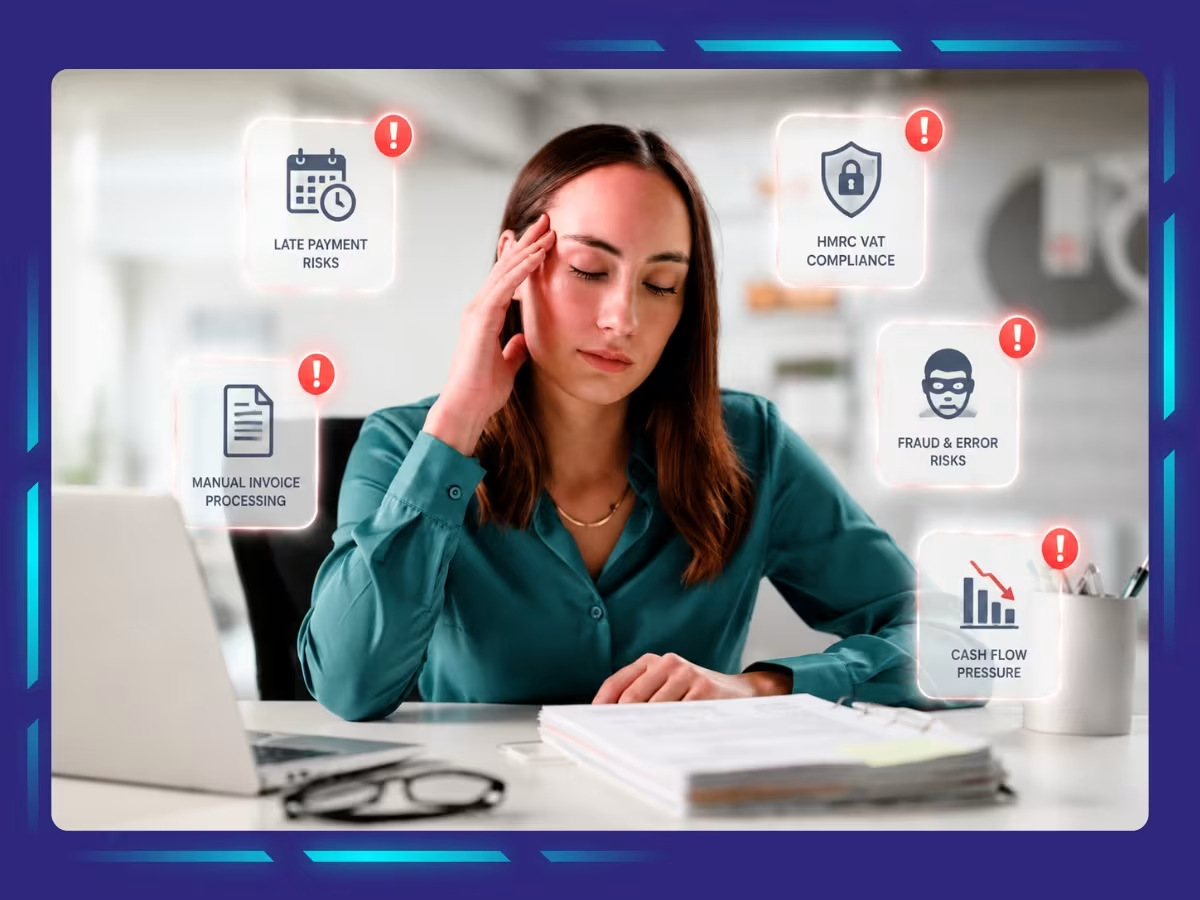
If your AP team is still manually keying invoice data, chasing approvals over email, and reconciling supplier statements by hand, you are not alone. Thousands of UK businesses are stuck in the same cycle. But with HMRC’s Making Tax Digital (MTD) rollout accelerating, and supplier volumes only growing, the manual approach is becoming a liability rather than just an inconvenience.
Vendor invoice automation is changing the way UK businesses manage their payables. It removes the repetitive, error-prone tasks from your team’s plate and replaces them with a streamlined, digital workflow that is faster, cheaper, and audit-ready. This blog walks you through exactly what it is, how it works, the tools available in the UK market, and how to implement it in a way that actually sticks.

Streamline AP with Automation
Automate Invoices & Reduce Errors with Experts
What Is Vendor Invoice Automation?
Vendor invoice automation is the use of software and technology to capture, process, validate, and approve supplier invoices without manual data entry. Instead of a team member opening an email, reading a PDF, and typing figures into an accounting system, the chosen accounting automation software handles all of that automatically. It extracts the relevant data, matches it against purchase orders, flags discrepancies, routes invoices for approval, and posts them to your ledger, all with minimal human intervention.
How Does Vendor Invoice Automation Work?
This is the part most finance teams want to understand before committing to any tool or process change. Here is a step-by-step breakdown of how automated vendor invoice processing typically works in a UK business context:
Invoice receipt and capture
Invoices arrive via email, supplier portal, or post. The software captures them in one place, whether they are PDFs, scanned documents, or structured e-invoices via the PEPPOL network.
Data extraction using OCR and AI
Optical character recognition (OCR) combined with AI in accounting and machine learning reads the invoice: supplier name, invoice number, date, line items, VAT amount, and payment terms. No manual keying required.
Three-way matching
The system automatically matches the invoice against the original purchase order and goods receipt note. If all three align, the invoice moves forward. If not, it is flagged for review.
Validation and compliance checks
The software checks for duplicate invoices, validates VAT numbers against HMRC records, and ensures the data meets your internal coding rules and chart of accounts.
Automated approval routing
Based on rules you set (invoice value, department, supplier category), the invoice is routed to the right approver. They receive a notification, review it, and approve with a click, no email chains needed.
Posting to your accounting system
Once approved, the invoice is automatically posted to your accounting software (Xero, Sage, NetSuite, QuickBooks, etc.) and scheduled for payment.
Audit trail and reporting
Every action is logged with a timestamp and user record. This creates a complete, searchable audit trail that supports MTD compliance, HMRC digital record-keeping requirements, and internal controls.
Manual Invoice Processing vs. Automated Invoice Processing
Before looking at the benefits in detail, here is a direct comparison that shows why the shift matters:
| Factor | Manual Processing | Automated Processing |
|---|---|---|
| Time per invoice | 10 to 15 minutes | Under 2 minutes |
| Error rate | High (data entry mistakes, missed duplicates) | Very low (automated validation and matching) |
| Scalability | Limited by headcount | Scales with volume, no extra resource needed |
| Audit readiness | Manual filing, hard to retrieve | Instant digital audit trail |
| MTD compliance | Risk of gaps in digital records | Built-in digital record-keeping |
What Are the Benefits of Automating Vendor Invoices?
Once businesses make the switch, the gains tend to show up quickly and, in more areas, than expected. These gains include time saving, fewer errors, faster approval cycles, stronger HMRC compliance, greater visibility, and scalability without hiring more.
Significant time savings across the team
Your AP staff spend less time on data entry and more time on supplier relationships, payment planning, and exception handling. Best-in-class AP teams process invoices at a fraction of the cost and time of manual operations, with automation being the single biggest differentiator.
Fewer errors and duplicate payments
Automated matching and validation catch mistakes before they become problems. Duplicate payments, a surprisingly common and costly issue in manual AP, are flagged instantly.
Faster approval cycles
Digital routing means approvers can sign off from anywhere, on any device. Payment terms are met more consistently, which protects supplier relationships and sometimes unlocks early payment discounts.
Stronger compliance with HMRC and MTD
Making Tax Digital Phase 2 requires businesses to maintain digital records of VAT transactions. Automated invoice processing creates those records as a natural byproduct of the workflow, rather than requiring a separate compliance exercise.
Greater visibility over cash flow
With real-time dashboards, you can see exactly what is approved, what is pending, and what is due for payment. That visibility helps with cash flow forecasting in a way that spreadsheets and filing cabinets simply cannot match.
Scalability without headcount growth
When invoice volumes spike, whether through seasonal demand, new supplier contracts, or business growth, automation absorbs the increase without requiring you to hire and train additional staff.
What Software is Used for Vendor Invoice Automation in the UK?
There is no shortage of tools on the market, but the right choice depends on your business size, existing accounting software, and the complexity of your approval workflows. Here is a comparison of the main platforms used by UK businesses:
| Software | Best For | Key Features | UK-Specific Strengths |
|---|---|---|---|
| Xero | SMEs already on Xero | Built-in invoice capture, bank reconciliation, MTD-ready | HMRC MTD VAT filing built in, widely supported by UK accountants |
| Sage Intacct / Sage 50 | Mid-market and larger SMEs | AP automation, multi-entity support, approval workflows | Strong UK presence, Sage-specific add-ons available |
| QuickBooks Online | Small businesses | Invoice management, receipt capture, reporting | MTD-compatible, strong accountant network in the UK |
| Dext (formerly Receipt Bank) | Document capture layer | OCR extraction, supplier rules, integrates with major platforms | Popular with UK accountants, strong VAT handling |
| ApprovalMax | Businesses needing structured approvals | Multi-step approval workflows, integrates with Xero and QBO | Ideal for UK businesses with complex sign-off requirements |
| NetSuite | Larger or growing businesses | Full ERP with AP automation, PEPPOL support, global capabilities | Supports UK statutory requirements and multi-currency |
How to Implement Invoice Automation in a UK Business
Getting the technology in place is only part of the job. A successful implementation requires some groundwork first.
1. Map your current invoice process
Before automating anything, document every step of how invoices currently move through your business. Where do they come in? Who touches them? Where do they get delayed? This map becomes the blueprint for your automated workflow.
2. Standardise your supplier communication
Ask suppliers to send invoices in a consistent format, ideally PDF via email to a dedicated AP inbox, or through a PEPPOL-compatible e-invoicing channel if applicable. The cleaner the input, the better the automation performs.
3. Choose the right software stack for your size and setup
Use the comparison table above as a starting point, but speak to your accountant or an AP specialist before committing. The right tool depends on your existing accounting platform, team size, and approval complexity.
4. Set up your chart of accounts and coding rules
Automation works best when the rules are clear. Define how different invoice types should be coded, which cost centres apply, and what thresholds trigger different approval levels. This setup work pays dividends in accuracy later.
5. Configure approval workflows
Build your approval matrix into the system. Decide who approves what, up to what value, and what happens when someone is unavailable. Most tools allow delegation rules so nothing gets stuck when an approver is on leave.
6. Train your team
Automation changes roles, not just processes. Your AP team needs to understand how to handle exceptions, review flagged invoices, and use the reporting dashboards. A short, practical training session goes a long way.
7. Consider outsourcing to an AP specialist
For many UK businesses, particularly those without a dedicated finance function, the most efficient route is to outsource accounts payable to a specialist firm. An experienced accounts payable service professional brings the tools, the processes, and the compliance knowledge without the overhead of building it all in-house. This is especially valuable during periods of growth, system migrations, or when HMRC compliance requirements are adding pressure to the finance team.
Automate Vendor Invoices Efficiently with a Skilled AP Professional
Vendor invoice automation is no longer a luxury reserved for large enterprises. With MTD Phase 2 requirements, growing supplier bases, and the very real cost of manual errors, UK businesses of all sizes are making the switch. The technology is accessible, the ROI is clear, and the compliance benefits are substantial. Whether you start with a simple document capture tool or build a fully automated AP workflow, the important thing is to start.
Whiz Consulting has been working for more than a decade with UK businesses to set up and manage automated accounts payable processes, from providing expertise in AP automation and its implementation to day-to-day invoice processing. Our team brings the expertise so yours does not have to. Get in touch with Whiz Consulting today to find out how we can streamline your vendor invoice process and keep you fully compliant with HMRC requirements.

Get customized plan that supports your growth

Have questions in mind? Find answers here...
Manual processing requires reading, entering, matching, and emailing invoices. Automation uses OCR and AI to capture data, match, validate, and route approvals digitally, reducing errors, cost, and processing time.
Automation eliminates manual data entry, speeds up approvals, instantly matches purchase orders, and flags exceptions, saving several hours weekly for busy finance teams.
Automated systems create digital VAT records as invoices are processed, ensuring HMRC-compatible submissions through tools like Xero, Sage, or QuickBooks.
Yes. Small companies or sole traders managing 50–200 invoices monthly can save hours weekly. Affordable tools like QuickBooks and NetSuite are widely recommended.
PEPPOL is a global e-invoicing network enabling structured invoice exchange without PDFs. Not mandatory for most private UK businesses but common in public sector and EU transactions.
Outsourcing is ideal if internal expertise is lacking, invoice volumes fluctuate, or cost-effective, reliable AP support is needed during growth or system changes.
Thousands of business owners trust Whiz to manage their account
Let us take care of your books and make this financial year a good one.




This website uses cookies to improve your experience. You can accept all or reject non-essential cookies.