

Table of Content
Share This Article
- Last Updated: Aug 6, 2026
- 🔊 Listen
TL;DR
- Centralise vendor data to reduce payment errors and maintain ABN compliance.
- Automate AP workflows for faster, more accurate invoice processing.
- Standardise vendor onboarding to prevent downstream issues.
- Conduct regular vendor performance reviews to improve supplier relationships.
- Define approval hierarchies to minimise fraud and strengthen financial controls.
Every Australian business faces a common challenge: paying the right supplier the correct amount on time. At the heart of this issue is 3-way matching, the process of cross-checking purchase orders, goods receipt notes, and supplier invoices before authorising payments. Done properly, it prevents duplicate payments, reduces errors and fraud risk, and keeps GST records accurate. However, even the best 3-way matching relies on solid supplier data and workflows. Effective vendor management process improvement ensures onboarding, data quality, and payment procedures support accounts payable efficiency. This guide walks through defining vendor management, implementing improvements, best practices, KPIs, and its connection to accounts payable health.

Simplify Your Vendor Management
Get Tailored AP Solutions for Your Business
What is the Vendor Management Process?
The vendor management process is the end-to-end system a business uses to identify, onboard, monitor, pay, and offboard external suppliers and service providers. It is not simply a list of your suppliers. It is a structured lifecycle that governs every touchpoint between your organisation and the vendors it relies upon.
For Australian businesses, this process carries additional compliance weight. The ATO requires businesses to maintain accurate vendor records for GST purposes, including ABN (Australian Business Number) verification, valid tax invoices, and BAS (Business Activity Statement) reconciliation. Failure to verify a supplier’s ABN before payment can result in a 47% withholding tax obligation under the ATO’s no-ABN withholding rules, a costly oversight that a robust vendor management process prevents.
The Vendor Lifecycle in an Australian Businesses
A complete vendor management process covers six stages:
- Onboarding: Collecting vendor details, verifying ABN via the ABN Lookup tool, confirming GST registration status, and setting up approved payment terms (typically 30 or 60 days in Australia).
- Contract Management: Establishing service-level agreements, payment schedules, and performance expectations.
- Performance Monitoring: Tracking delivery accuracy, quality, lead times, and responsiveness against agreed benchmarks.
- Payment Management: Invoice processing through 3-way matching, managing cash flow, and ensuring timely payment to maintain supplier relationships.
- Risk Management: Assessing supplier financial stability, compliance with Australian consumer law, and business continuity risks.
- Offboarding: Formally closing vendor relationships, settling outstanding obligations, and archiving records in line with ATO record-keeping requirements (minimum five years).
When this lifecycle is managed systematically, businesses gain better cash flow visibility, stronger supplier relationships, and a far more reliable accounts payable process.
How Can I Improve My Vendor Management Process?
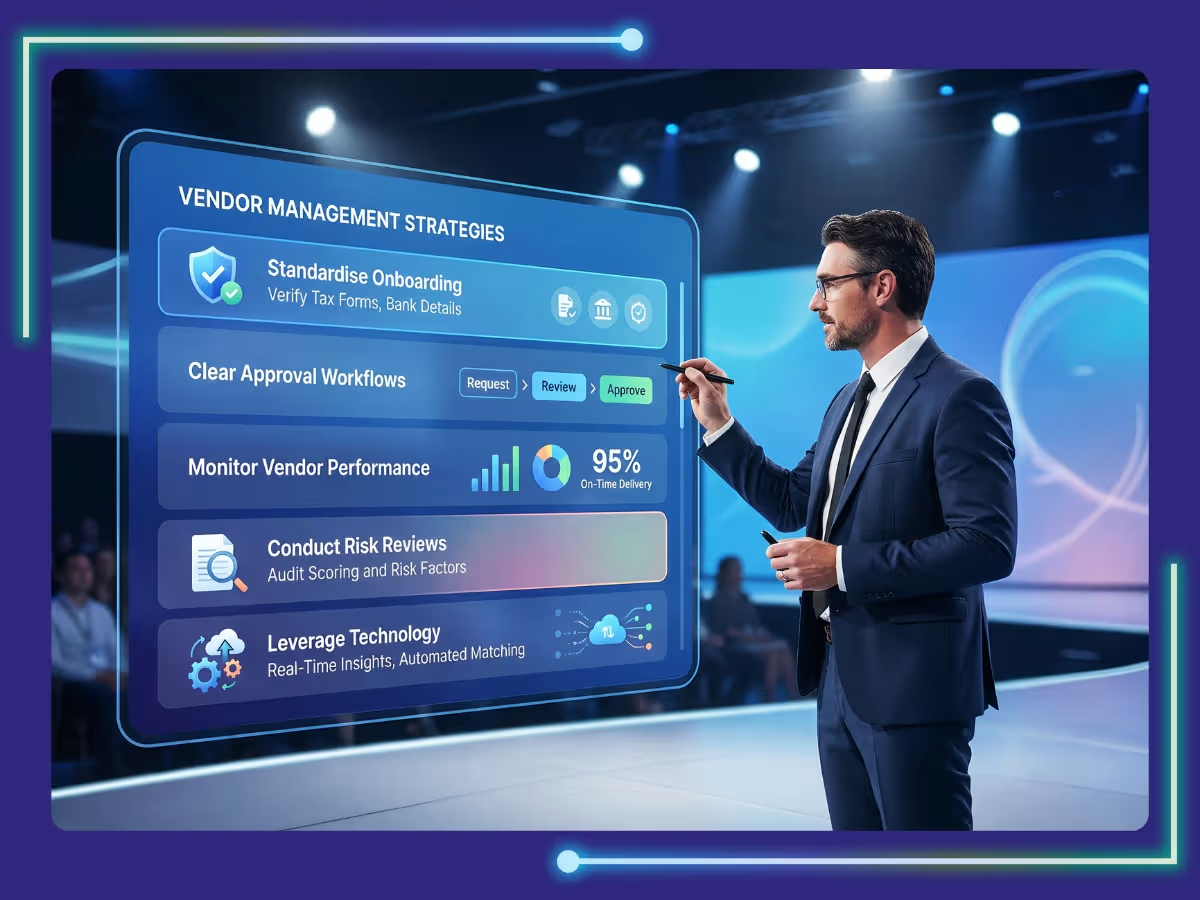
Knowing how to improve your vendor management process is the difference between reactive firefighting and proactive financial control. Here are five proven strategies that Australian businesses can implement immediately.

Centralise Your Vendor Data
The most common cause of AP errors, including duplicate payments, incorrect bank details, and missed ABN withholding, is fragmented vendor data. When supplier information lives across spreadsheets, email inboxes, and accounting software simultaneously, challenges in AP are inevitable.
Centralising your vendor master file into a single source of truth, whether in Xero, MYOB, QuickBooks AU, or Wiise, ensures that every team member references the same verified supplier details. Your vendor master should include the ABN, GST registration status, preferred payment method, bank account details, standard payment terms, and contact information.
Automate Accounts Payable Workflows
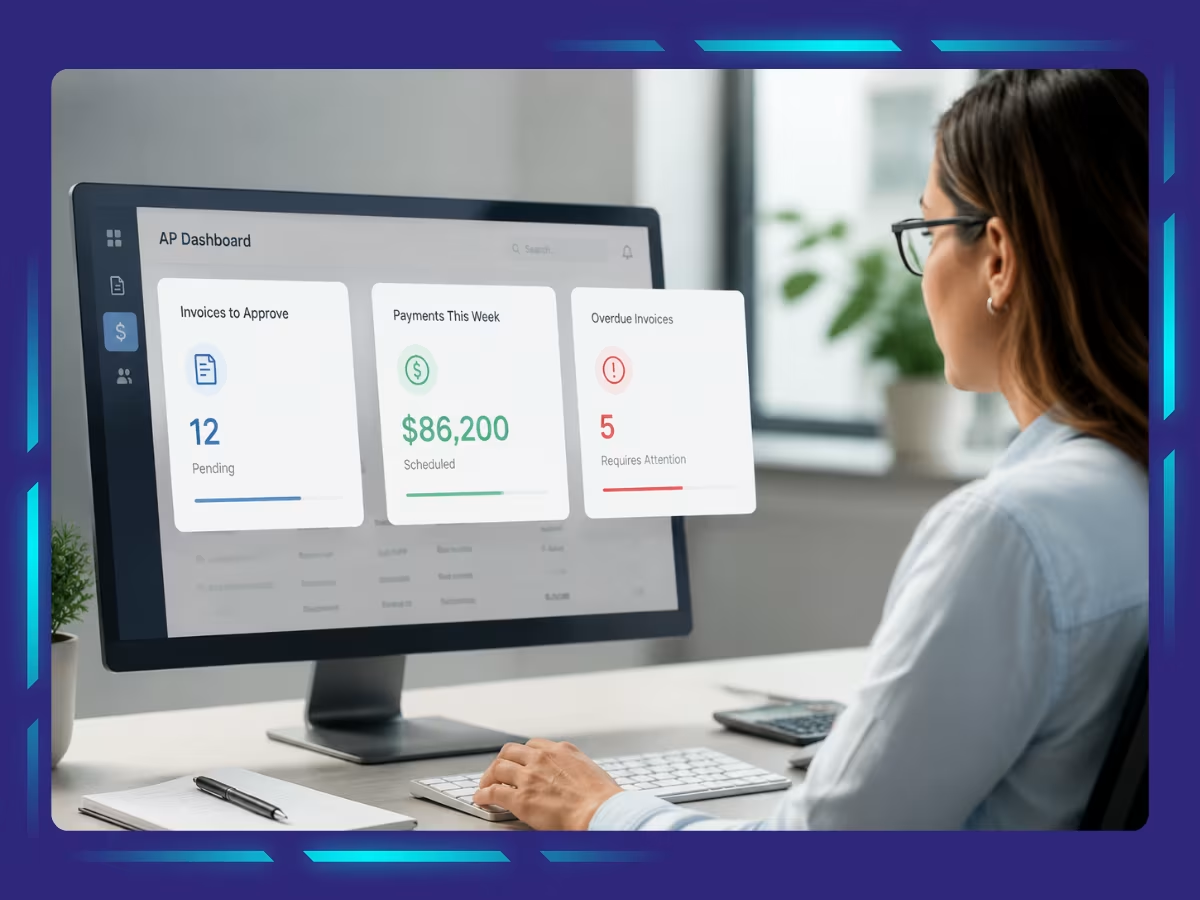
Manual data entry slows down processes and increases the risk of errors. Organisations that rely heavily on manual invoice processing often face higher operational costs, while automating accounts payable tasks can significantly streamline workflows. For Australian SMEs managing tight margins, reducing this overhead can make operations more efficient and manageable.
Automating your AP workflow means invoices are captured digitally (via OCR or supplier portal), matched automatically against POs and GRNs, routed for exception handling when discrepancies arise, and approved for payment within a defined workflow. Tools like Xero, MYOB Essentials, and Wiise (built on Microsoft Dynamics 365 and popular among mid-market Australian businesses) offer built-in AP automation features that handle the 3-way matching process at scale.
Accounting automation does not replace human oversight. It redirects it. Instead of manually keying in every invoice, your AP team focuses on resolving exceptions, managing supplier relationships, and improving process controls.
Standardise Vendor Onboarding Procedures
Inconsistent onboarding is a significant risk for Australian businesses. When a new vendor is set up without a standardised checklist, critical details get missed, including GST registration status, correct ABN, bank account verification, and approved payment terms. This creates downstream problems in accounts payable that are expensive to unwind.
A standardised onboarding procedure should include a vendor registration form, ABN verification, a signed supplier agreement (or at minimum, an accepted purchase order), bank account confirmation (consider using BPAY or direct debit verification), and an internal approval step before the vendor is activated in your system.
This standardisation also improves your supplier management process by ensuring every vendor starts the relationship on the same clear footing.
Implement a Formal Vendor Performance Review Cycle
Too many Australian businesses only evaluate suppliers reactively, when something goes wrong. A formal, quarterly or biannual vendor performance review transforms this reactive stance into a proactive one.
Your review cycle should assess delivery performance, invoice accuracy rates, responsiveness to queries, quality consistency, and compliance with agreed terms. Sharing performance data with your vendors is not confrontational. It is professional. Suppliers who understand your expectations are more likely to meet them, and those conversations often surface process improvements on both sides.
Documenting these reviews also creates an evidence trail that supports contract renegotiation and, where necessary, the vendor offboarding process.
Define and Enforce Clear Payment Approval Hierarchies
In many Australian businesses, particularly SMEs, payment approval processes are informal. An invoice arrives, someone approves it verbally, and it gets paid. This informality creates significant fraud and error risk.
Defining a clear approval hierarchy, where invoices under a certain threshold can be approved by a single authoriser and higher-value invoices require dual sign-off, dramatically strengthens your internal controls.
Pair your approval hierarchy with segregation of duties: the person who creates a vendor record should not be the same person who approves vendor payments. This simple control prevents a large proportion of accounts payable fraud.
What Are the Best Practices for Vendor Management?
Vendor management best practices in Australia reflect both global financial governance principles and the specific compliance obligations of doing business under Australian law.
Verify ABNs Before First Payment
Always verify that a vendor’s ABN is active and matches their registered legal name before processing any payment. If the vendor cannot provide a valid ABN or an exemption, you are required to withhold a portion of the payment.
Use Standardised Tax Invoices
Under Australian GST law, a valid tax invoice must include the supplier’s ABN, a description of goods or services, the GST amount (or a statement that the total includes GST), the date, and the total price. Accepting non-compliant invoices creates BAS reconciliation problems. See the ATO’s tax invoice requirements for full details.
Maintain a Vendor Approved List
Not every supplier request should be fulfilled. An approved vendor list (AVL) gives your procurement and AP teams a pre-vetted pool of suppliers to draw from, reducing onboarding delays and compliance risk.
Document Payment Terms Clearly
Australia’s standard commercial payment terms are 30 days from invoice date, though 60-day terms are common in construction and professional services. Whatever terms you agree upon, document them in your contract and reflect them in your accounting system to avoid late payment penalties.
Conduct Annual Vendor Audits
Reconcile your vendor master file at least annually to deactivate inactive suppliers, update changed ABNs, and correct banking details. This prevents misdirected payments, reduces chances to errors in vendor billing process, and fraud.
Train AP Staff on GST Compliance
GST misclassification, such as incorrectly claiming input tax credits on non-GST supplies or paying GST-inclusive amounts to non-registered vendors, is a common ATO audit trigger. Regular training keeps your AP team current with any changes to GST rulings.
Why Is Vendor Management Important for Small Businesses?
For small businesses in Australia, vendor management is like a financial survival tool. It is important for cash flow protection, GST compliance, fraud prevention, supplier relationship quality, and scalability.
Cash Flow Protection
When invoice discrepancies go undetected, businesses either overpay suppliers or delay payment while resolving disputes. Both outcomes damage cash flow. A structured vendor management process, anchored in 3-way matching, catches errors before payment is released.
GST Compliance
Small businesses registered for GST must maintain accurate records of all supplier transactions. The ATO can request these records during an audit, and poorly managed vendor data leads to incorrect BAS lodgements, interest charges, and penalties.
Fraud Prevention
Small businesses are often vulnerable to accounts payable fraud, including fake invoice scams and business email compromise. Reports indicate that many Australian businesses have experienced losses due to payment redirection and invoice fraud. Implementing a formal vendor approval process and maintaining segregation of duties are effective measures to reduce this risk.
Supplier Relationship Quality
Your best suppliers have choices. A business that pays accurately, on time, and communicates professionally retains preferred supplier status and often receives priority service, better pricing, and greater flexibility in lean periods.
Scalability
The vendor management processes you build as a small business become the foundation you scale on. Businesses that invest in proper vendor governance early avoid the costly, disruptive process overhauls that come with rapid growth.
What Are Vendor Management KPIs?
Measuring the performance of your vendor management process requires a clear set of key performance indicators (KPIs). The following table outlines eight essential KPIs, including formulas, that Australian AP and finance teams should track regularly.
| KPI | Description | Formula |
|---|---|---|
| Invoice Accuracy Rate | Percentage of invoices received without errors or discrepancies | (Accurate Invoices ÷ Total Invoices Received) × 100 |
| On-Time Payment Rate | Percentage of supplier invoices paid within agreed terms | (Invoices Paid On Time ÷ Total Invoices Paid) × 100 |
| 3-Way Match Success Rate | Percentage of invoices auto-matched without manual intervention | (Auto-Matched Invoices ÷ Total Invoices Processed) × 100 |
| Vendor Onboarding Lead Time | Average number of days from vendor request to active status | Total Onboarding Days ÷ Number of Vendors Onboarded |
| Invoice Processing Cost | Average cost to process a single supplier invoice end-to-end | Total AP Processing Costs ÷ Total Invoices Processed |
| Duplicate Payment Rate | Percentage of invoices paid more than once in a period | (Duplicate Payments ÷ Total Payments Made) × 100 |
| Supplier Query Resolution Time | Average days to resolve a supplier invoice or payment query | Total Query Resolution Days ÷ Number of Queries Resolved |
| Vendor Spend Under Management | Percentage of total supplier spend covered by approved contracts | (Contracted Spend ÷ Total Supplier Spend) × 100 |
How Does Vendor Management Affect Accounts Payable?
Vendor management and accounts payable are not separate functions. They are two sides of the same financial control coin. The quality of your vendor management process directly determines the efficiency, accuracy, and compliance of your accounts payable operation.
The 3-Way Matching Connection
3-way matching sits at the intersection of vendor management and accounts payable. It works by comparing three documents:
- Purchase Order (PO): Issued by your business, authorising a specific purchase at an agreed price and quantity.
- Goods Receipt Note (GRN): Confirming that the goods or services were actually received as ordered.
- Supplier Invoice: The vendor’s request for payment, which should reflect what was ordered and received.
When all three documents align, the invoice is approved for payment. When they do not, the exception is flagged for investigation before any funds are released.
The effectiveness of 3-way matching depends entirely on the quality of your vendor master data. If a vendor’s ABN is incorrect, their payment terms are not recorded, or their contact details are outdated, the matching process breaks down, either producing false positives (approving incorrect invoices) or false negatives (flagging correct invoices as exceptions).
Downstream Impacts on Financial Health
A well-run vendor management process improves accounts payable performance across several dimensions:
- Fewer Payment Errors: Verified vendor data and automated matching reduce the incidence of overpayments, underpayments, and duplicate payments.
- Better Cash Flow Forecasting: When payment terms are accurately recorded against each vendor, finance teams gain clearer visibility into weekly and monthly cash outflows, providing better guidance for cash flow forecasting and more reliable financial planning.
- Stronger GST Compliance: Accurate vendor records, particularly ABN and GST registration status, ensure that input tax credits are claimed correctly on your BAS, reducing ATO audit risk.
- Reduced AP Cycle Times: Automation and clean vendor data mean invoices move through the approval process faster, allowing businesses to capture early payment discounts where available.
- Audit Readiness: The ATO requires businesses to retain records of all supplier transactions for a minimum of five years. A centralised, well-maintained vendor management system means those records are accessible, accurate, and audit-ready at any time.
Optimise Vendor Relationships with Proven Expertise
Effective vendor management is not a one-time project. It is an ongoing discipline that connects supplier relationships directly to accounts payable accuracy, GST compliance, and business cash flow. For Australian businesses navigating ATO requirements, 3-way matching complexity, and the pressure to do more with lean teams, the gap between current practice and best practice often comes down to the right process and the right expertise.
Whiz Consulting works with Australian businesses of all sizes to design, implement, and optimise end-to-end accounts payable services that include vendor management solutions, from vendor onboarding frameworks and 3-way matching automation to KPI dashboards and ATO-compliant record-keeping systems. Our team brings deep expertise in Xero, MYOB, QuickBooks AU, and Wiise, giving you a partner who understands both the tools and the Australian compliance landscape. Contact Whiz Consulting today to discover how we can help your business pay the right supplier, the right amount, at the right time, every time.

Get customized plan that supports your growth

Have questions in mind? Find answers here...
Mistakes include not verifying ABNs, keeping fragmented or outdated vendor data, using informal approvals, neglecting performance reviews, failing to archive records, and risking duplicate payments across multiple channels.
Start with vendor registration capturing legal, tax, and payment details. Verify the ABN, centralise records in an accounting system, document approval workflows, and implement 3-way matching of POs, receipts, and invoices. Layer automation and monitoring later.
Vendor management focuses on financial controls and the payment lifecycle for third-party providers. Supplier management is broader, covering sourcing, contracting, and performance across the supply chain.
Outsourcing provides expert AP management, compliance adherence, and scalable support without full-time costs. It’s valuable for growing businesses, system transitions, or audit readiness.
Matching invoices to POs and receipts ensures only valid tax invoices are processed. It confirms goods/services are received and GST is correct, preventing errors and speeding up BAS reconciliation.
Thousands of business owners trust Whiz to manage their account
Let us take care of your books and make this financial year a good one.