


Table of Content
Share This Article
- Last Updated: Aug 11, 2026
- 🔊 Listen
TL;DR
- Australia’s evolving business environment is changing how companies access accounting support, as talent constraints, rising regulatory demands, and operational complexity drive the need for more flexible and scalable models.
- The definition of a good accountant has evolved beyond qualifications, placing greater emphasis on adaptability, system readiness, and consistent reliability.
- Proactive compliance management is essential as frequent changes to BAS, GST, STP Phase 2, superannuation, and ATO data-matching leave little room for reactive fixes.
- Technology now forms the foundation of effective accounting, with cloud platforms, automation, and AI enabling accuracy, real-time visibility, and efficient collaboration.
- Accounting has moved beyond bookkeeping, with businesses increasingly expecting forecasting, margin analysis, and decision-ready financial insights.
- Clear communication matters more than physical location, requiring accountants to remain aligned with operations and accessible when financial decisions are needed.
- Scalability has become a key decision factor, with online and virtual accounting models allowing Australian businesses to grow support smoothly without adding internal complexity.
By 2026, credentials alone no longer differentiate accounting providers. The profession’s baseline expectations have risen. Businesses now require accountants who can operate within an increasingly rigorous regulatory framework, adapt to continuous compliance evolution, and deliver dependable support despite persistent talent shortages across the sector.
What matters now is capability under pressure: the ability to scale without compromising quality, to maintain compliance across shifting requirements, and to provide consistent, insight-driven support that keeps pace with business needs.

Experience Seamless Accounting
Enhance Accuracy and Efficiency with a Virtual Accountant
Must-Have Skills of an Accountant in 2026
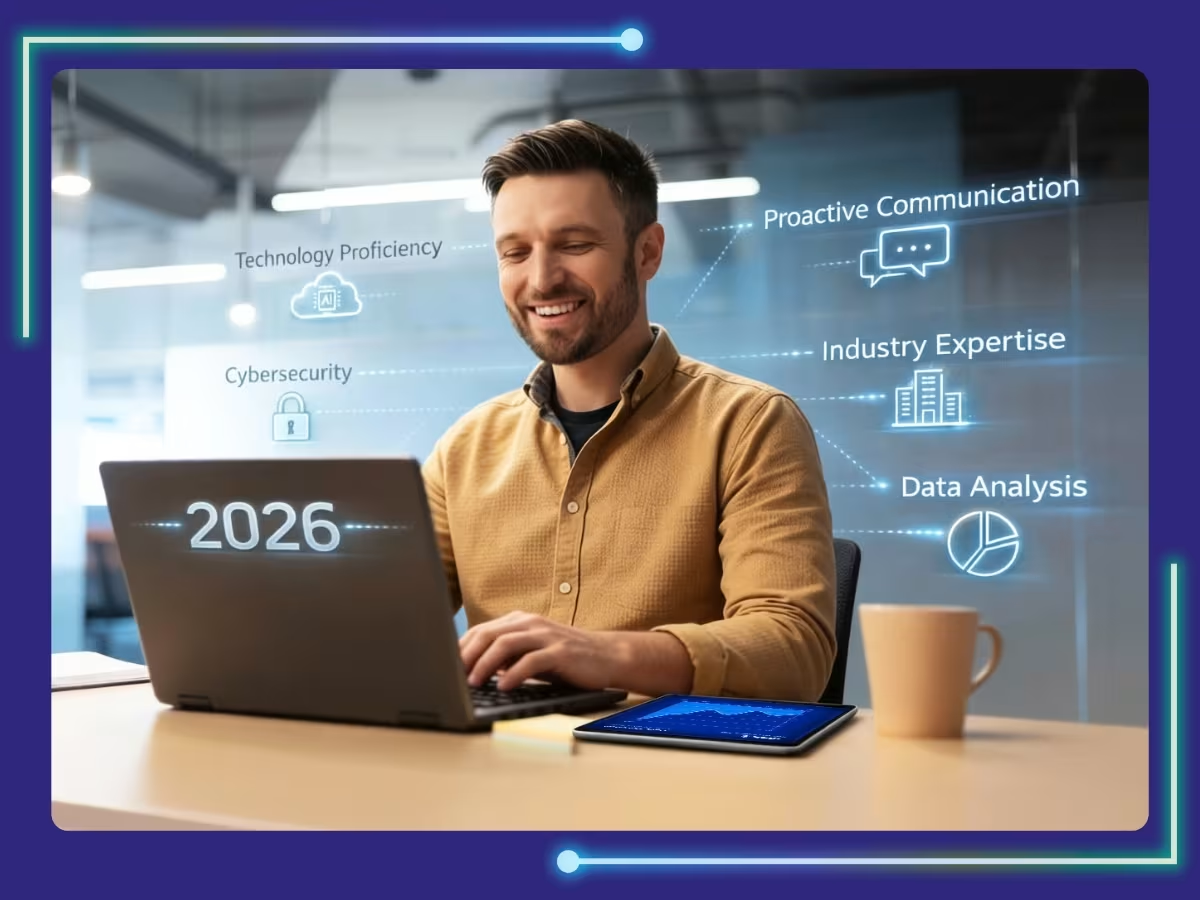
The skills that defined accounting excellence a decade ago are no longer sufficient. Today’s accountants must combine regulatory mastery with technological fluency, strategic thinking with operational precision, and compliance rigour with advisory capability all while delivering comprehensive accounting services within distributed, technology-enabled delivery models.
1. Command of Australia’s Evolving Compliance Environment
Expanded reporting obligations, enhanced ATO data-matching capabilities, and stricter enforcement protocols mean regulatory missteps carry greater consequences than in previous years. The right accountant doesn’t simply respond to regulatory change; they anticipate it, translating complex obligations into clear operational guidance before issues arise.
This means:
- Proactive monitoring of changes across BAS reporting, GST treatment (including nuanced areas like mixed supplies and adjustments), and PAYG instalment variations
- Active management of Single Touch Payroll Phase 2 compliance, including detailed income classifications, employment condition reporting, and correct contractor categorisation
- Close tracking of superannuation guarantee rate changes, contribution deadlines, and expanded reporting expectations under strengthened ATO enforcement
- Strategic interpretation of ATO data-matching programs, covering bank interest, payroll, contractor payments, cryptocurrency, and payment platforms to identify exposure before it becomes problematic
- Embedded process updates that align internal controls with regulatory shifts proactively, rather than correcting issues retrospectively
2. Technology Fluency as a Baseline Capability
In 2026, technological competence is a fundamental requirement. Modern accounting increasingly relies on AI in accounting, alongside cloud platforms, automation, and intelligent workflow tools to maintain accuracy, reduce manual workload, and deliver real-time financial visibility across distributed operating models. Whether you choose an in-house or an online accountant, they must:
- Operate fluently across cloud accounting platforms including Xero, MYOB, NetSuite, Microsoft Dynamics, and QuickBooks Online, enabling real-time data access and controlled client visibility
- Deploy automated reconciliation tools and bank feeds to minimise manual entry errors and improve data integrity
- Leverage AI-assisted categorisation and exception flagging within modern software to identify inconsistencies early and reduce cleanup work
- Shift from month-end-heavy processing to continuous transaction management, reducing delays and improving reporting responsiveness
- Enable seamless remote collaboration through shared dashboards, cloud-based document management, and live reporting access
3. Proactive Compliance Management, Not Reactive Firefighting
The distinction between proactive and reactive compliance has become more pronounced. As ATO scrutiny of SMEs and privately owned businesses intensifies, waiting until lodgement deadlines to address compliance issues introduces unnecessary risk and operational disruption. The ideal accountant builds compliance into ongoing operations by:
- Establishing forward-planned lodgement schedules for BAS, IAS, and payroll obligations to eliminate last-minute pressure
- Conducting regular compliance reviews rather than correcting issues after reporting periods close
- Preparing businesses for ATO reviews and data-matching enquiries by maintaining current, traceable documentation year-round
- Identifying exposure early across payroll reporting (STP Phase 2), GST treatment, contractor payment classifications, and PAYG obligations
- Embedding compliance controls into day-to-day workflows to reduce manual intervention and ongoing stress

4. Financial Analysis That Supports Decision-Making
Bookkeeping accuracy remains essential, but in 2026, businesses expect their accountants to convert that accuracy into insight. The value now lies in translating financial data into analysis that directly informs operational decisions, profitability planning, and strategic direction. This includes:
- Cash flow forecasting aligned with trading cycles, seasonal patterns, and funding requirements
- Margin and cost analysis that identifies profitability gaps, pricing vulnerabilities, and cost-control opportunities
- Scenario and sensitivity modelling to assess the impact of growth plans, cost changes, or economic uncertainty
- Clear translation of complex financial results into decision-ready insights for owners and leadership teams
- Regular performance reviews that track trends, highlight variances, and support proactive management decisions
5. Communication Clarity and Operational Integration
Remote and hybrid work models are now standard across professional services. For accounting relationships, this has elevated communication from a soft skill to a critical operational requirement. This allows businesses to work confidently with virtual accountants who remain fully integrated into daily financial operations, regardless of location. Effective accountants, whether in-house or operating remotely:
- Communicate financial outcomes in clear, business-focused language that supports decision-making, not technical jargon
- Align reporting schedules with operational timelines and cash flow cycles to maximise relevance
- Maintain consistent response times and service standards within distributed working models
- Use structured communication channels to ensure clarity, accountability, and proper documentation
- Enable seamless collaboration without dependence on physical presence
6. Structured, Secure Digital Record-Keeping
ATO expectations around data accuracy, record retention, and audit trails continue to rise. Businesses can no longer rely on ad hoc filing systems or inconsistent documentation practices. The right accountant maintains structured, secure digital records that support compliance, streamline reporting, and reduce risk during ATO interactions. This involves:
- Implementing cloud-based document management systems for financial records, source documents, and supporting evidence
- Maintaining clear audit trails, version control, and change histories to meet ATO review requirements
- Ensuring secure access controls, including role-based permissions and data protection protocols
- Supporting ATO record-retention obligations through automated storage and retrieval
- Minimising data loss, duplication, and compliance risk through consistent documentation standards
Partner With an Ideal Accountant Who Supports Financial Growth
The decision of how to find the best accountant in 2026 comes down to capability, reliability, and alignment with your business trajectory. The accountants delivering the most value are those who combine compliance rigour with strategic insight, leverage technology to maintain responsiveness, and remain operationally integrated regardless of location.
With the right partner, you can streamline financial operations, improve decision-making, and build a foundation for sustainable growth. At Whiz Consulting, our expert virtual accounting services are designed to meet these evolving demands, delivering scalable, compliance-focused support that grows alongside your business.
Ready to elevate your financial operations? Partner with Whiz Consulting today.

Get customized plan that supports your growth

Have questions in mind? Find answers here...
Yes, in most cases. You avoid fixed overheads like in-house salaries, superannuation, leave entitlements, and office costs. You pay only for the work required, which keeps accounting costs flexible as your business scales.
Absolutely. An experienced accountant can manage BAS lodgements, GST, PAYG withholding, STP Phase 2 payroll reporting, and year-end compliance, all aligned with ATO and Australian accounting standards.
Common platforms include Xero, QuickBooks Online, MYOB, and for larger or complex businesses, NetSuite or Zoho Books. Most Australian-focused accountants work within your existing system.
Look for experience with Australian businesses, knowledge of ATO obligations, strong software capability, clear communication, and reliable reporting. A short trial or sample report is a smart way to assess fit.
Yes, when you work with reputable providers. They use encrypted cloud platforms, role-based access, NDAs, secure data storage, and internal controls to protect sensitive financial information and meet Australian data security expectations.
Thousands of business owners trust Whiz to manage their account
Let us take care of your books and make this financial year a good one.