


Table of Content
Share This Article
- Last Updated: Jul 31, 2026
- 🔊 Listen
TL;DR
- Businesses with an annual turnover exceeding £90,000 must register for VAT, charge it on sales, file quarterly returns to HMRC, and may reclaim VAT on business-related purchases.
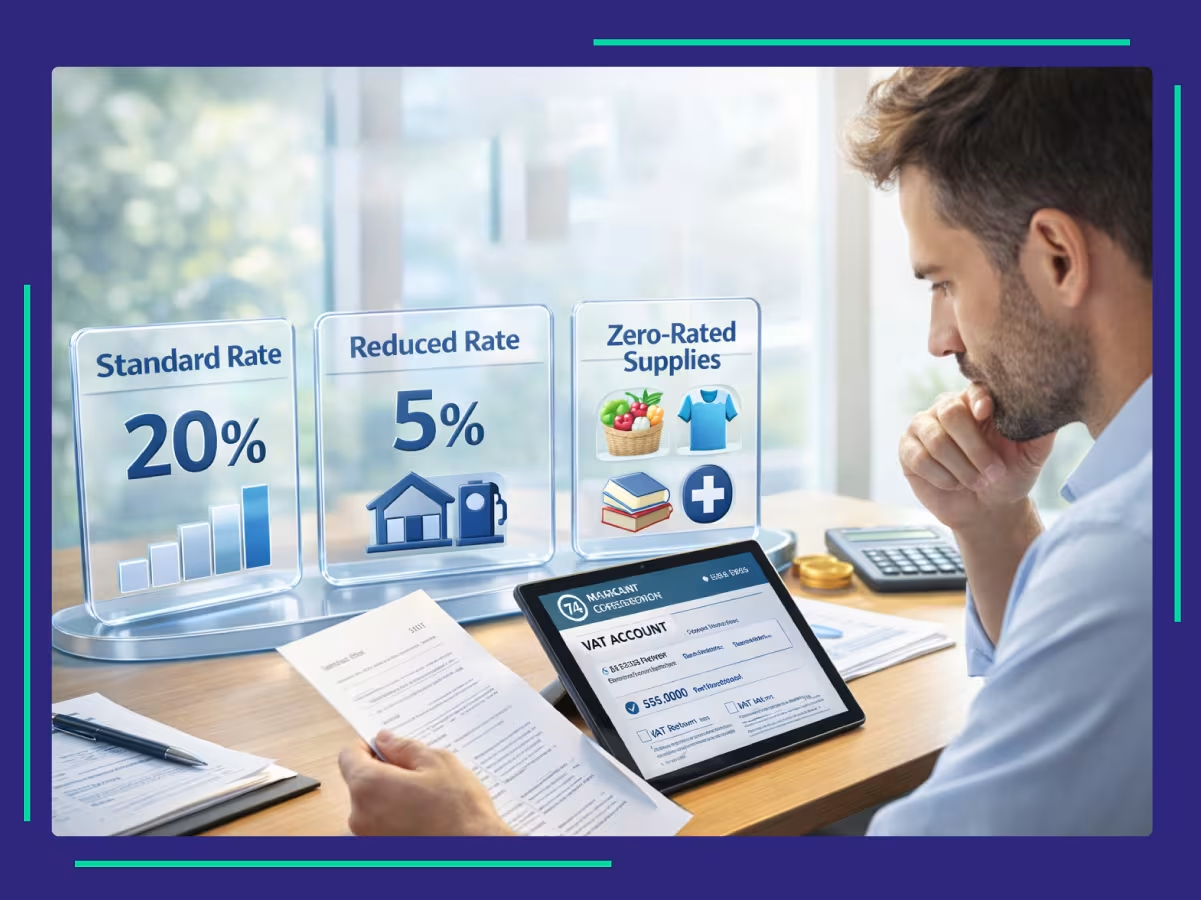
- VAT is applied based on the nature of the goods or services, and different rates include Standard Rate (20%), Reduced Rate (5%), and Zero-Rated.
- Five common VAT schemes cater to different business needs including Flat Rate scheme, Annual Accounting scheme, Cash Accounting scheme, VAT Retail scheme, and VAT Margin scheme.
- While VAT schemes offer flexibility, each comes with its own limitations. Selecting the most appropriate one depends on your business type, revenue model, and cash flow.
- Consulting with a VAT expert or accountant ensures compliance, efficiency, and optimal tax savings.
UK VAT Rates & VAT Schemes: All You Need to Know About It
Whether you are launching a new venture or scaling an established business in the UK, understanding how VAT rates apply to your operations is essential. VAT is not just a regulatory requirement, it directly affects how you price your products or services, manage your margins, and plan your cash flow. You need to know when to register and how much to charge and only then can you select the most suitable VAT scheme.
In this blog, we walk you through UK VAT rates and key VAT schemes in a clear and practical manner, helping you stay compliant while making smarter financial choices for your business.

Payroll Outsourcing Done Right!
Streamline Pay Runs, Save Time & Stay Compliant.
What is VAT?
VAT or Value-Added Tax was introduced in 1973. VAT is a tax on purchasing goods or services and other taxable supplies. Consumers and manufacturers ultimately pay the tax amount, not the manufacturers or producers. The businesses collect and pay it to Her Majesty’s Revenue and Customs (HMRC).
Thus, VAT is an indirect tax because the businesses collect it on behalf of the government. A business over this threshold must be registered to charge VAT on all the goods and services offered.
While the end consumer ultimately bears the cost, businesses play a crucial role in the process. They collect VAT on sales, remit it to HMRC, and reclaim VAT on eligible business expenses, making a clear understanding of VAT essential for compliance, cash flow management, and financial stability.
Types of VAT Rates in the UK
There are namely four main VAT rates, depending on the type of goods or services that are supplied: the standard rate (20%), the reduced rate (5%), zero-rated supplies, and exempt supplies. These rates are further defined below for clearer understanding.
1. Standard Rate (20%)
It is charged mostly on all goods or services and other taxable supplies, such as electronics, hotel stays, furniture, restaurant means, and professional services (except those covered under reduced rate and zero-rated supplies).
2. Reduced Rate (5%)
It is charged on children’s car seats, electricity, natural gas, district heating supplies (for domestic purposes only), LPG and heating oil (for domestic purposes only), and mobility aids for the elderly.
3. Zero-Rated Supplies
Zero-rated VAT supplies include goods and some particular services, such as basic fresh produce, equipment for disabled people, construction of new buildings for charitable purpose, and advertising services for charities.
It includes the following categories:
- Food and drinks
- Health, Education, Welfare, and Charities
- Printing, Postage, and Publications
- Children’s Clothing and Footwear, Protective and Safety Equipment
4. Exempt Supplies
A business that sells only VAT-exempt items that cannot be registered under VAT is known as a VAT-exempt business. It includes some of the following items:
- Insurance
- Health Services
- Granting Credit Loans
- Leisure Activities
- Antiques
- Charitable Fundraising Events
- Financial Services & Investments
- Physical Education & Sports Activities
The list mentioned above is not exhaustive. To understand in detail, contact your tax consultant or refer to www.gov.uk for further information.

Key VAT Schemes
VAT schemes are designed to help UK businesses improve their finances and cash flow management. The main schemes include the Flat Rate, Annual Accounting, Cash Accounting, Retail, and Margin scheme.
1. Flat Rate Scheme
In this scheme, a business only calculates the VAT paid to HMRC as a percentage of the annual turnover. The actual flat rate to be used by businesses depends on the industry. Since the businesses pay VAT to HMRC at a flat rate, they can keep the difference if more VAT is collected from the customers.
Unlike the standard VAT accounting, business owners cannot reclaim VAT paid on purchases except for capital assets worth more than £2,000. The eligibility to use the Flat Rate Scheme is that a business must be VAT registered with a turnover of less than £150,000 (excluding VAT).
Benefits:
- No need to record VAT charged on every sale and purchase.
- 1% reduction in the flat rate percentage for the first year of VAT registration.
- Businesses get a sense of certainty because they always know what percentage is to be paid to the HMRC.
2. Annual Accounting Scheme
VAT is paid on account in this scheme, suggesting that VAT can be either paid in nine monthly or three quarterly instalments. After that, a single annual VAT return is submitted. However, a scheme like this would not suit a business that reclaims VAT regularly because that particular business will get one refund a year (when it submits the VAT return).
The eligibility to join the Annual Accounting Scheme is when the estimated VAT taxable turnover is £1.35 million or less. It is intended to help with the budgeting and cash flow and minimise paperwork.
Benefits:
- Only a single VAT return is to be submitted.
- Buinesses get to know about the cash flow in advance.
- VAT returns can be prepared at the same time as the annual accounts.
3. Cash Accounting Scheme
In this scheme, VAT is recorded based on payments made or received. The VAT Cash Accounting Scheme follows the principles of cash accounting, which means that income is recorded as soon as it is received, and expenses are recorded in the period they are paid.
However, a business need not inform HMRC to join the Cash Accounting VAT Scheme. A business willing to join must do so at the start of a new VAT accounting period. Similarly, if a business leaves the scheme, it must be done at the end of the accounting period.
4. VAT Retail Scheme
In this scheme, businesses calculate the VAT dues by various methods. Using VAT retail scheme, businesses can calculate the value of total taxable sales for a particular period.
Further, businesses can join VAT retail schemes at the beginning of any VAT period, and there is no compulsion to inform HMRC about it. However, businesses cannot use a VAT retail scheme with flat rate schemes. Three standard VAT retail schemes exist under it, including the point-of-sale scheme, apportionment scheme, and direct calculation scheme.
5. VAT Margin Scheme
A scheme like this can be used by business owners who sell second-hand goods, works of art, antiques, and other collectors’ items. This scheme is used to tax the difference between the amount a business pays for specific items and the amount in which those items are sold.
A VAT at the rate of 16.67% is applicable on this difference. To use the scheme, businesses do not have to apply anywhere but rather keep a record of sales and purchases. A business that sells high volumes of low-priced qualifying items may be eligible to use a simplified VAT margin scheme known as a global accounting scheme.
Partner with Experts & Stay Updated with Changing VAT Rates
While each VAT rate in UK offers its own advantages and limitations, you must be careful when calculating the rates. Evaluate your business structure, cash flow, and growth plans and then decide which accounting service provider is right for you.
With the right professional guidance, VAT compliance can become a strategic advantage rather than a complication. We at Whiz Consulting help businesses assess their VAT position, select the most appropriate scheme, and manage their accounting and bookkeeping efficiently.

Get customized plan that supports your growth

Have questions in mind? Find answers here...
We have 11+ years of experience in supporting varied industries across e-commerce, hospitality, healthcare, real estate, and marketing agencies, helping businesses prepare accurate VAT data and reports for compliant submissions.
Yes. We ensure your records are MTD-ready, so you can seamlessly report VAT to HMRC. Experience smooth tax advisory assistance with our experts and focus on growing your operations.
We automate reconciliations, multi-level reviews, and audit trails to validate figures before submission, ensuring accuracy all the while aligning with HMRC guidelines.
You’ll work with a dedicated account manager and collaborate over email, Teams, Meet, Zoom, or Slack, with regular check-ins and real-time access to reports and supporting documentation.
Thousands of business owners trust Whiz to manage their account
Let us take care of your books and make this financial year a good one.




This website uses cookies to improve your experience. You can accept all or reject non-essential cookies.