

Table of Content
Share This Article
- Last Updated: Aug 24, 2026
- 🔊 Listen
TL;DR
- Timing is critical, as deductions like bad debts are only valid if they are formally written off in the accounts before 30 June.
- GST errors, including incorrect coding or claiming credits without valid tax invoices, are among the most common triggers for ATO scrutiny.
- All financial data across STP, payroll, BAS, and financial statements must align, as even small mismatches can raise red flags.
- Proper documentation is essential, with every adjustment, deduction, and transaction needing clear supporting evidence to withstand review.
- Maintaining a strict separation between personal and business expenses is crucial, as misclassified costs are easily identified and often disallowed.
- Year-end adjustments, such as inventory changes or prior-year corrections, must be justified, consistent, and properly recorded to avoid suspicion.
- Consistency in accounting methods, reporting practices, and reconciliations helps reduce compliance risks and keeps your business off the ATO’s radar.
As 30 June approaches, year-end accounting mistakes that trigger ATO scrutiny are usually mismatches between reported income, GST, payroll, superannuation, deductions, and business records. In FY 2025-26, these errors are easier for the ATO to detect because data from STP, BAS, banks, and digital records can be cross-checked more quickly.
Most businesses do not attract attention because of deliberate fraud. They are often flagged because EOFY work is rushed, reconciliations are incomplete, or expenses are classified incorrectly. This blog explains seven common year-end accounting mistakes Australian businesses should fix before 30 June to support cleaner reporting, stronger compliance, and a smoother EOFY close.

Stop ATO Scrutiny Before It Starts
Missed deductions · Wrong GST · Unreconciled accounts
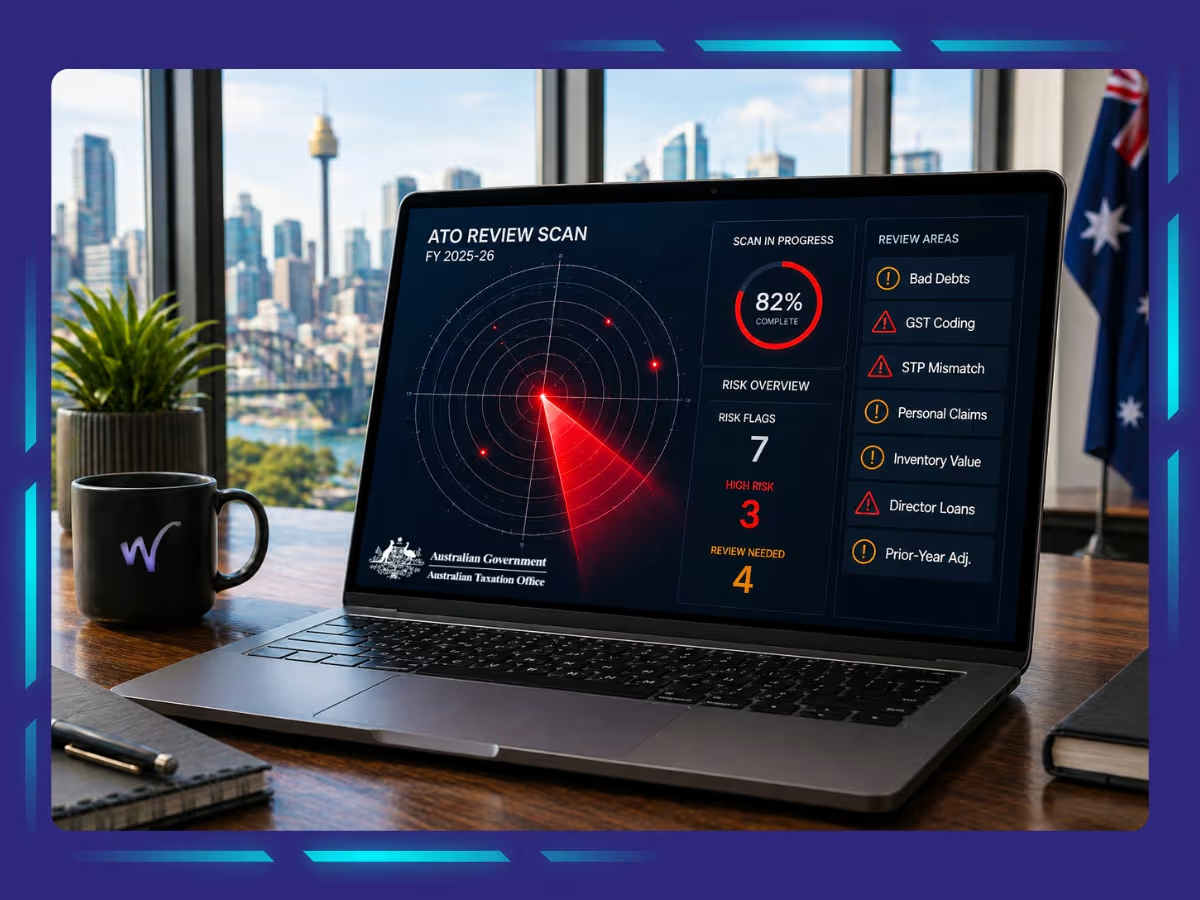
Mistake 1: Bad Debts Not Written Off Before 30 June
Bad debts may qualify as tax deductions for Australian businesses only when they are formally written off before the end of the financial year. Identifying a debt as unrecoverable is not enough. It must be recorded in the accounts within the same financial year. If this step is missed, the deduction may be deferred or, in some cases, disallowed.
Why it triggers scrutiny
The ATO examines the timing of income recognition and subsequent write-offs. If a deduction is claimed without a corresponding write-off entry dated before 30 June, it creates a mismatch.
Example
A business raises an invoice of $20,000 in December 2025 and reports it as income. By June 2026, the customer has not paid, and recovery attempts have failed. However, the business delays writing off the debt until July 2026. In this case, the bad debt deduction cannot be claimed for FY 2025–26.
What to do
- Review outstanding receivables before year-end
- Document recovery attempts (calls, emails, formal demand letters)
- Pass formal write-off entries before 30th June
Mistake 2: Incorrect GST Coding
GST errors are one of the most common reasons businesses come under ATO review. Incorrect coding affects Business Activity Statements and can lead to over-claimed credits or under-reported liabilities.
Why it triggers scrutiny
The ATO compares GST reported in BAS with underlying transaction data. Inconsistent patterns, especially repeated errors, raise compliance concerns.
Common issues
- Claiming GST on expenses that are input-taxed or GST-free
- Misclassifying taxable and non-taxable sales
- Claiming input tax credits without valid tax invoices
Example
A business claims GST credits on bank charges and interest expenses. These items do not include GST, resulting in inflated input tax credits.
What to do
- Run a GST coding audit across your chart of accounts
- Verify that high-volume expense categories are correctly mapped in your accounting system
- Ensure every input tax credit claim is backed by a valid tax invoice dated in the correct period
- Conduct periodic GST reviews, ensure accurate tax code mapping in accounting systems, and verify that all claims are supported by valid documentation.
Mistake 3: STP Figures Not Matching Payroll Records
Single Touch Payroll has made payroll discrepancies visible in real time. There is no longer anywhere to hide a mismatch. Since Single Touch Payroll became mandatory, the ATO receives payroll data; wages, PAYG withholding, and superannuation, each time you process a pay run. That data is then cross-referenced against your financial statements and BAS lodgements.
Why it triggers scrutiny
Differences between STP submissions, payroll reports, and financial statements indicate reporting inaccuracies. These inconsistencies often lead to further investigation.
Common mismatches
- PAYG withholding discrepancies
- Superannuation not aligned with reported wages
- Incorrect year-end STP finalisation
Example
A company’s financial statements show total wages of $520,000, while STP reports only $495,000. This gap signals incomplete or incorrect reporting.
What to do
- Reconcile STP submissions to your payroll records and general ledger before finalisation
- Confirm superannuation accruals are correctly recorded and align with actual contributions
- Complete STP year-end finalisation accurately
Mistake 4: Personal Expenses Claimed as Business Costs
Blurring the line between personal and business expenses is a common EOFY issue, especially in closely held businesses.
Why it triggers scrutiny
The Australian Taxation Office uses data matching and behavioural analysis to flag expenses that don’t align with business activity. Repeated misclassification increases the risk of audits and penalties.
Common examples
- Personal travel recorded as business travel
- Private vehicle expenses claimed without proper logbooks
- Household costs included as business expenses
Example
A director claims family holiday expenses as a business deduction without demonstrating a clear business purpose. These claims are typically disallowed and may attract penalties.
What to do
- Clearly separate personal and business expenses using dedicated business accounts and cards
- Maintain a compliant logbook for any vehicle-related claims
- Document the business purpose for all travel and entertainment expenses
- Apportion home and mixed-use expenses accurately, based on actual business usage
- Review expense classifications regularly before EOFY to catch and correct errors early
Mistake 5: Unjustified Inventory Valuation Changes
Inventory valuation directly impacts cost of goods sold and taxable income. Any change in valuation method must be justified and consistently applied.
Why it triggers scrutiny
Significant year-end adjustments that reduce taxable income can raise concerns, particularly if they lack supporting documentation or deviate from prior methods.
Common issues
- Switching valuation methods without rationale
- Writing down inventory without evidence of obsolescence
- Inflating closing stock to manipulate profits
Example
A retailer reduces inventory value by 30 percent at year-end without documenting damage, expiry, or slow-moving stock analysis. This adjustment is likely to be questioned.
What to do
- Conduct a physical stocktake and retain supporting records
- Document any write-downs with evidence: condition reports, photos, supplier communications, or market analysis
- If changing valuation methods, record the reason and obtain accounting advice before lodgement
Mistake 6: Undocumented Director or Shareholder Loans
Loans between a company and its directors or shareholders must be properly structured and documented in line with Division 7A rules, especially as EOFY approaches.
Why it triggers scrutiny
The Australian Taxation Office closely reviews director loan accounts. Non-compliant or undocumented loans can be treated as unfranked dividends, leading to unexpected tax liabilities.
Common issues
- No formal loan agreement
- No interest charged
- No defined repayment terms
Example
A director withdraws funds from the company during the year without recording them as salary, dividends, or a formal loan. Without proper documentation, the ATO may treat these withdrawals as taxable income.
What to do
- Put a compliant Division 7A loan agreement in place before the company tax return lodgement date
- Charge interest at or above the ATO benchmark rate
- Set clear repayment terms, including minimum yearly repayments
- Record all director withdrawals accurately as salary, dividends, or loans
- Review director loan accounts before EOFY to ensure compliance and avoid reclassification
Mistake 7: Prior-Year Adjustments Not Updated Correctly
Adjustments relating to previous financial years must be handled carefully. Errors here can affect both current and historical reporting.
Why it triggers scrutiny
The ATO reviews amended figures and reconciles them with prior lodgements. Poorly documented adjustments create inconsistencies across reporting periods.
Common issues
- Adjusting prior-year figures without explanation
- Failing to amend previously lodged returns where required
- Incorrectly posting adjustments in the current year
Example
A business identifies an expense omission from FY 2024–25 but records it entirely in FY 2025–26 without disclosure. This distorts financial results and may require amended filings.
What to do
- Review prior-year accounts for any known omissions or misclassifications.
- Consider using catch-up bookkeeping services to identify missing transactions, reconcile overdue accounts, and restore complete financial records.
- Determine whether a formal amendment is required, as material errors in lodged returns generally need to be corrected.
- Where adjustments are made in the current year, disclose them clearly in the financial statements and seek advice on whether an amended return is also required.
Partner with Professionals Who Keep Your Numbers Clean and Compliant
As EOFY approaches, many Australian businesses focus on closing their books quickly, often overlooking accuracy, reconciliation, and proper documentation before the 30 June deadline. Following a thorough EOFY accounting checklist can help businesses identify inconsistencies, complete necessary adjustments, maintain accurate records, and reduce compliance risks that may attract ATO attention.
A structured EOFY close changes this completely. With timely reconciliations, accurate adjustments, and alignment across GST, payroll, and financial reports, your numbers are not just complete, they are reliable and audit-ready.
At Whiz Consulting, we help Australian businesses manage year-end accounting with precision and consistency; ensuring your records are clean, compliant, and fully aligned with ATO requirements, so you can close the year with confidence and step into the next with complete financial clarity.

Get customized plan that supports your growth

Have questions in mind? Find answers here...
The ATO cross-checks data from bank feeds, payroll systems, Single Touch Payroll (STP), and BAS submissions to identify inconsistencies. Any mismatch between reported income, GST, or payroll figures can quickly trigger reviews or audits.
Regular bank reconciliation ensures your recorded transactions match actual bank activity. It helps catch missing income, duplicate entries, or misclassifications early, reducing the risk of discrepancies flagged by the ATO.
At a minimum, businesses should review their chart of accounts annually before year-end. However, quarterly reviews are more effective to keep classifications accurate and aligned with reporting and tax requirements.
Automation tools minimise manual errors by streamlining data entry, categorisation, and reconciliations. They also create consistent audit trails, making it easier to maintain accurate records and respond to ATO queries.
Businesses should verify that all expenses are valid, properly documented, and correctly classified. This includes ensuring receipts are available, personal expenses are excluded, and GST treatment is accurate.
Use standardised accounting processes, consistent chart of accounts, and centralised reporting systems. Regular intercompany reconciliations and consolidation reviews also help maintain accuracy across entities.
Key documents include invoices, receipts, bank statements, payroll records, contracts, asset purchase details, and prior tax filings. Keeping organised, complete records ensures you can substantiate all claims if reviewed by the ATO.
For the June quarter, covering April to June, most Australian businesses need to lodge and pay their BAS by 28 July. However, your exact due date may vary if you lodge electronically or through a registered BAS or tax agent. Before lodging, reconcile sales, GST, PAYG withholding, expenses, and bank transactions to avoid reporting mismatches.
You cannot fully guarantee avoiding an ATO review, but you can reduce the risk by keeping clean records, reconciling bank accounts, matching BAS with sales and payroll data, claiming only valid deductions, reviewing GST codes, finalising STP correctly, and fixing errors before 30 June. The key is to ensure your reported figures are consistent across your accounting system, BAS, payroll, and supporting documents.
Thousands of business owners trust Whiz to manage their account
Let us take care of your books and make this financial year a good one.