


Table of Content
Share This Article
- Last Updated: Nov 19, 2026
- 🔊 Listen
TL;DR
- AI accounting risks often stem from poor implementation, inadequate employee training, weak security controls, and unverified outputs.
- Businesses can protect financial information through data encryption, access controls, vendor assessments, and employee training.
- Human oversight, regular monitoring, and audit trails help maintain accounting accuracy, regulatory compliance, and accountability.
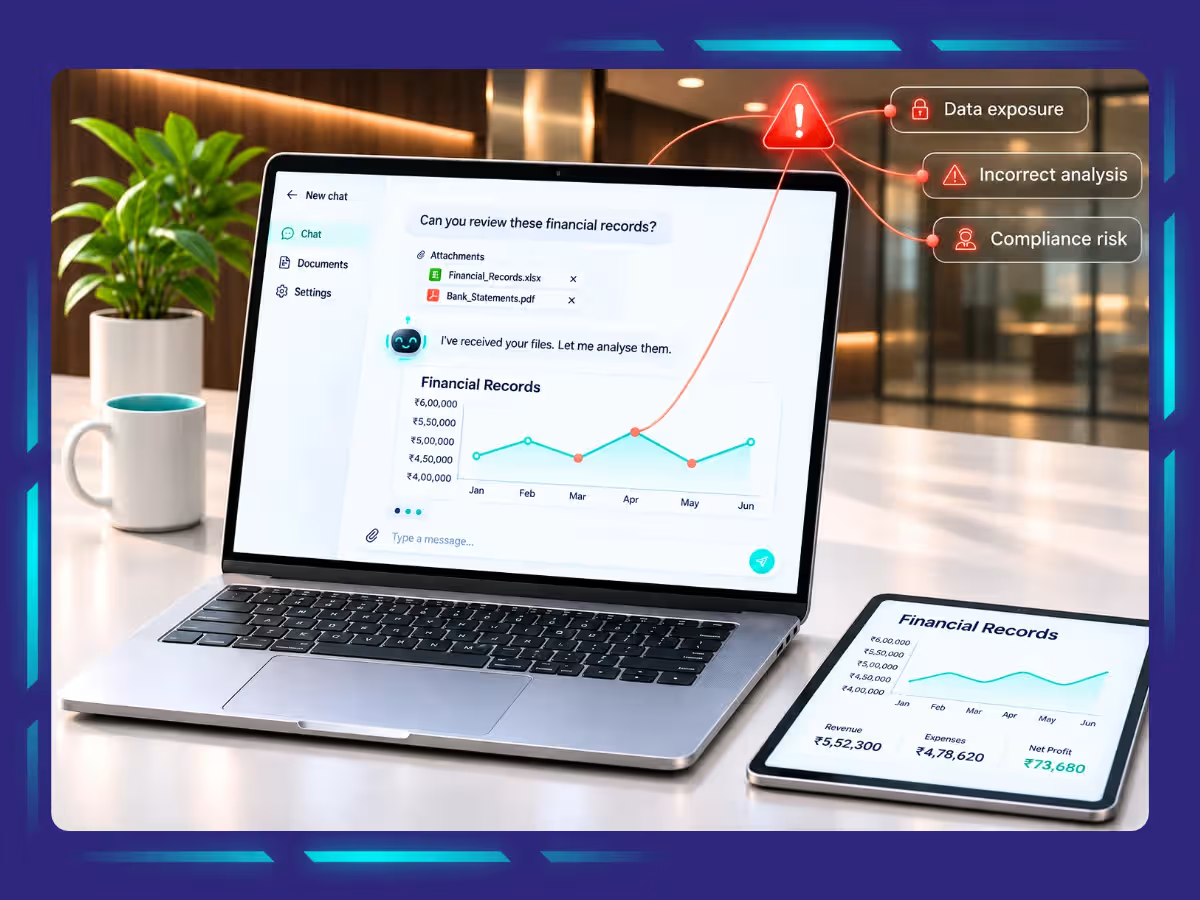
AI in accounting can expose sensitive financial records, misclassify transactions, and produce incorrect tax or reporting information if AI systems are poorly configured or used without appropriate accounting expertise. Further, the risks associated with inappropriate use of AI in accounting extend to how vendors store financial data, use it to train AI models, and transfer it across borders.
This blog examines these risks and practical ways to protect accounting data. It also explains where accountants must review AI outputs before they affect financial records or compliance decisions.

Use AI with Confidence
Automate accounting securely with our AI-skilled accountants!
What are the main risks of AI in accounting?
The main risks of AI in accounting include financial data exposure, inaccurate outputs or hallucinations, limited transparency, compliance gaps, and overdependence on automation. These risks typically arise when businesses use AI tools without proper training, data security controls, or human oversight. Without clear usage guidelines and output verification, businesses risk compromising financial accuracy, confidential information, and regulatory compliance.

-
Errors and AI Hallucinations
AI-generated accounting errors often become a problem when finance teams accept outputs without checking their accuracy. Generative AI can produce plausible but incorrect figures, misclassify transactions, or invent explanations when users provide incomplete instructions.
For example, an accountant might ask an AI tool to categorise bank transactions without providing the company’s chart of accounts or sufficient transaction context. The tool could classify a director’s personal withdrawal as a business expense and present the recommendation confidently. If the accountant posts it without checking the underlying transaction, the error enters the books.
The risk increases when businesses:
- Use vague prompts without providing relevant accounting context
- Allow AI-generated journal entries to post without accountant approval
- Reuse AI-generated financial reports without validating the underlying figures
-
Data Privacy and Confidentiality
Data privacy risks arise when employees use AI accounting tools without understanding how these platforms collect, store, and process financial information.
Consider an accountant who uploads a client’s payroll spreadsheet to a public AI chatbot to analyse salary expenses. If the employee has not checked the platform’s data retention and model-training policies, confidential employee information could be handled in ways the business has not authorised.
Businesses can reduce this exposure by:
- Using approved AI platforms: Restrict accounting work to tools assessed and authorised by the organisation
- Limiting data sharing: Remove unnecessary personal identifiers and confidential details before submitting documents
- Reviewing vendor policies: Understand whether providers retain prompts, uploaded files, or use submitted information for model training
- Controlling employee access: Apply role-based permissions so employees access only the financial information required for their responsibilities
-
Lack of Transparency in AI-Generated Decisions
Limited transparency becomes an accounting risk when businesses use AI recommendations without documenting their inputs, reasoning, and subsequent human approvals. If finance teams cannot explain why a system suggested a particular classification or adjustment, verifying the result and supporting it during an audit becomes difficult.
This problem often develops when finance teams:
- Choose AI tools without checking their explainability and logging capabilities
- Allow automated recommendations to influence accounting entries without recording the reasons
- Fail to preserve original transaction details and supporting documents
- Do not document who reviewed, modified, or approved AI-generated recommendations
-
Compliance and Liability Gaps
Compliance risks arise when finance teams introduce AI into accounting workflows without assessing applicable regulations. Relying on AI-generated tax interpretations or processing personal information without appropriate safeguards can expose businesses to regulatory and reporting issues.
Common mistakes include:
- Using AI tools to process personal data without assessing applicable Digital Personal Data Protection (DPDP) Act obligations
- Accepting AI-generated GST classifications without checking current tax provisions
- Failing to maintain supporting documents for AI-assisted accounting entries
- Allowing automated systems to prepare compliance information without an appropriate review process
-
Loss of Human Judgment and Skill Erosion
Overdependence on AI becomes a risk when accountants stop applying professional judgment and treat automated recommendations as final decisions. Finance teams that automate accounting tasks without defining human responsibilities may also weaken their teams’ ability to identify unusual transactions.
For example, an accountant might rely on an AI tool to determine revenue recognition based solely on invoice dates. However, the correct treatment may depend on contractual obligations and when the business satisfies its performance obligations. Without reviewing these details, the accountant could accept an incorrect accounting treatment.
AI should help accountants spend less time on repetitive tasks, not reduce their ability to question figures or interpret business transactions.
-
Bias and Workflow Disruption
Bias and workflow disruption can arise when businesses implement AI in accounting workflows without checking the quality of their data. Poor configuration can produce unreliable recommendations, duplicate records, and additional reconciliation work.
For example, an expense-monitoring tool trained on incomplete historical data might repeatedly flag legitimate vendor transactions as suspicious. Similarly, an incorrectly configured ERP integration could duplicate transactions or transfer outdated account balances into the general ledger.
How can Indian businesses secure financial data when using AI in accounting?
Indian businesses can secure financial data when using AI by following DPDP requirements, minimising sensitive data, encrypting records, and restricting access. They should also vet AI vendors, use approved tools, train employees, maintain human oversight, and monitor AI activity to prevent data breaches and accounting errors.
- Minimise Sensitive Data: Mask PANs, bank details, customer identifiers, and payroll information before uploading records
- Secure Data Access: Encrypt financial information in transit and at rest. Apply role-based access controls and multi-factor authentication to restrict access.
- Use Approved AI Tools: Prevent employees from uploading confidential financial records to unapproved public AI platforms
- Follow DPDP Requirements: Map personal data, establish legitimate uses for using information, provide required privacy notices, and define data retention and deletion practices under the DPDP Act
- Check Data Localisation Rules: Verify where AI vendors store and process data
- Vet AI Vendors: Review security certifications, data retention policies, subprocessors, and data residency. Use contracts to restrict unauthorised data sharing and model training.
- Train Employees: Set clear AI usage policies covering approved tools, permitted data uploads, output verification, and incident reporting
- Maintain Human Oversight: Require accountant approval for AI-generated journal entries, GST and TDS classifications, reconciliations, and financial reports
- Prepare for Security Incidents: Establish breach response procedures and account for applicable reporting requirements
- Monitor AI Activity: Review prompts, outputs, access logs, and system integrations. Conduct periodic security and accuracy checks to identify errors and unauthorised activity.
Secure your accounting processes without losing the benefits of AI
AI can make accounting workflows faster and simplify repetitive tasks. However, these benefits depend on how businesses implement and supervise the technology. Without proper data controls, employee training, and human review, AI adoption can expose confidential information.
At Whiz Consulting, we use AI tools mindfully and expertly to help businesses streamline financial operations while maintaining accuracy and control. With our AI in accounting services, we offer professional oversight and reliable financial reporting. This allows businesses to benefit from automation while keeping important accounting decisions in human hands.

Get customized plan that supports your growth

Have questions in mind? Find answers here...
Yes, it can be safe when businesses use approved AI tools with suitable privacy settings and security controls. Finance teams should understand vendor data policies, avoid sharing unnecessary sensitive information, and verify how uploaded data is stored and used.
No, AI supports accountants by automating repetitive tasks, analysing data, and assisting with reports. However, accountants and chartered accountants remain essential for professional judgment, output verification, and financial decision-making.
The major risks of using AI in accounting include inaccurate outputs, data exposure, limited transparency, compliance gaps, and over-reliance on automation. These risks often arise when businesses use AI without proper training, security controls, or human verification.
Businesses can reduce AI-generated errors by using clear prompts, maintaining accurate source data, and checking outputs against invoices, bank statements, and accounting records. Accountants should approve important entries, tax calculations, and financial reports before using AI’s output.
When choosing an AI in accounting services provider, look for encryption, multi-factor authentication, role-based access controls, audit logs, clear data retention policies, and restrictions on model training. Independent security assessments, such as ISO 27001 certification or SOC 2 reports, can support further evaluation.
Thousands of business owners trust Whiz to manage their account
Let us take care of your books and make this financial year a good one.