


Table of Content
Share This Article
- Published: Apr 13, 2026
- Last Updated: Apr 13, 2026
- 🔊 Listen
Quick Reads
- In-house accounting involves multiple fixed costs beyond salaries, while offshore accounting offers a more flexible and cost-efficient model.
- Offshore accounting services make it easier to scale your finance function quickly without the challenges of hiring and infrastructure.
- Access to global talent improves accuracy, efficiency, and brings broader expertise to your financial processes.
- The success of offshore accounting depends on choosing the right partner with strong compliance, security, and communication practices.
- A hybrid approach; keeping strategy in-house and execution offshore—often provides the best balance of control, efficiency, and scalability.
Every growing business reaches a point where it must decide whether to build an in-house accounting team or shift toward offshore accounting. At first, keeping accounting in-house appears to be the obvious choice, offering direct control, immediate access, and closer alignment with operations. However, as businesses grow, challenges begin to surface rising costs, hiring difficulties, and limited scalability.
This is where offshore accounting services come into play. They provide a flexible, cost-efficient way to manage financial operations while offering access to skilled professionals across global markets.
The real question is not simply in-house vs offshore, but which model delivers control without added complexity and scalability without operational strain.
This blog explores both approaches, where each works, where each falls short, and how businesses can choose the model that best supports their next stage of growth.

Offshore Accounting Simplified
Explore How Global Accounting Talent Transforms Bottom Line.
Inhouse vs Offshoring: Cost Comparison
Cost is usually the first thing businesses look at, but the real comparison between in house accounting and offshore accounting is about total cost structure. An in-house team brings multiple ongoing expenses beyond salaries, while offshore accounting services replace that with a lean, flexible model that reduces overhead and scales with your needs.
How Much Does it Cost to Hire an In-House Accountant?
The cost of hiring an in-house accountant goes far beyond the base salary. It’s a long-term fixed commitment that varies by region but consistently adds significant overhead for most businesses. On average, annual salaries are around $61,492 in the US, £33,164 in the UK, and AU$68,305 in Australia. These typically include:
- Salaries, which vary based on location and experience
- Employee benefits such as insurance, pensions, bonuses, and paid leave
- Recruitment and onboarding costs
- Office space, equipment, and infrastructure
- Accounting software and technology investments
- Continuous training and compliance updates
When all these elements are combined, the total cost of maintaining an in-house team becomes significantly higher and fixed. This means businesses continue to incur these expenses regardless of workload or seasonal fluctuations.
The Cost Advantage of Offshore Accounting
With offshore accounting services, the cost model becomes far more flexible:
- Access to skilled professionals at lower labour costs
- No infrastructure or HR-related expenses
- Flexible pricing models based on workload
- No long-term hiring commitments
Many businesses report cost savings ranging from 20% to 50%, depending on the scope of work and the offshore location. In some cases, savings can be even higher for specialized roles.

In-House vs Offshore Accounting: Comparative Table
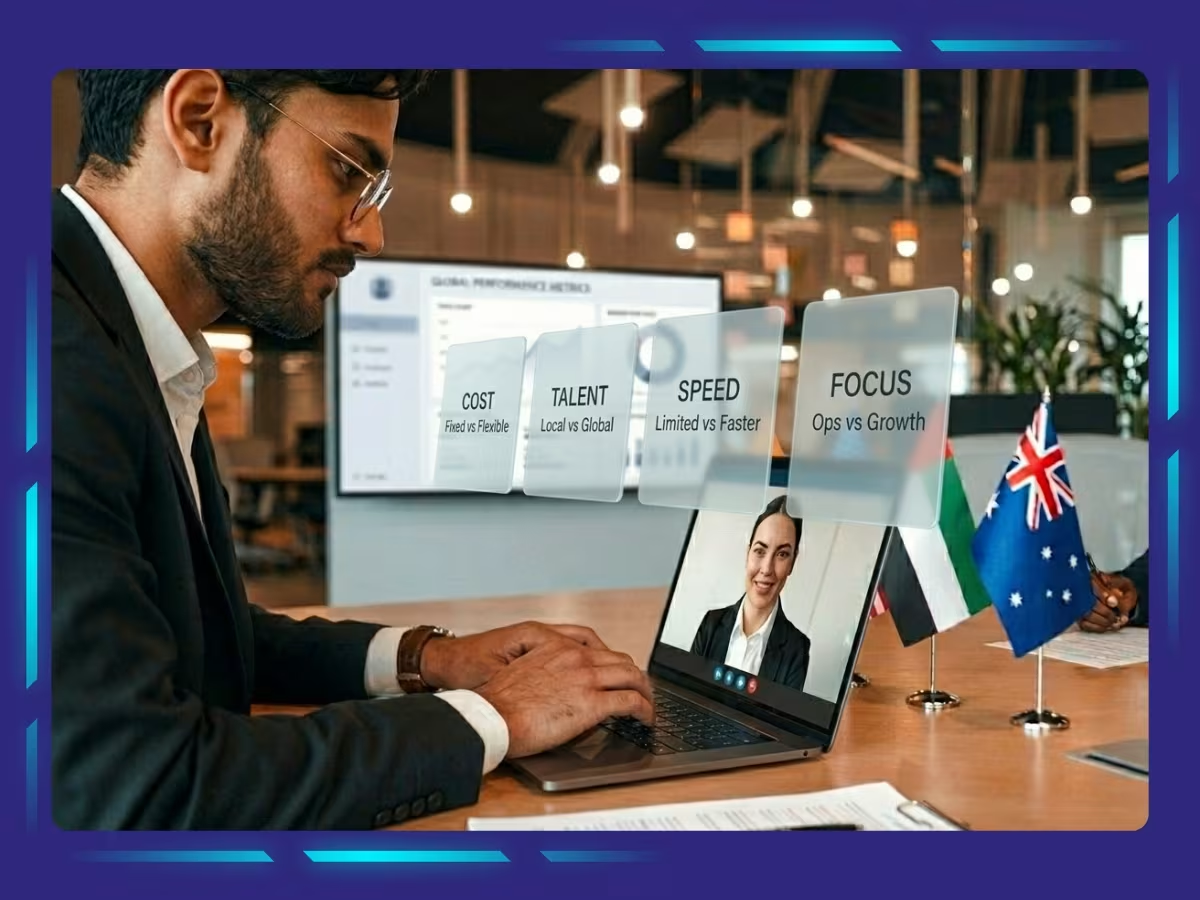
The choice between in-house accounting and offshore accounting goes beyond cost, it affects how efficiently your finance function runs. In-house teams offer control, but come with higher costs and limited scalability, while offshore accounting services provide flexibility, skilled talent, and faster turnaround. A clear comparison helps determine what best fits your business.
| Factor | In House Accounting | Offshore Accounting |
|---|---|---|
| Cost Structure | High fixed costs including salaries and overheads | Flexible, usage-based pricing |
| Scalability | Limited and slower to expand | Easily scalable based on demand |
| Talent Access | Restricted to local talent pool | Access to global accounting professionals |
| Technology | Requires separate investment | Often included within service |
| Control | Full direct control | Requires structured communication systems |
| Turnaround Time | Dependent on team size | Faster due to larger teams and time zone advantage |
| Compliance | Depends on internal expertise | Providers stay updated with regulations |
| Business Focus | Time spent on operations | Frees leadership for strategic growth |
How to Find the Right Offshore Accounting Partner for Your Business?
Choosing the right partner is critical when adopting offshore accounting services, as the success of your strategy depends on it. Look for a provider with industry-specific experience, strong compliance knowledge, and robust data security. Clear communication, scalable support, and a focus on long-term value; not just cost, are equally important to ensure accuracy, efficiency, and consistent results.
1. Look for Industry-Specific Experience: Choose a partner who understands your industry. Whether you operate in e-commerce, real estate, or professional services, domain expertise ensures accuracy and fewer revisions.
2. Evaluate Compliance Knowledge: Your offshore partner should be well-versed in relevant accounting standards and tax regulations such as GAAP or IFRS, along with country-specific requirements like IRS regulations (US), HMRC guidelines (UK), and ATO compliance (Australia). This ensures your financials remain accurate, compliant, and audit-ready.
3. Prioritize Data Security: Financial data protection is critical. Choose a partner that follows strict security protocols and complies with standards like SOC 2 and ISO 27001, along with using secure systems and maintaining confidentiality across all processes.
4. Assess Communication and Workflow: Clear communication is essential for offshore accounting success. Choose teams that work on platforms like Microsoft Teams, Slack, or Zoom, and use project management tools such as Asana or Trello to maintain structured workflows, regular reporting, and smooth collaboration across time zones.
5. Ensure Scalability: Your business will grow, and your accounting needs will evolve. Choose a partner that can scale services up or down without disruption.
6. Focus on Value, Not Just Cost: Choosing the lowest-cost provider can lead to errors, delays, and rework. Instead, focus on quality, reliability, and long-term value.
Scale Your Business with the Right Offshore Accounting Partner
Getting real value from outsourcing requires more than just shifting tasks; it needs the right structure, clear workflows, and a partner aligned with your business goals. If managing processes, communication, and quality feels complex, working with an experienced team can help you improve efficiency and maintain control.
At Whiz Consulting, we deliver reliable offshore accounting services designed to support your growth. From managing day-to-day bookkeeping and reporting to ensuring accuracy, compliance, and seamless collaboration, our team helps you free up internal resources and scale with confidence. With the right setup and ongoing support, you gain flexibility, faster turnaround, and a finance function that truly works for your business.
Sources:
- https://www.payscale.com/research/AU/Job=Accountant/Salary
- https://www.payscale.com/research/US/Job=Accountant/Salary
- https://www.payscale.com/research/UK/Job=Accountant/Salary

Get customized plan that supports your growth

Have questions in mind? Find answers here...
Yes, if you choose a provider with strong data security standards, secure systems, and strict confidentiality protocols.
Most businesses can save up to 60% when offshoring accounting, depending on the scope of work, role complexity, and the offshore location, driven by lower labour costs and reduced overhead expenses.
No, with clear processes and communication, you maintain control while improving efficiency.
Yes, experienced offshore teams often specialise in industries like e-commerce, real estate, and professional services.
Yes, it helps small businesses reduce costs and access skilled support without hiring full-time staff.
Reputable providers stay updated with relevant standards and ensure compliance through trained professionals.
Typically, it takes a few weeks, depending on complexity and data readiness.
Minimal training is needed if you choose an experienced provider with established processes.
Yes, offshore models are highly scalable and can adjust quickly to your changing needs.
Thousands of business owners trust Whiz to manage their account
Let us take care of your books and make this financial year a good one.





This website uses cookies to improve your experience. You can accept all or reject non-essential cookies.